
Notarize an Affidavit in 10–15 Minutes: RON, In Person, Checks
Notarize an Affidavit in 10–15 Minutes: RON, In Person, Checks
An affidavit is a sworn written statement made under penalty of perjury, and notarizing one almost always means a jurat; the notary administers an oath, watches you sign, and seals the document. The one rule that trips up more people than anything else is timing. Do not sign the affidavit before you meet the notary, and bring valid photo ID. If you’re considering remote online notarization, call the person or agency who requested the affidavit first and confirm they’ll accept it.
TL;DR:
- Affidavits almost always require notarization with a jurat, meaning the signer must swear an oath in front of a notary before signing.
- Most affidavits are invalid if signed before the notary witnesses the signature, which is the most common reason for rejection.
- In-person notarization involves preparing the document unsigned, bringing valid ID, and scheduling an appointment at a location like a bank or shipping store.
- Remote online notarization is accepted in many states but may not be recognized internationally or by certain courts; confirmation with the recipient is essential.
- Bringing current, government-issued photo ID is critical, and any signature or seal errors identified on-site should be corrected immediately to avoid rejection.
Table of Contents
- What Is an Affidavit, and Where Does Affidavit Notarization Come Up?
- Does an Affidavit Have to Be Notarized? Jurat vs. Acknowledgment
- How to Notarize an Affidavit in Person: A Step-by-Step Walkthrough
- Remote Online Notarization: How It Works and When It’s Risky
- What to Bring: IDs, Documents, and Witness Rules
- Common Mistakes That Void a Notarized Affidavit
- If Your Notarized Affidavit Gets Rejected
- What I’d Tell a Friend Before They Book an Appointment
- Book Your Affidavit Notarization With Notary Page
- Sources
What Is an Affidavit, and Where Does Affidavit Notarization Come Up?
An affidavit is a written statement of fact that you swear or affirm is true, under penalty of perjury, in front of a notary public. That distinction, sworn under oath rather than just signed, is what separates an affidavit from a simple signed letter or a declaration.
You’ll run into affidavit notarization far more often than you’d expect:
- Court filings and small claims cases
- Probate and estate matters
- Real estate title transfers and corrections
- Fixing errors on vital records like birth certificates
- Immigration paperwork and certain bank or loan requirements
A notarized affidavit needs to be specific. If you’re correcting a record, list the exact date and the exact factual error, not a vague summary. Some jurisdictions also accept a “declaration under penalty of perjury,” a similar sworn statement that skips the notary altogether. If you’re not sure which one your situation calls for, that’s a question for the agency requesting it, not a guess you make yourself.
Does an Affidavit Have to Be Notarized? Jurat vs. Acknowledgment
Almost always, yes. Affidavits carry legal weight specifically because a notary witnessed the oath. The certificate that makes this official is called a jurat, and it’s not the same as an acknowledgment, even though people use the terms interchangeably.
- Jurat: you swear or affirm the contents are true, and the notary watches you sign. This is the standard for affidavits.
- Acknowledgment: you simply confirm that the signature is yours, with no oath involved. Deeds and powers of attorney typically use this instead.
The National Notary Association is clear that a jurat generally requires a formal oath administered in the notary’s presence, along with the notary’s seal. Before you show up, read the notarial certificate language printed on your document. If it says “acknowledged” instead of “sworn” or “subscribed,” that’s a mismatch worth clearing up with the requesting party before you waste a trip.
How to Notarize an Affidavit in Person: A Step-by-Step Walkthrough
In-person notarization is still the most reliable route for affidavits, especially when you’re not sure the receiving party will accept a remote session. Here’s how it actually goes.
- Prepare the affidavit, but don’t sign it. If you need more than one notarized original, print extra unsigned copies. Each one needs its own live signature.
- Find and schedule a notary. Banks, public libraries, UPS stores, mobile notaries, and booking platforms all offer this. Availability varies a lot by location, so call ahead rather than assume walk-ins are fine.
- Bring ID that matches the name on the affidavit. Every signer named in the document has to physically appear. No exceptions, no signing on someone else’s behalf.
- Let the notary do their job. They’ll verify your ID, administer the oath or affirmation, watch you sign, complete the jurat wording, apply their seal, and log the transaction in their notary journal if their state requires one.
- Pay and go. Bank notarizations are often free for account holders. Mobile notaries and after-hours appointments typically have a range of fees depending on distance and urgency, though exact pricing depends heavily on your state and the notary you use.
The whole appointment usually takes ten to fifteen minutes once you’re in the chair, assuming your paperwork is in order.
Pro Tip: Call the notary’s location the same day you plan to go. Bank branches sometimes have only one commissioned notary on staff, and if that person is out sick or at lunch, you’ve made the trip for nothing.

Remote Online Notarization: How It Works and When It’s Risky
Remote online notarization, usually shortened to RON, lets you complete the entire process over a live video call instead of sitting across a table from a notary. It’s not a video chat with a rubber stamp. States that authorize RON require real identity verification before the notary ever watches you sign.
- You upload the document to a secure platform ahead of the session.
- The notary verifies your identity through a combination of camera-based ID scanning, knowledge-based authentication questions, and credential analysis software.
- You sign electronically while the notary watches live, and the notarial certificate and audit trail are generated automatically.
Here’s the catch. Most states now authorize RON, but authorization isn’t the same as acceptance. Some courts, some title companies, and most foreign government agencies still require a wet-ink signature or won’t recognize an electronic notarial act at all. If your affidavit is headed anywhere outside a standard domestic transaction, call the receiving party before you book a RON session, not after; you might also need to learn more about how to apostille federal documents like your notarized affidavit for international use by visiting How to Apostille an FBI Report for International Use.
What to Bring: IDs, Documents, and Witness Rules
Bring a current, government-issued photo ID. A driver’s license, state ID card, U.S. passport, or military ID all work. The name on that ID has to match the name typed on the affidavit.
- If your name has changed (marriage, divorce, court order), bring the supporting document along with your primary ID.
- Some states allow a “credible witness,” someone who personally knows you and can vouch for your identity, when you don’t have acceptable ID. Rules on this vary a lot by state, so confirm with the notary beforehand rather than assuming it’s an option.
- Bring every unsigned original if you need multiple notarized copies. Photocopies of an already-notarized document usually won’t satisfy a receiving party that requires an original.
Common Mistakes That Void a Notarized Affidavit
Most rejected affidavits fail for the same handful of preventable reasons, and every one of them is fixable if you catch it early.
- You signed before the notary watched. This is the single most common error, and there’s no workaround. A notary who sees a pre-signed document is required to refuse it, so you’ll need a fresh, unsigned original.
- The wrong notarial act. If the certificate says “acknowledged” when it should say “sworn,” confirm the correct wording with the recipient and get it re-notarized with the right language.
- Expired or mismatched ID. Bring current identification, or line up a credible witness if your state allows it.
- Incomplete seal or missing date on the jurat. The notary’s seal, signature, and the venue (state and county) all need to be complete and legible, or you may need a corrective notarization.
Pro Tip: Before you leave the notary’s table, glance at the completed jurat. Check that the date, county, and seal impression are all there and readable. Fixing it on the spot takes thirty seconds; fixing it after you’ve left means starting over.
If Your Notarized Affidavit Gets Rejected
Rejections usually come down to technical defects rather than anything wrong with the substance of your statement. The fix is almost always faster than people expect.
- Wrong or missing notarial language: contact the receiving agency, get the exact wording they require, and prepare a new affidavit with that language built in.
- ID or signature issues discovered later: mark the old copy void, prepare a clean original, and re-notarize.
- Uncertainty about what went wrong: ask the agency directly, or consult an attorney if the requirement isn’t spelled out clearly. Notaries can’t advise you on this themselves.
A mobile notary or, where accepted, a remote online session can usually get you a corrected version notarized within a day.
What I’d Tell a Friend Before They Book an Appointment
The rule that matters more than any other in this whole process: never sign the affidavit before the notary is watching. Every rejected notarization I’ve seen traced back to that one habit, someone signing at home out of convenience, then finding out the notary has to refuse it and start over. It’s a completely avoidable delay.
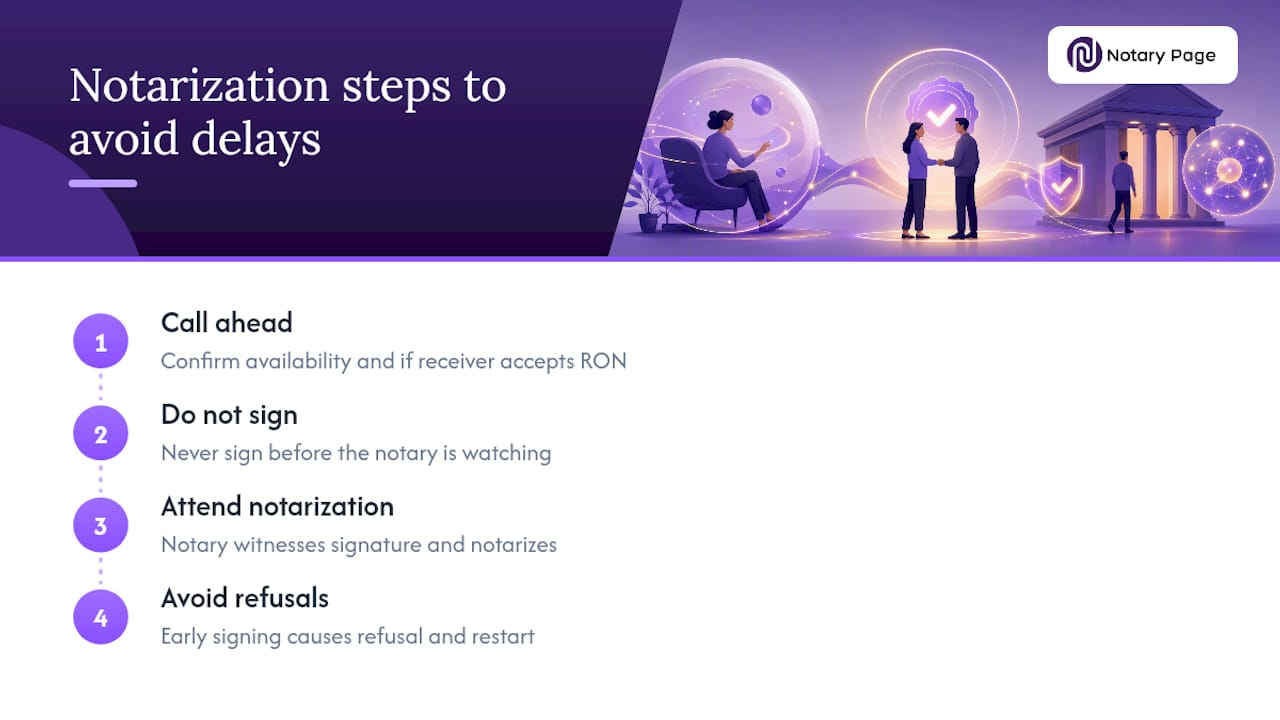
The other habit worth building is calling ahead, both to confirm the notary is actually available and to confirm the receiving party will accept how you plan to notarize. This matters more with remote online notarization than with in-person appointments, since acceptance still varies by court, agency, and country.
Notary Page handles both sides of this by design, offering nationwide in-person, mobile, and remote sessions backed by $1,000,000 in E&O coverage through Hiscox. If you’re planning a real estate closing, an estate document, or a general affidavit, that combination of reach and coverage removes most of the guesswork about where to go and whether the notary is properly credentialed.
— Amy
Book Your Affidavit Notarization With Notary Page
You’ve got two real options for getting an affidavit notarized: track down a bank, library, or shipping store and hope they have an available notary that day, or book one through a platform built specifically for this. Notary Page gives you a nationwide network of vetted notaries offering in-person, mobile, and remote online sessions, so you’re not stuck calling around town.
Every booking includes secure document upload, order tracking so you know exactly where your affidavit stands, and $1,000,000 in E&O coverage through Hiscox backing the transaction. Whether you’re handling a real estate closing, an estate planning document, or a straightforward affidavit for court, you pick the format that fits: someone at your door, a mobile notary at a location that works for you, or a live video session if the receiving party accepts RON. Head to Notary Page to see available notaries near you and get your document scheduled, or check your existing order if you’ve already booked one.
Sources
- How to notarize an affidavit | National Notary Association
- Notary public services | Citizens Bank
- What is a notarized affidavit? What should the affidavit include | TN Vital Records
- Notary Public Services | City of Buda, TX