
After Hours Online Notary Options: Your 2026 Guide
After Hours Online Notary Options: Your 2026 Guide
After hours online notary options are remote notarization services that connect signers with a commissioned notary public via live video call, available outside standard 9-to-5 business hours, including nights, weekends, and holidays. The industry term for this service is Remote Online Notarization, or RON, and it has fundamentally changed how urgent documents get signed and sealed. Platforms like Notarize and OneNotary have made true 24/7 availability a reality, not just a marketing claim. Whether you need a power of attorney notarized at midnight or a real estate document signed before a morning deadline, RON platforms give you that access without leaving your home.
What are after hours online notary options?
After hours online notary services operate on the same legal foundation as traditional in-person notarization, with one critical difference: the entire session happens over a secure video call. Remote online notarization requires real-time audio and video linking the signer and notary, along with digital identity verification. The notary witnesses your signature electronically, applies a digital seal, and the resulting document carries the same legal weight as one notarized in person. Over 40 U.S. states have passed permanent RON legislation, making this a widely accepted and legally sound option.
The key advantage over traditional notary services is not just convenience. It is speed. When a lender calls you at 9 p.m. asking for a notarized affidavit by morning, a physical notary office is not an option. RON platforms fill that gap directly.

What you need to use after-hours online notary services
Before you open a platform at midnight, make sure you have the right setup. Missing one item can delay or cancel your session entirely.
Device and connectivity requirements:
- A computer, tablet, or smartphone with a working front-facing camera and microphone
- A stable internet connection, ideally broadband or a strong 4G/5G signal
- An up-to-date browser (Chrome, Safari, or Firefox) or the platform’s dedicated mobile app
Identity and document requirements:
- A valid, government-issued photo ID such as a U.S. driver’s license or passport
- The document you need notarized, either as a PDF upload or a clear scan
- In some cases, a secondary ID or knowledge-based authentication (KBA) questions about your personal history
Online notary platforms require a device with a camera and internet connection, plus a valid photo ID to complete notarizations successfully. That means a cracked camera lens or an expired license can stop the process cold.
Pro Tip: Scan your document to PDF before starting your session. Uploading a blurry photo of a paper document is the single most common reason sessions get delayed or rejected.
Most platforms also ask you to create a free account before scheduling or joining an on-demand session. Do this in advance, not at 11 p.m. when you actually need the service.
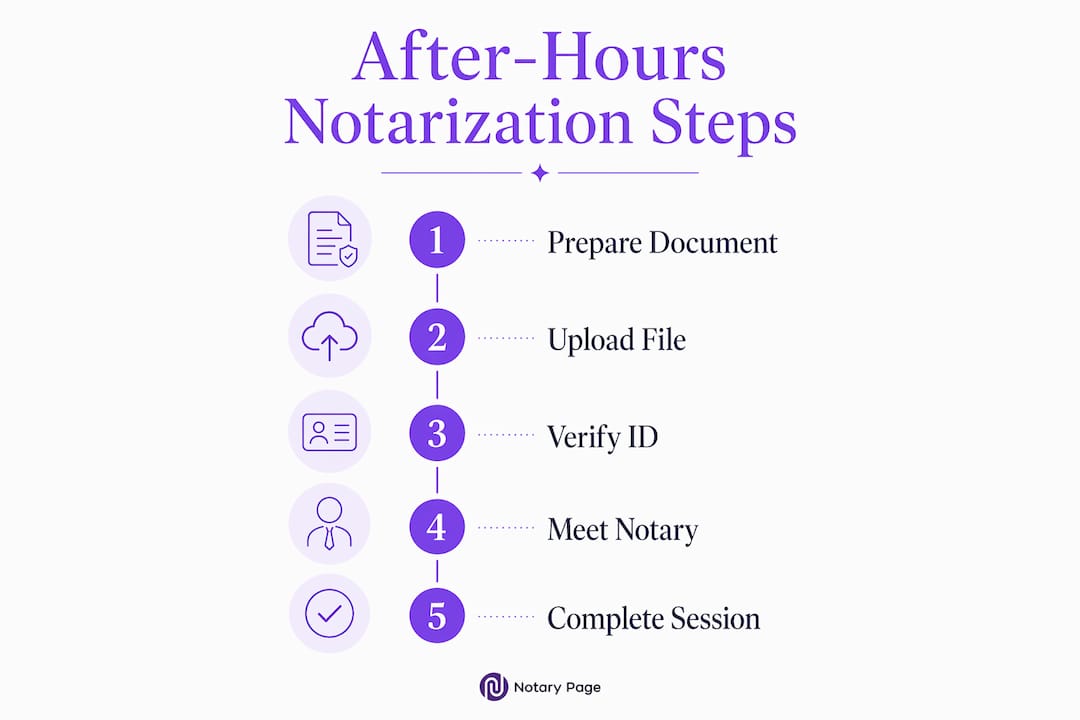
How to notarize documents after hours online: step by step
The process is more straightforward than most people expect. Here is exactly what happens from start to finish.
- Create your account. Register on your chosen platform. Most require only an email address and basic personal information. This takes under five minutes.
- Upload your document. Submit the PDF you need notarized. The platform will flag any pages that require a notary signature or seal.
- Complete identity verification. You will answer KBA questions and submit a photo of your government-issued ID. Some platforms use facial recognition to match your face to your ID photo.
- Connect with a live notary. On-demand platforms connect you with an available notary via video call. Wait times average about 15 minutes on platforms like Notarize, though this can stretch longer during peak off-hours.
- Sign and witness in real time. The notary watches you sign electronically on screen. They then apply their digital seal and commission information to the document.
- Download your notarized document. The completed file is available immediately as a tamper-evident PDF. You can email it, upload it to a portal, or print it.
Pro Tip: If your document involves multiple signers, confirm in advance whether the platform supports multi-party sessions. Not all after-hours services handle this without scheduling in advance.
The table below shows what each step requires from you versus the platform:
| Step | Your responsibility | Platform’s role |
|---|---|---|
| Document upload | Prepare a clean PDF | Validate format and flag signature fields |
| Identity verification | Provide valid photo ID | Run KBA and biometric checks |
| Video session | Sign on screen in real time | Connect you with a commissioned notary |
| Final document | Download and distribute | Apply digital seal and store the session recording |
Which platforms offer the best after-hours availability?
Not every platform that claims 24/7 availability actually delivers it consistently. Here is how the major options compare on the factors that matter most for late-night and urgent use.
Notarize is the most recognized name in RON. It offers true 24/7 availability with average wait times around 15 minutes, a polished mobile app for both iOS and Android, and SOC 2 Type II certification along with HIPAA compliance for sensitive documents. Pricing sits at the higher end of the market.
OneNotary is a strong alternative for after-hours use, with extended availability and a clean user interface. It works well for real estate and legal documents and is often recommended for professionals who need reliability over the lowest price.
NotaryLive is the budget-conscious choice. Wait times run 30 to 60 minutes and after-hours availability is less consistent than Notarize. It suits users with flexible timing who prioritize cost over speed.
DocVerify focuses on enterprise and business clients, offering audit trails and bulk notarization features. It is less suited for individual urgent needs but strong for legal teams processing multiple documents.
On pricing, online notarization ranges from $15 to $30 depending on the platform and service tier. Budget platforms like NotaryLive sit in the $15 to $20 range, while premium on-demand services with true 24/7 access typically charge $25 to $30 per notarization. That price difference reflects real differences in wait time, support quality, and reliability.
Mobile app quality varies significantly across platforms. Notarize and NotaryLive both offer mobile apps, but Notarize delivers a noticeably more polished experience. If you are completing a notarization from your phone at midnight, that polish matters.
For a broader evaluation framework when comparing platforms, the tips for evaluating RON platforms from legal professionals offer useful criteria beyond just price and availability.
Common challenges and how to avoid them
Even the best platforms have friction points. Knowing them in advance saves you time and stress.
- Longer wait times during peak off-hours. Late-night notarizations can encounter wait times of 30 to 60 minutes during holidays or high-demand periods. If your deadline is firm, start the session at least an hour before you actually need the document.
- Identity verification failures. KBA questions pull from public records. If you have recently moved or have a thin credit file, you may fail the automated check. Have a backup plan, such as a platform that accepts manual ID review.
- Document formatting issues. Platforms require PDFs with editable signature fields in most cases. A scanned image of a document may not be accepted. Convert and prepare your file before starting.
- State authorization gaps. Not all states accept RON documents from all platforms. Confirm that the receiving party, whether a court, lender, or government agency, will accept a remotely notarized document before you begin.
- Connectivity drops mid-session. A dropped video call during the signing step requires restarting the session. Use a wired connection or move to a location with a stronger signal before you begin.
“Users should weigh urgency and convenience against cost, choosing convenience-focused platforms for urgent after-hours needs.” — Remote Notary Experts, 2026
The single most avoidable mistake is treating an after-hours notarization like a casual task. Prepare your document, your ID, and your connection before you open the platform. The session itself takes under 15 minutes when everything is ready.
Key takeaways
After hours online notary options work best when you choose a platform matched to your urgency level, prepare your documents in advance, and understand the legal requirements in your state.
| Point | Details |
|---|---|
| RON is legally valid in 40+ states | Confirm your receiving party accepts remotely notarized documents before starting. |
| Pricing ranges from $15 to $30 | Budget platforms trade lower cost for longer wait times and less consistent availability. |
| Notarize leads on 24/7 reliability | Average 15-minute wait times and SOC 2 Type II certification make it the top pick for urgent needs. |
| Prepare before your session | Have your PDF and valid photo ID ready before opening the platform to avoid delays. |
| Peak hours extend wait times | Start at least one hour before your deadline during holidays or late-night periods. |
What I’ve learned from watching people use these platforms under pressure
I have spent years watching professionals scramble for notarizations at the worst possible moments: the night before a real estate closing, the weekend a family member needs a power of attorney, the Sunday a lender sends a last-minute request. The pattern is always the same. People discover the platform exists, create an account in a panic, and then hit a snag they could have avoided with five minutes of preparation.
Here is what I think most articles get wrong about RON services. They focus almost entirely on price comparisons and feature lists. The real differentiator for after-hours use is not the price. It is whether a live notary actually picks up at 1 a.m. on a Tuesday. Advertised 24/7 availability and actual 24/7 performance are two different things. Platforms with larger notary networks, like Notarize, deliver more consistently at odd hours simply because they have more notaries on call. Smaller platforms may technically be “available” but leave you waiting 45 minutes for a connection.
My honest recommendation: if the document is urgent, pay the extra $10 for a premium platform. The cost difference between a $15 and $25 notarization is trivial compared to a missed deadline. If you have flexibility on timing, budget platforms are perfectly fine. The mistake is using a budget platform for an urgent need and discovering its limitations at midnight.
I also think the mobile experience is underrated as a selection criterion. Many urgent notarizations happen when you are not at a desk. A platform with a poor mobile app creates real friction when you are trying to upload a document from your phone in a hospital waiting room or a hotel lobby.
— Amy
Get your documents notarized anytime with Notarypage
When a document cannot wait until morning, you need a platform that is actually ready when you are.
Notarypage connects you with certified notary professionals nationwide, covering both remote video notarizations and in-person signings depending on your situation. The platform is built for exactly the moments this article describes: real estate closings, estate planning documents, and urgent legal paperwork that cannot sit in a queue until Monday. With $1,000,000 in E&O coverage through Hiscox and a network of verified professionals, Notarypage delivers the reliability that urgent notarizations demand. Start your session and get your document sealed without the wait.
FAQ
What is remote online notarization?
Remote online notarization (RON) is a legally recognized process where a commissioned notary public witnesses a document signing via live video call and applies a digital seal. Over 40 U.S. states have passed permanent RON legislation authorizing this method.
How much does an after-hours online notary cost?
Online notarization costs between $15 and $30 per session. Budget platforms charge $15 to $20, while premium 24/7 on-demand services typically charge $25 to $30.
How long does an online notarization session take?
The session itself takes under 15 minutes once you are connected with a notary. Total time including identity verification and document upload is typically 20 to 30 minutes, though wait times can reach 30 to 60 minutes during peak off-hours.
Is a remotely notarized document legally valid?
Yes, in states that have enacted RON legislation, a remotely notarized document carries the same legal weight as one notarized in person. Always confirm the receiving party, such as a court or lender, accepts RON documents before starting your session.
What do I need to complete an online notarization?
You need a device with a working camera and microphone, a stable internet connection, a valid government-issued photo ID, and your document in PDF format. These prerequisites apply across all major RON platforms.