
Bulk Notary Scheduling for Real Estate Teams: A Practical Guide
Bulk Notary Scheduling for Real Estate Teams: A Practical Guide
For real estate operations teams managing more than a handful of closings per month, the answer is a centralized booking platform that supports both Remote Online Notarization (RON) and mobile notaries, automates assignment and confirmations, and consolidates billing and recordkeeping into one place. That single shift cuts turnaround time, lowers per-signing administrative cost, and creates the audit trail compliance teams actually need.
Here is what that looks like in practice before you read further:
- Faster closings: RON signings can complete same-day; mobile assignments typically confirm within hours.
- Lower cost per signing: Volume pricing, pre-paid credits, and route-optimized mobile batches reduce what you pay per transaction.
- Centralized compliance: One platform holds ID verification records, audio/video logs, and signed documents, so audits do not require hunting across email threads.
Pro Tip: Before choosing a platform, map your monthly signing volume by state. RON authorization varies state by state, and a platform that cannot handle your specific state mix will create gaps you will fill manually, which defeats the purpose.
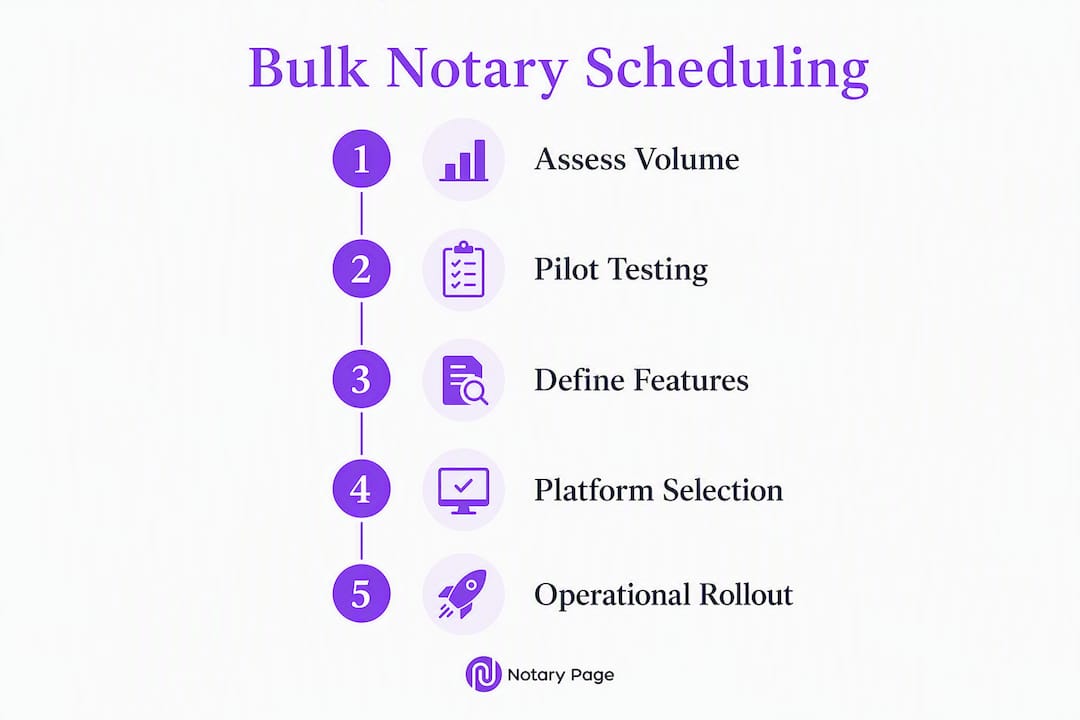
Start with a pilot of several signings across your most active counties. Define your must-have features (RON capability, bulk import, E&O verification per agent), run the pilot for 30 days, then scale.
Table of Contents
- What does “bulk notary scheduling” actually mean for real estate teams?
- How do state rules and compliance requirements change at scale?
- How do you build a bulk notary scheduling workflow from scratch?
- What features should a bulk scheduling platform actually have?
- What do bulk notarizations actually cost, and how long do they take?
- Copy-ready templates for bulk notary operations
- How Notarypage handles bulk scheduling at scale
- Key Takeaways
- The part most teams underestimate about scaling notarizations
- Notarypage: a turnkey option for real estate teams ready to scale
- Useful sources for verifying state rules, fees, and RON status
What does “bulk notary scheduling” actually mean for real estate teams?
The industry term is batch notarization management, though real estate operations teams commonly call it bulk notary scheduling. Both phrases describe the same thing: capturing multiple notarization orders, routing them through a single workflow, and settling them on one invoice rather than chasing individual appointments and separate bills.
The scenarios where this becomes necessary tend to cluster around a few recurring patterns:
- High-volume lenders and title companies processing 50 or more closings per month, where manual scheduling creates a bottleneck at the coordinator level.
- Portfolio closings and REO programs, where a single transaction event triggers simultaneous signings across multiple properties or borrowers.
- Corporate relocation programs, where employees in different states need notarized documents on a compressed timeline.
- Bulk-sale transactions, where multiple sellers or buyers sign separate but related documents that must all close within the same window.
- Seasonal volume spikes, where a title company’s normal workflow cannot absorb a sudden surge without a scalable system behind it.
The stakeholders in a bulk scheduling workflow typically include loan officers, closing coordinators, notary signing agents (commissioned notaries with additional real estate training), title producers, borrowers, and settlement attorneys. Each party has a different information need, which is exactly why a platform with automated status updates matters more at scale than it does for a one-off signing.
Anytime notarization, including RON, extends this further by letting off-hour signings proceed without a coordinator actively managing each one.

How do state rules and compliance requirements change at scale?
RON vs. in-person: what your state mix determines
Not every state authorizes Remote Online Notarization. The National Notary Association tracks RON authorization state by state, and the list continues to evolve. For bulk operations, the practical implication is straightforward: if your portfolio spans RON-authorized and non-RON states, your platform must support both delivery modes, or you will manage two separate workflows.
| Signing Type | When to Use | Key Requirement |
|---|---|---|
| Remote Online Notarization (RON) | RON-authorized states, off-hour signings, remote borrowers | Audio/video session log, tamper-evident seal, identity proofing |
| Mobile / in-person | Non-RON states, wet-signature lenders, complex multi-party closings | Credentialed signing agent, travel fee, physical document handling |
Identity verification and tamper-evident records
At scale, identity verification cannot be ad hoc. A compliant platform should require knowledge-based authentication (KBA) or credential analysis for RON sessions, and it should produce a tamper-evident audit trail for every signing. Digital notary seals applied to electronic documents create that tamper-evident layer, making post-closing audits far cleaner than paper-based alternatives.
For in-person signings, the signing agent must verify government-issued photo ID and record the transaction in their notary journal per state law. Your platform should capture confirmation that this step occurred, not just that the signing was completed.
E&O insurance and recordkeeping at volume
Errors & Omissions insurance protects against mistakes in the notarization process. At low volume, a single agent’s individual E&O policy may suffice. At scale, you want platform-level E&O coverage that applies across every agent in the network, plus per-agent verification before assignment. Centralized document storage also reduces the risk of a missing record surfacing during a title dispute months later.
Pro Tip: During peak volume periods, require your platform to confirm E&O status on every agent before assignment, not just at onboarding. Agent policies lapse, and a lapsed policy on a high-value closing is a liability you do not want to discover after the fact.
How do you build a bulk notary scheduling workflow from scratch?
Step-by-step operational rollout
-
Define your pilot parameters. Choose a 30-day window, a moderate number of signings, and two or three active states that represent your typical mix of RON and mobile needs. This gives you real data without committing your full operation to a new system.
-
Build your intake flow. Standardize how orders enter the system: property address, state, signing type (RON or mobile), preferred time window, party contact details, and document upload. A CSV import template (covered in the templates section below) speeds this up considerably.
-
Configure assignment logic. Set priority rules: RON-first for authorized states, travel radius limits for mobile agents, E&O verification as a gate before any assignment, and a backfill rule that auto-reassigns if an agent cancels within a defined window.
-
Set communication checkpoints. Buyers, sellers, agents, and lenders each need a different message at a different time. A confirmation at booking, a reminder 24 hours out, and a completion notice with document link covers most scenarios. Automated templates reduce coordinator workload and cut no-show rates.
-
Run verification and reconciliation. After each signing, confirm the signed document has returned to the platform, the audit log is complete, and the invoice matches the order. Do this daily during the pilot, then weekly once the workflow is stable.
| Milestone | Target Timing | Owner |
|---|---|---|
| Pilot order intake complete | Day 1–3 | Closing coordinator |
| Agent assignments confirmed | Within 2 hours of order | Platform / auto-assign |
| Borrower confirmation sent | Immediately after assignment | Automated |
| Signing completed | Per scheduled window | Signing agent |
| Document returned and verified | Within 1 hour of signing | Platform / coordinator |
| Invoice reconciliation | End of week | Operations / accounting |
What features should a bulk scheduling platform actually have?
Core capabilities
The non-negotiables for any platform handling real estate notarization at volume:
- Support for both RON and mobile notaries in a single order portal
- Bulk order import via CSV or API
- Automated agent assignment with configurable rules (geography, qualification, E&O status)
- Multi-order batching and consolidated invoicing
- Real-time status updates for every party in the transaction
- Secure document upload and storage with access controls
- Retry and reschedule logic for cancellations and no-shows
Integrations that matter
Loan Origination System (LOS) and Title Production System (TPS) integrations eliminate duplicate data entry. API/webhook support lets your tech team trigger orders programmatically. SSO reduces login friction for large teams. Accounting exports (CSV or direct integration) make month-end reconciliation faster. The Notarypage admin portal supports order management and audit log access for teams that need centralized oversight.

| Feature | Priority | Why It Matters |
|---|---|---|
| RON + mobile support | Must-have | Covers all state requirements |
| Bulk CSV import | Must-have | Eliminates manual order entry at volume |
| Auto-assignment with E&O gate | Must-have | Reduces compliance risk per signing |
| Real-time status updates | Must-have | Cuts coordinator follow-up calls |
| Consolidated invoicing | Must-have | Simplifies accounting and audit |
| API / webhooks | High-value | Enables LOS/TPS integration |
| SSO | High-value | Reduces friction for large teams |
| Route optimization (mobile) | High-value | Lowers travel fees on same-day batches |
| Accounting export | High-value | Speeds month-end close |
| Custom reporting / analytics | Nice-to-have | Useful for SLA tracking and vendor reviews |
Pro Tip: Ask any platform vendor to show you the assignment failure rate and average reassignment time from their production data. A platform that auto-assigns quickly but fails often on first assignment costs you more in coordinator time than one that takes slightly longer but assigns correctly the first time.
What do bulk notarizations actually cost, and how long do they take?
Pricing components
Every bulk notary order carries several cost layers. Understanding each one prevents budget surprises:
- Base notarization fee: The per-signature fee charged by the notary or platform. State law caps this in many jurisdictions. For example, both California and Washington cap notary fees at $15 per signature, though platform service fees are separate.
- Travel / trip fee: Applies to mobile signings. Varies by distance, market, and time of day. Same-day and rush assignments carry a premium.
- RON platform fee: Charged by the technology provider for the video session, identity verification, and tamper-evident seal.
- Witness fees: Required in some states for certain document types (deeds, wills). Add per-witness cost when applicable.
- Rush / same-day premium: Expect a surcharge for orders placed with less than 24 hours’ notice.
Volume pricing structures
Volume buyers typically access pricing through pre-paid credit bundles, tiered per-signing rates that drop as monthly volume increases, or negotiated flat-rate packages for defined signing types. The operational benefit of bundles extends beyond cost: consolidated invoicing means one line item per month instead of dozens of individual charges.
| Price Component | Typical Range | Notes |
|---|---|---|
| Base notarization fee | Typically capped by state; platform fee is additional | |
| Mobile travel fee | Varies by trip distance and urgency | Higher in rural or same-day scenarios |
| RON platform fee | Varies by provider and ID verification method | |
| Rush / same-day premium | Applied when order lead time is under 24 hours | |
| Witness fee | Varies based on state and document type |
Timeline expectations
RON signings can complete the same day an order is placed, often within a few hours, because there is no travel involved. Mobile signings in dense metro areas typically confirm within two to four hours and complete the same day when the order arrives before noon. For batches of 50 or more orders, expect a 24–48 hour ramp as the platform distributes assignments across its agent network. Orders of 200 or more benefit from advance scheduling of at least three to five business days to allow route optimization and agent confirmation.
Copy-ready templates for bulk notary operations
CSV intake template columns
A standardized intake file prevents data errors at the order-entry stage. Include these columns at minimum:
order_id(your internal reference)property_addresscity,state,zipsigning_type(RON or mobile)preferred_dateandpreferred_time_window(e.g., 9 AM–12 PM)buyer_name,buyer_email,buyer_phoneseller_name,seller_email,seller_phoneagent_name,agent_emaillender_contact_emaildocument_upload_linkspecial_instructions
Slot scheduling pattern for batch assignments
For same-day mobile batches, pack appointments in 60-minute slots with 30-minute buffers between stops to account for signing time variability and travel. A morning block (8 AM–12 PM) and an afternoon block (1 PM–5 PM) with no more than four stops per agent per block keeps routes manageable and reduces late completions.
- Sort orders by zip code cluster before assigning to minimize total drive time.
- Assign the farthest stop first so the agent works back toward a central point.
- Reserve one slot per agent per block as a buffer for overruns.
- Flag any order with more than three signatories for a 90-minute slot instead of 60.
Escalation and cancellation rules
Include these terms in your vendor SLA:
- Agent cancellation within four hours of signing: platform must reassign within 60 minutes or provide a credit.
- Borrower no-show: one complimentary reschedule within 48 hours; second no-show triggers a rebooking fee.
- Document not returned within two hours of signing: automatic coordinator alert.
Pro Tip: For same-day mobile batches, group orders by zip code cluster before assigning agents. A platform with route-optimization logic does this automatically, but if yours does not, a simple sort by zip in your CSV before upload cuts average travel time and reduces trip fees meaningfully.
How Notarypage handles bulk scheduling at scale
Notarypage operates a nationwide network of certified notaries covering both RON and mobile signings through a single order portal. For real estate teams, that means one place to submit orders, track status, upload documents securely, and pull consolidated invoices, regardless of whether the signing is a video session in a RON-authorized state or a mobile appointment at a borrower’s kitchen table.
The trust signals that matter most for procurement teams: Notarypage carries $1,000,000 in Errors & Omissions coverage through Hiscox, every agent in the network is certified and verified, and every order generates a status trail that serves as an audit record. For title companies and lenders subject to investor or regulatory review, that paper trail is not optional.
Getting started follows a straightforward path: assess your monthly volume and state mix, request a pilot onboarding through the platform, and connect your team to the order management portal for admin access, audit log review, and integration setup.
Key Takeaways
A centralized bulk notary scheduling platform that supports both RON and mobile signings, automates assignment with E&O verification, and consolidates invoicing is the fastest way for real estate teams to scale notarizations without adding coordinator headcount.
| Point | Details |
|---|---|
| RON vs. mobile mix matters | Map your state portfolio first; RON-only platforms leave gaps in non-authorized states. |
| E&O verification per signing | Require per-agent E&O confirmation before assignment, not just at onboarding. |
| Volume pricing reduces cost | Pre-paid credit bundles and tiered rates lower per-signing cost and simplify invoicing. |
| Pilot before full rollout | Run 10–50 signings over 30 days to validate assignment speed, completion rate, and SLA fit. |
| Notarypage for turnkey coverage | Notarypage provides nationwide RON and mobile coverage with $1,000,000 E&O through Hiscox and centralized order tracking. |
The part most teams underestimate about scaling notarizations
The operational wins in bulk notary scheduling are real, but the failure modes are specific and predictable. Most teams that struggle at scale do not fail because they chose the wrong platform. They fail because they underestimated three things.
First, state RON variability. The map of authorized states changes, lender overlays sometimes restrict RON even where the state allows it, and some document types require wet signatures regardless of state law. A platform that handles RON beautifully in 40 states still leaves you with a manual process for the other 10, and if those 10 happen to be your busiest markets, the efficiency gains evaporate.
Second, E&O limits at the agent level. Platform-level coverage is not the same as per-agent coverage, and not every platform verifies both. A signing that goes wrong on a $2 million property needs clear coverage, not a conversation about whose policy applies.
Third, siloed invoicing. Teams that route some orders through a platform and others through individual agents end up with two reconciliation processes, two audit trails, and twice the accounting work. The efficiency case for bulk scheduling only holds when the entire volume runs through one system.
The practical advice: automate aggressively for routine signings, but keep a coordinator reviewing exceptions daily during the first 90 days. Automation catches the 90% case; a human catches the edge cases before they become disputes.
Notarypage: a turnkey option for real estate teams ready to scale
Real estate teams that have outgrown manual scheduling need more than a directory of notaries. They need a platform that handles the full workflow: order intake, agent assignment, status tracking, secure document storage, and consolidated billing, all backed by coverage that holds up under scrutiny.
Notarypage delivers exactly that for teams operating nationwide. The $1,000,000 E&O coverage through Hiscox, a certified notary network spanning in-person and RON signings, and real-time order tracking give procurement and compliance teams the confidence to scale without adding risk. Whether you are managing 20 closings a month or 200, the platform handles assignment, confirmation, and recordkeeping so your coordinators focus on exceptions, not logistics.
Request a volume quote or start a pilot at notarypage.com.
Useful sources for verifying state rules, fees, and RON status
Operations teams should consult these resources directly when determining whether a signing can proceed as RON or must be in-person, and when verifying fee structures and compliance requirements:
-
National Notary Association — Remote Online Notary Knowledge Center: The most current state-by-state RON authorization tracker, updated as legislation changes. Start here before assuming RON is available in a new state.
-
Pennsylvania Department of State — Notary Program: A model state notary portal showing the level of detail available from state agencies. Check your target states’ equivalent pages for fee caps, journal requirements, and RON-specific rules.
-
American Land Title Association (ALTA) — RON Transaction Data: Industry-level data on RON adoption trends, useful for benchmarking your own volume against market growth.
-
Notarypage — Platform Overview and Nationwide Services: The publisher’s platform page covering in-person, mobile, and RON capabilities, E&O coverage details, and order tracking features.
-
Notarypage — Order Administration Portal: Admin access for bulk order management, audit log review, and integration setup for procurement and operations teams.
Pro Tip: State notary portals update fee caps and RON rules on their own schedules, often without broad announcement. Set a calendar reminder to check your active states’ portals every six months, or assign one team member to own that review. A fee cap change or a new RON restriction discovered mid-closing is a costly surprise.