
Closing Document Preparation for Notary: A Practical Guide
Closing Document Preparation for Notary: A Practical Guide
Closing document preparation for notary is the process of organizing, verifying, and readying all required legal and real estate paperwork before a notarization appointment. Get this wrong and you risk delays, rejected documents, and costly re-signings that can push back a real estate closing by days. Get it right and the appointment moves quickly, your lender gets funded on time, and you walk away with properly executed documents. This guide covers exactly what to bring, how to organize it, and what mistakes to avoid so your notarization goes off without a problem.
What documents are required for a notary closing appointment?
The document package at a real estate closing is larger than most buyers expect. Loan packages can exceed 100 pages with dozens of required signatures, initials, and dates. That volume means a single missed initial can stall the entire closing, so knowing what you need before you arrive is not optional.
The core documents in a standard real estate closing package include:
- Closing Disclosure: The final breakdown of loan terms, monthly payments, and all closing costs. Review this before the appointment, not during it.
- Promissory Note: Your legal promise to repay the loan. Every borrower on the loan must sign this.
- Deed of Trust or Mortgage: The document that secures the lender’s interest in the property. It requires notarization in every state.
- Affidavit of Occupancy: Confirms whether the property is your primary residence, a second home, or an investment property.
- Right of Rescission (refinances only): Gives you three business days to cancel a refinance. You sign it, but the clock starts at signing.
- Title Transfer Documents: The deed that transfers ownership from seller to buyer.
Beyond the loan package itself, you need to bring supporting materials. A government-issued photo ID is non-negotiable. Most notaries require a current driver’s license or passport. Some transactions also require proof of address, a second form of ID, or entity documentation if a trust or LLC is involved. Estate planning closings often add powers of attorney, trust certification documents, or healthcare directives to the stack.
| Document type | Purpose |
|---|---|
| Promissory Note | Borrower’s legal commitment to repay the loan |
| Deed of Trust / Mortgage | Secures lender’s interest in the property |
| Closing Disclosure | Itemizes all loan terms and closing costs |
| Affidavit of Occupancy | Confirms intended use of the property |
| Power of Attorney | Authorizes another party to sign on your behalf |
| Trust Certification | Verifies authority of trustee in estate transactions |
Pro Tip: If a trust or LLC is taking title to the property, call your title company at least 48 hours before the appointment to confirm exactly which entity documents the notary will need. Missing these is one of the most common causes of same-day delays.
How to prepare closing documents step-by-step
A smooth notarization appointment depends heavily on preparation done before you walk in the door. The steps below apply whether you are buying a home, refinancing, or executing estate planning documents.
-
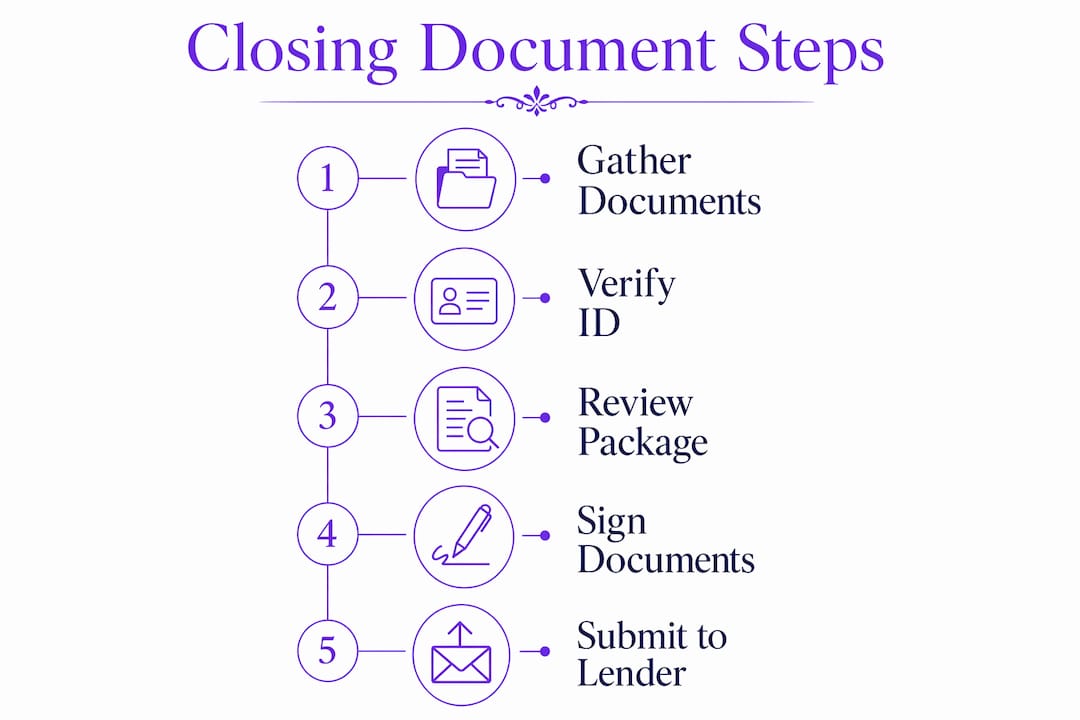
Receive and inventory your document package. Your lender or title company will send the closing package, often 24 to 48 hours before the appointment. Open it immediately. Count the pages, check that all borrower names are spelled correctly, and confirm the property address matches your records exactly.
-
Read the Closing Disclosure carefully. Compare the loan amount, interest rate, and closing costs against the Loan Estimate you received earlier. Discrepancies at this stage are far easier to fix than discrepancies discovered at the signing table.
-
Do not sign anything yet. Unless your lender or title company explicitly instructs you to pre-sign specific pages, leave all signature lines blank. Signing before the notary witnesses your signature defeats the purpose of notarization and can invalidate the document.
-
Flag every signature and initial line. Use sticky tabs or a highlighter to mark every place you need to sign or initial. This prevents missed signatures during the appointment and keeps the process moving.
-
Confirm your ID is current and matches the documents. Your name on the ID must match your name on the closing documents exactly. A middle name on the deed but not on your license can create a problem. Address it before the appointment, not during it.
-
Ask about special requirements early. Discovering apostille or legalization requirements after signing causes significant delays. If any document will be used internationally, confirm with your notary or attorney whether an apostille, translation, or consular legalization is needed before the appointment.
-
Send documents to the notary in advance. Sending documents ahead of the appointment for review avoids delays and catches missing information before you are sitting at the table. Most professional notary signing agents welcome this.
-
Confirm logistics the day before. Verify the appointment time, location (or video link for remote notarizations), and whether any co-signers or witnesses need to be present.
Pro Tip: If you are doing a remote online notarization, test your device’s camera, microphone, and internet connection the night before. Technical failures during a remote session are the equivalent of forgetting your ID at an in-person appointment.
Common mistakes that cause delays or rejections

The most preventable closing problems share a common thread: they were all avoidable with a few minutes of review before the appointment. Errors found at closing can cause delays or rejections, and the cost of re-signing goes beyond inconvenience. It can mean a missed rate lock, a delayed move-in date, or additional fees from the title company.
The most frequent mistakes include:
- Overlooked signatures and initials. A 100-plus page loan package has many signature points. Missing even one requires the document to be re-executed.
- Wrong or inconsistent dates. Dates must match across all documents. Writing yesterday’s date or leaving a date blank creates a rejection.
- Name mismatches. Your legal name on the documents must match your ID exactly. Nicknames, missing middle names, or maiden name discrepancies all cause problems.
- Signing before the notary is present. A pre-signed document cannot be notarized. The notary must witness the actual act of signing.
- Bringing an expired ID. Notaries are required to verify identity with a current, valid document. An expired license fails that test.
- Failing to bring all required parties. If two borrowers are on the loan, both must be present and both must bring valid ID.
“Alerting the notary immediately when you spot an error usually allows for on-the-spot correction. Staying quiet and hoping it goes unnoticed guarantees a bigger problem later.”
One distinction worth understanding: notaries verify identity and witness signatures but do not provide legal advice. If you have questions about what a specific clause means, direct those to your real estate attorney or loan officer before the appointment. Asking the notary to interpret your loan terms puts them in an impossible position and slows the process for everyone.
What to expect during the notary appointment
A standard real estate closing with a notary lasts about 45 minutes, though complex transactions involving trusts, multiple properties, or estate documents can run longer. Knowing the sequence helps you stay focused and move efficiently through the stack.
Here is what typically happens:
- The notary reviews the document package to confirm completeness before any signing begins.
- You present your government-issued photo ID. The notary records the ID details and confirms your identity.
- The notary walks through each document, explaining what you are signing at a high level. They are not interpreting legal terms, but they will tell you the name and purpose of each form.
- You sign and initial where indicated, with the notary witnessing each signature in real time.
- The notary applies their seal and signature to documents requiring notarization, completing the notarial act.
- The executed package is then prepared for return to the lender or title company, often via overnight courier.
Notary signing agents coordinate with lenders, title companies, and borrowers to meet signing deadlines and prevent loan funding delays. This coordination role means a good notary signing agent is not just a witness. They are a checkpoint in the entire closing process. Remote notarizations follow the same sequence but take place over a secure video platform, with the notary applying a digital seal and electronic signature.
Key takeaways
Proper closing document preparation prevents the most common and costly notarization failures, including missed signatures, name mismatches, and last-minute ID problems.
| Point | Details |
|---|---|
| Know your document package | Real estate loan packages exceed 100 pages; review every page before the appointment. |
| Never pre-sign documents | Sign only in the notary’s presence to preserve the legal validity of notarization. |
| Confirm ID matches documents | Your legal name on the ID must match the closing documents exactly, with no exceptions. |
| Ask about special requirements early | Apostille or legalization needs discovered after signing cause significant, avoidable delays. |
| Send documents ahead of time | Sharing the package with your notary before the appointment catches errors before they become problems. |
What I’ve learned from watching closings fall apart at the last minute
I have seen closings derail over a single missing initial on page 87 of a 110-page loan package. The borrower was frustrated, the notary was apologetic, and the title company had to reschedule the funding wire. The entire situation was preventable with 20 minutes of review the night before.
The advice I give every client is this: treat the document review as part of the closing, not a formality before it. Read the Closing Disclosure line by line. Flag every signature point with a sticky tab. Confirm your ID is current. Do all of this before you sit down with the notary.
The other thing most people underestimate is communication. Call your title company or notary signing agent the day before and ask one direct question: “Is there anything specific about my transaction I should know before tomorrow?” That single question has saved more closings than any checklist I have ever handed out. It surfaces issues like a co-borrower who needs to be present, a trust document that was not included in the package, or a name discrepancy that can be corrected before it becomes a rejection.
Remote notarizations have added a new layer to preparation. Test your technology the night before. A dropped video call mid-signature is the digital equivalent of forgetting your ID, and it creates the same delay. Approach the process with preparation and confidence, and the appointment itself becomes the easy part.
— Amy
Get your closing documents notarized without the stress
Notarypage connects you with certified notary signing agents nationwide, whether you need an in-person appointment or a remote online notarization via video call. Every notary in the Notarypage network is vetted, experienced with real estate and estate planning documents, and backed by $1,000,000 in E&O coverage through Hiscox. You receive updates throughout the process so you always know where your documents stand. If you are preparing for a real estate closing or need estate planning documents notarized, find a notary through Notarypage and get it done right the first time.
FAQ
What documents do I need to bring to a notary closing?
Bring your complete loan or closing package, a current government-issued photo ID, and any supporting entity documents such as trust certifications or powers of attorney. Your title company will confirm the full list specific to your transaction.
Can I sign closing documents before the notary appointment?
No. Signing before the notary witnesses your signature invalidates the notarization. Leave all signature lines blank until you are seated with the notary present.
How long does a notary closing appointment take?
A standard real estate closing with a notary takes about 45 minutes. Complex transactions involving trusts, multiple borrowers, or estate planning documents may run longer.
What happens if an error is found during the closing?
Alert the notary immediately. Errors caught at closing can often be corrected on the spot. Errors discovered after the package is returned to the lender require re-signing and can delay loan funding.
Can a notary explain what my closing documents mean?
No. Notaries verify identity and witness signatures but are not authorized to provide legal advice or interpret document terms. Direct legal questions to your real estate attorney or loan officer before the appointment.