
Corporate Closing Signing Agent Coordination Guide
Corporate Closing Signing Agent Coordination Guide
Corporate closing signing agent coordination is the systematic management of signing agents, authority validation, and transaction workflows to produce compliant, error-free closings. For corporate executives and real estate professionals, a single misstep in this process, such as an unauthorized signature or a missed scheduling confirmation, can delay recording by days and expose all parties to legal liability. The industry term for the broader discipline is closing coordination, and it encompasses everything from verifying signatory authority to confirming document handoff with escrow. Getting this right requires defined roles, verified authority, and a disciplined workflow before anyone picks up a pen or opens a DocuSign envelope.
What is corporate closing signing agent coordination and why does it matter?
Corporate closing signing agent coordination is the structured process of aligning signing agents, closing coordinators, title companies, and authorized corporate signatories to execute transaction documents accurately and on schedule. The closing agent’s core responsibility is to act neutrally, verify title clearance, hold and disburse funds only when contractual obligations are met, and facilitate recording. That neutrality is not passive. It demands active coordination with every party in the signing chain.
In Florida, for example, closing agents are typically licensed title companies or real estate attorneys who manage title clearance, document notarization, funding, and recording. This means their duties extend from preparing closing documents to verifying identities at the closing table. That scope illustrates why coordination failures are so costly: one unverified identity or one document signed out of sequence can unwind an entire transaction.
For corporate deals, the stakes are higher still. Multi-entity transactions involve boards, officers, and delegated signatories across multiple legal structures. Without a defined coordination framework, the risk of premature signing, authorization lapses, and scheduling conflicts multiplies with every additional party.

What are the prerequisites and key tools for successful closing signing coordination?
Effective signing agent management starts well before closing day. The prerequisites fall into three categories: verified authority, clear instructions, and the right technology.
Verified signing authority is the non-negotiable starting point. Corporate signing authority is multi-dimensional, involving entity, role, contract type, approval chain, and thresholds. Codifying this in a matrix and syncing it with signatory lists is the only reliable way to prevent invalid executions. A delegation of authority (DOA) matrix documents exactly who can sign what, under which conditions, and up to what dollar threshold.
Clear escrow and closing instructions must be in writing before any signing session is scheduled. Escrow agents are fiduciaries. They follow written instructions precisely and nothing else. Verbal agreements or informal understandings have no standing in a dispute.
Technology tools that support corporate signing coordination include:
- E-signature platforms such as DocuSign and Adobe Acrobat Sign, which enforce signing order and capture audit trails automatically
- AI-powered contract platforms such as Legitt AI, which automate multi-party workflows and flag delegation violations before they reach the signing table
- Document management systems that store executed documents securely and track version history
- Scheduling software that synchronizes signing sessions across multiple parties and time zones
| Tool Category | Primary Function | Example Platforms |
|---|---|---|
| E-signature | Enforce signing order, capture audit trail | DocuSign, Adobe Acrobat Sign |
| AI contract workflow | Automate delegation rules, flag violations | Legitt AI, Pactvera |
| Document management | Secure storage, version control | SharePoint, NetDocuments |
| Scheduling | Coordinate multi-party signing sessions | Calendly, scheduling modules in closing software |
Pro Tip: Build your signatory list directly from the DOA matrix before scheduling any signing session. If a name on the closing documents does not appear in the matrix at the correct authority level, stop and resolve it before the session begins.
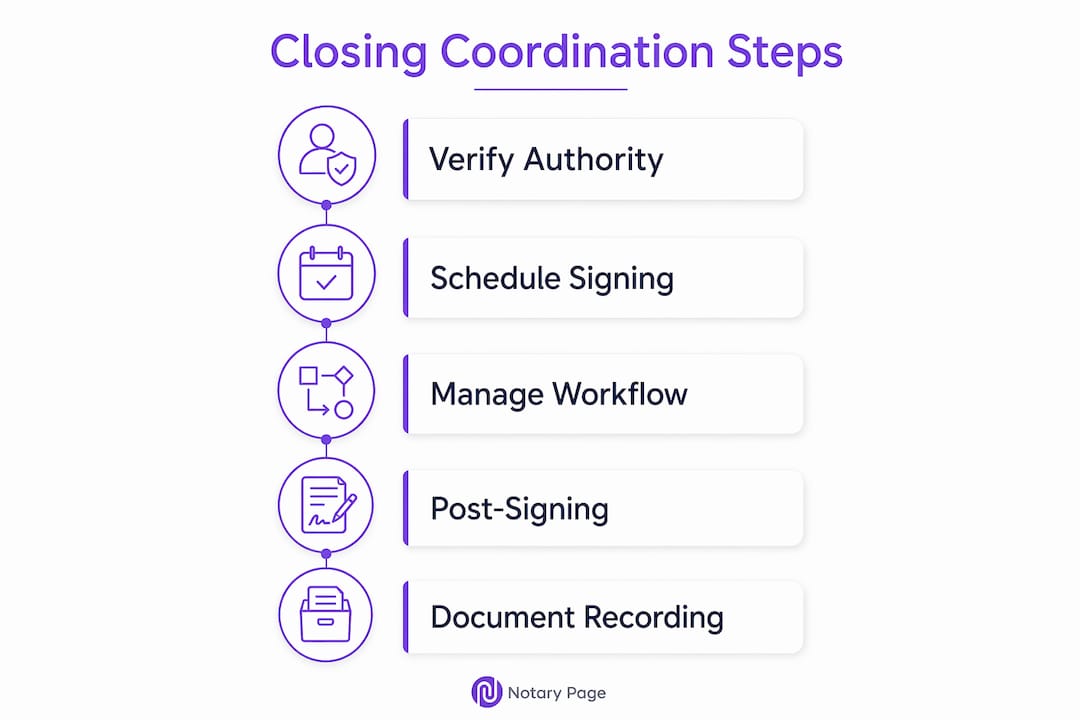
The roles involved in closing agent services for corporate transactions typically include the notary signing agent (who witnesses and notarizes), the transaction coordinator (who manages document flow), and the closing agent or escrow officer (who holds funds and manages recording). Each role has a distinct lane, and overlap creates liability.
How to coordinate signing schedules and manage multi-party signing workflows effectively?
Scheduling is where most corporate signing coordination failures originate. A signing session that starts late, involves the wrong signatory, or produces documents in the wrong order can invalidate the entire closing sequence.
Follow this sequence to manage multi-party signing workflows without errors:
- Confirm the signing order in writing. Multi-party signing requires defining signing order, delegation authority, and parallel signing capabilities to reduce cycle time while maintaining control. Document the sequence before scheduling begins.
- Synchronize schedules with the title company and closing coordinator. Closing coordination should revolve around schedules agreed upon with title or closing coordinators, with a confirmation-driven approach that ensures signing completion and handoff before recording occurs.
- Use parallel signing where the transaction structure permits. Parallel signing allows independent signatories to execute documents simultaneously rather than sequentially, cutting cycle time without sacrificing governance. AI-driven tools that orchestrate signing workflows provide speed and governance, enabling parallel execution with audit trails.
- Assign a single point of contact for each signing session. In corporate transactions, diffuse accountability produces missed confirmations. One coordinator owns each session from scheduling through handoff.
- Build confirmation checkpoints into the workflow. Closing-day coordination benefits from a series of confirmation checkpoints rather than assumptions, ensuring a clean handoff for post-signing steps.
- Confirm completion before releasing any funds or triggering recording. No recording instruction should leave the closing coordinator’s desk until every required signature is confirmed and the document packet is secured.
Pro Tip: Send a written pre-closing checklist to every signing party 48 hours before the session. Include the signing order, required identification, and the name of the notary signing agent. This single step eliminates the majority of day-of delays.
Common challenges in coordinating signing sessions include premature signing (a party executes before their turn in the sequence), authorization lapses (a delegated authority expires or is revoked between scheduling and signing), and scheduling conflicts that force last-minute substitutions. Each of these is preventable with upfront documentation and a confirmation-driven workflow.
What are best practices for verifying signing authority and compliance in corporate closings?
Authority verification is the compliance backbone of any corporate closing. A signature from an unauthorized party is not just procedurally incorrect. It can render a document legally unenforceable and expose the corporation to claims of breach.
The best practices for authority verification in business document signing are:
- Maintain a current DOA matrix. Synchronizing signatory lists with authority matrices reduces the risk of over-delegation and invalid signatures. Review the matrix before every major transaction, not just annually.
- Use time-bound role snapshots. Authority granted to an officer who has since resigned or been reassigned is invalid. Capture a dated snapshot of the signatory’s role and authority level at the time of signing.
- Require explicit delegation instruments. Board resolutions, powers of attorney, and corporate authorizations must be current, properly executed, and attached to the closing file before the signing session begins.
- Enforce sequential approval chains. Delegated signing controls require proving identity, role, authority, approval chain, and integrity with enforceable workflows and audit-grade evidence. Platforms like Pactvera enforce these controls with policy-as-code and immutable audit logs.
- Prevent over-delegation. Strictly enforcing signing order and delegation reduces the risk of broken attribution and unauthorized signatures in multi-party corporate deals.
- Require government-issued identification at every in-person signing. Notary signing agents are required to verify identity, but the closing coordinator should confirm this step is documented in the closing file.
“Corporate signing authority is multi-dimensional, involving entity, role, contract type, approval chain, and thresholds. Codifying this in a matrix and syncing it with signatory lists is essential to avoid invalid executions.” — Aptly Done
Audit trails are not optional in corporate closings. Every signing event should produce a tamper-evident record that captures who signed, when, from what device or location, and under what authority. This record is your primary defense in any post-closing dispute.
How to handle post-signing coordination for document finalization and recording?
Post-signing coordination is where many otherwise well-run closings break down. The documents are signed, the pressure releases, and the confirmation discipline disappears. That is precisely when errors in recording, escrow release, and document custody create costly problems.
The post-signing workflow for notary services for corporations and real estate transactions follows a clear sequence:
| Step | Action | Responsible Party |
|---|---|---|
| 1. Confirm signing completion | Verify all required signatures are present and notarized | Notary signing agent, closing coordinator |
| 2. Secure document packet | Collect and transmit executed documents to escrow or title | Signing agent, transaction coordinator |
| 3. Follow written escrow instructions | Escrow agents must follow only written instructions to maintain compliance | Escrow officer |
| 4. Coordinate recording | Submit deeds and documents for recording; recording typically occurs 1 to 3 business days after settlement in escrow states | Title company, closing agent |
| 5. Confirm funding triggers | Verify all conditions for fund release are met before disbursement | Escrow officer, closing coordinator |
Conditional signing steps require particular attention. Conditional signing steps should clearly define signer roles, trigger events, required evidence, and subsequent platform actions to prevent errors in complex closings. In merger and acquisition transactions, for example, escrow release conditions may depend on regulatory approvals that arrive after the signing session. The workflow must account for this gap explicitly.
Fraud prevention during post-signing handling is a real concern in high-value corporate transactions. Limit access to executed document packets to named parties only. Use encrypted transmission for digital documents and tracked courier services for physical originals.
Pro Tip: Assign a post-signing checklist to the closing coordinator that mirrors the pre-closing checklist. Every item confirmed before signing should have a corresponding confirmation after signing. This creates a closed-loop record that protects all parties.
Technology platforms that track post-signing workflow, such as DocuSign’s transaction management features or dedicated closing management software, reduce the risk of a document falling through the cracks between signing and recording.
Key takeaways
Effective corporate closing signing agent coordination requires verified authority, defined signing sequences, and disciplined post-signing confirmation at every stage of the transaction.
| Point | Details |
|---|---|
| Authority verification is foundational | Maintain a current DOA matrix and require explicit delegation instruments before every signing session. |
| Signing order must be documented in writing | Define sequence, delegation rules, and parallel signing permissions before scheduling begins. |
| Confirmation checkpoints prevent post-signing failures | Use a closed-loop checklist from pre-signing through recording to eliminate gaps in document custody. |
| Technology enforces what policy cannot | Platforms like DocuSign, Legitt AI, and Pactvera automate compliance and produce audit-grade evidence. |
| Escrow agents follow written instructions only | Verbal agreements have no standing; all closing instructions must be documented before the signing session. |
What I’ve learned from watching corporate closings go wrong
I have spent years watching well-prepared transactions unravel in the final hours, and the pattern is almost always the same. The legal work is solid. The deal terms are agreed. But nobody owns the coordination layer between the signed documents and the recorded deed.
The most common failure I see is treating the signing agent as a commodity rather than a critical link in a controlled handoff chain. A notary signing agent who shows up without a confirmed signatory list, without knowledge of the signing order, and without a direct line to the closing coordinator is a liability, not an asset. The credential matters less than the coordination protocol surrounding that person.
The second failure is assuming that a signed document is a completed document. Post-signing coordination, specifically the confirmation of completion, the secure transfer of the document packet, and the verification of recording, deserves the same rigor as the signing session itself. I have seen transactions delayed by a week because a signed deed sat in someone’s inbox waiting for a recording instruction that never came.
My practical advice: treat every corporate closing as a project with a defined critical path. Map the signing sequence, assign owners to each step, and build confirmation checkpoints that require an explicit response, not just an assumption of completion. The closing coordination process rewards preparation and punishes improvisation every time.
For regional context, understanding how closing coordination differs by jurisdiction can also sharpen your process, particularly when corporate entities span multiple states or provinces.
— Amy
Find vetted signing agents for your next corporate closing
Corporate closings require signing agents who understand authority verification, document sequencing, and post-signing handoff protocols. Not every notary has that background. Notarypage connects corporate executives and real estate professionals with a nationwide network of vetted, certified signing agents who are prepared for the complexity of multi-party transactions. The platform offers both in-person and remote notarization options, $1,000,000 E&O coverage through Hiscox, and real-time scheduling tools that eliminate the back-and-forth of manual coordination. When your next closing depends on getting every signature right the first time, find your signing agent through Notarypage and close with confidence.
FAQ
What is a corporate closing signing agent?
A corporate closing signing agent is a certified notary professional who facilitates the execution of closing documents in real estate or corporate transactions, verifying signer identity and witnessing signatures on behalf of the closing or title company.
How far in advance should signing sessions be scheduled?
Signing sessions for corporate closings should be scheduled at least 48 to 72 hours in advance to allow time for signatory confirmation, authority verification, and document preparation by the closing coordinator.
What is a delegation of authority matrix?
A delegation of authority matrix is a document that specifies which individuals within a corporation are authorized to sign specific document types, up to defined thresholds and under defined approval chains. It is the primary tool for preventing unauthorized signatures in corporate closings.
How long does recording take after a corporate closing?
Recording typically occurs 1 to 3 business days after settlement in escrow states, though timelines vary by county and jurisdiction. The closing coordinator confirms recording completion and notifies all parties.
What happens if the wrong person signs a closing document?
A signature from an unauthorized party can render the document legally unenforceable and may require re-execution, delaying recording and funding. Maintaining a current DOA matrix and confirming signatory authority before every session prevents this outcome.