
Estate Planning Notary Best Practices for Signers
Estate Planning Notary Best Practices for Signers
The single best practice for a valid estate document notarization: arrive with fully drafted, unsigned documents, a government-issued photo ID that matches your name on every page, required witnesses confirmed, and a booked appointment — either in-person or remote. Do that, and most notarizations go off without a problem. Skip any one of those steps, and you risk a refused signing or a document that fails probate.
Signing-day checklist:
- Documents: Printed originals, fully completed, with all signature lines left blank
- ID: Current government-issued photo ID (driver’s license, passport, state ID) with name matching the document exactly
- Witnesses: Confirmed and present for the same session (required for wills and self-proving affidavits in most states)
- Appointment type: In-person or Remote Online Notarization (RON) confirmed in advance; note that most states exclude wills from RON
- Payment: Cash, card, or platform payment ready; ask for a total upfront
- Attorney review: Have an attorney review drafts before the appointment — notaries cannot give legal advice or fix document content per the National Notary Association
- Self-proving affidavit: Request one for your will; it reduces probate steps under the Uniform Probate Code
Key Takeaways
Arriving with fully drafted, unsigned documents and a matching government-issued photo ID is the foundation of every valid estate notarization — everything else builds from there.
| Point | Details |
|---|---|
| Leave signature lines blank | Never sign before the notary is present; a pre-signed document requires full re-execution. |
| Add a self-proving affidavit | Attach one to your will to reduce probate steps under the Uniform Probate Code. |
| Wills and RON don’t mix in most states | RON is authorized in 44 states and D.C. for most documents, but wills remain excluded in the majority of jurisdictions. |
| Ask for total fees upfront | In-person fees commonly run $5–$10 per signature; mobile travel adds $30–$60 or more; get an itemized total before the appointment. |
| Book through Notarypage | Notarypage offers nationwide in-person, mobile, and RON bookings with E&O coverage through Hiscox for estate signing sessions. |
Table of Contents
- Which estate documents require notarization?
- In-person vs. remote notarization: which is right for your estate documents?
- What to bring and how to prepare before your appointment
- Scheduling signers and witnesses: timing and mobile options
- What happens during the notarization ceremony
- Fees and how to budget for estate notarizations
- After signing: storing originals and granting access
- Red flags and common mistakes that invalidate notarizations
- How to choose and book a notary for estate planning
- Notarizing documents for signers with disabilities or special needs
- How to verify signer competency and willingness
- The case for defaulting to in-person notarization for wills
- Notarypage makes booking estate signings straightforward
- Sources
Which estate documents require notarization?
Not every estate document has the same notarization requirement, and confusing them is one of the most common notary mistakes in estate planning.
| Document | Notarization Required? | Notes |
|---|---|---|
| Will | Rarely required by law | Self-proving affidavit strongly recommended |
| Self-proving affidavit | Yes | Requires notary + witnesses together; oath typically required |
| Living trust | Strongly recommended | Not always legally required, but banks and title companies expect it |
| Deed into trust | Yes | Must be notarized to record at the county recorder’s office |
| Durable power of attorney | Yes in most states | Banks almost universally require notarization |
| Advance healthcare directive | Yes in most states | Some states also require witnesses |
The self-proving affidavit deserves special attention. Attached to a will, it lets the witnesses swear under oath before a notary that the signing was valid. Courts in states that follow the Uniform Probate Code can then admit the will to probate without tracking down those witnesses years later. That single step can save a family weeks of delay.
State variation matters here. A durable POA that a bank will accept in one state may need additional language or a second witness in another. When in doubt, check your state’s Secretary of State website or confirm with the document drafter before your appointment.
Pro Tip: For living trusts, notarizing the trust and preparing a certificate of trust lets you share proof of the trust’s existence with banks and title companies without exposing every private detail of the full document.
In-person vs. remote notarization: which is right for your estate documents?
Most estate documents can go either way. Wills are the exception.
RON is permanently authorized in 44 states and Washington D.C. as of 2025, and it works well for durable POAs, healthcare directives, and trust documents. For wills, the picture is different: most states still require physical presence for execution, and only a small number permit electronic wills under narrow, specific rules. Before scheduling a RON session for a will, verify your state’s law directly.
In-person advantages:
- Notary can observe body language, hesitation, and signs of pressure
- No technology requirements for signers or witnesses
- Universally accepted across all document types and institutions
RON advantages:
- No travel required; schedule from home
- KBA (knowledge-based authentication) plus credential analysis and a recorded video session create a strong forensic record of identity
- Faster scheduling for time-sensitive documents like POAs
The recorded RON session is worth understanding. RON platforms require multi-factor identity checks that can actually produce stronger documentary evidence of identity than a simple in-person ID review. The gap is elsewhere: a camera cannot reliably detect coercion or undue influence the way a notary in the room can. Practitioners at Saul Ewing caution that RON can mask signs of undue influence, which is why many estate attorneys still recommend in-person signing for wills and high-stakes documents regardless of what the law technically permits.
What to bring and how to prepare before your appointment
Finalize every detail in the document before you print: names spelled correctly, dates filled in, addresses complete. Then leave every signature line blank. Signing before the notary is present forces a refused notarization and requires full re-execution.
For ID, bring a current government-issued photo ID. A driver’s license, U.S. passport, or state ID card all work. The name on the ID must match the name on the document exactly, including middle names or initials if they appear. A hyphenated name on the document but not on the ID is enough to cause a refusal. If a signer has no qualifying ID, some states allow a credible identifying witness — a person who knows the signer and can vouch for their identity under oath.
Pro Tip: Have your attorney review the final draft before printing. Notaries cannot correct document language or give legal advice, and a drafting error discovered at the table means rescheduling.
Scheduling signers and witnesses: timing and mobile options
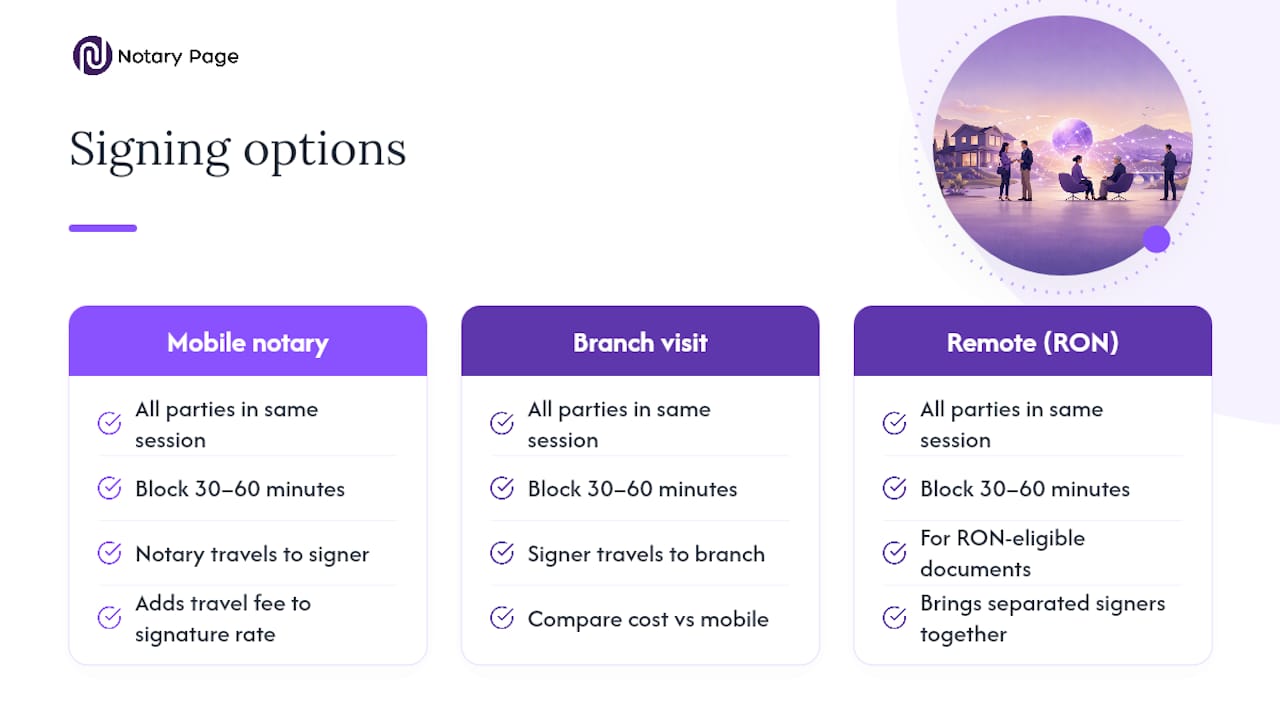
All required signers and witnesses need to be in the same session. For a will with a self-proving affidavit, that means the testator, both witnesses, and the notary must all be present simultaneously. Staggering signatures across separate appointments invalidates the affidavit.
Block 30–60 minutes for a standard estate signing. Multi-document packages (will, POA, healthcare directive, trust) can run longer, especially when multiple signers are involved. Confirm witness availability before booking the notary, not after.
For homebound or hospitalized signers, a mobile notary travels to the location. Mobile visits typically add a travel fee on top of the per-signature rate, but they eliminate the logistics of transporting someone who cannot easily leave. Compare that cost against the alternative of a branch visit, and for most families dealing with an elderly or ill signer, the mobile option is worth it.
Pro Tip: When coordinating multiple signers across different locations, ask whether the notary service supports split signings or whether all parties must be physically co-located. For RON-eligible documents, a remote session can bring geographically separated signers together without travel.
What happens during the notarization ceremony
The sequence matters, and knowing it prevents the most common mistake: signing too early.
- Identity check: The notary reviews each signer’s government-issued photo ID and confirms the name matches the document.
- Willingness and capacity confirmation: The notary asks the signer to confirm they are signing voluntarily and understand the document. This is not a legal competency exam, but a notary who observes confusion or apparent pressure can and should pause.
- Signer signs: Only after identity is confirmed does the signer sign, in the notary’s presence.
- Witnesses sign: For documents requiring witnesses, they sign in the same session.
- Oath (if required): For a self-proving affidavit, the notary administers an oath to the witnesses before they sign.
- Notarial certificate and seal: The notary completes the certificate (acknowledgment or jurat), applies the official seal, and records the transaction in the notary journal.
The difference between an acknowledgment and a jurat: an acknowledgment confirms the signer appeared and acknowledged the signature as their own; a jurat requires the signer to swear or affirm the document’s contents are true. Self-proving affidavits typically require a jurat with an oath.
Pro Tip: A RON session’s recorded video serves a similar evidentiary function to a notary journal entry — and in some disputes, the video record is more detailed. Ask your RON provider how long recordings are retained.
Fees and how to budget for estate notarizations
In-person per-signature fees commonly run $5–$10; RON per-signature caps in some states reach $25–$30; mobile notary travel fees often add $30–$60 or more on top of the signing fee.
An estate package with a will, self-proving affidavit, durable POA, and healthcare directive can involve six or more notarized signatures. Add two witnesses and a mobile travel fee, and the total climbs quickly. Always ask for an itemized total before the appointment, not after.
State law caps the per-signature fee, but not always the travel fee or platform fee. Check your state’s Secretary of State website for the statutory maximum. Banks and shipping stores that offer notary services sometimes charge a convenience fee on top of the notary fee itself.
After signing: storing originals and granting access
Banks and courts prefer original documents with a raised or inked seal. Photocopies are often insufficient for recording a deed or opening an estate account. Store originals somewhere your successor can actually find and access.
The safe-deposit box trap is real: if the box is in your name only, your successor may need a court order to open it after your death. Use attorney vaulting with written access instructions, or store originals at home in a fireproof document safe with a note to your executor describing exactly where they are.
For living trusts, a certificate of trust is a notarized summary that confirms the trust exists, names the trustee, and describes trustee powers — without revealing the full trust terms. Keep secure digital scans of all signed documents as a backup, but treat them as reference copies, not originals.
Pro Tip: Write a one-page “document locator” letter to your executor or successor trustee. List every estate document, where the original is stored, and who holds copies. Update it whenever documents change.
Red flags and common mistakes that invalidate notarizations
Most notarization failures are preventable. The errors that cause the most damage:
- Signing before the notary arrives: The most common and most damaging mistake. The notary must witness the signature. A pre-signed document requires full re-execution.
- Name mismatches: The name on the ID differs from the name on the document. Even a missing middle initial can trigger a refusal.
- Missing witnesses: A will or self-proving affidavit signed without the required witnesses present is invalid in most states.
- Incomplete forms: Blank fields in the document body (dates, addresses, beneficiary names) give grounds for refusal or later challenge.
- Wrong witness: A witness who is also a beneficiary under the will creates a conflict in many states and can void the bequest or the will itself.
If an error is discovered after signing, the fix depends on the error. A clerical mismatch in a non-signature field may be correctable with a notarized amendment. A missed witness or a pre-signed document typically requires full re-execution: a new document, new signatures, new notarization. Contact the document drafter or an attorney before attempting any correction.
If you discover a problem after the notary has left, do not alter the document yourself. Any handwritten change to a signed, notarized document — even a correction of an obvious typo — can void the entire instrument. Stop, call your attorney, and re-execute cleanly.
How to choose and book a notary for estate planning
A short checklist before you book:
- Commission status: Confirm the notary holds a current commission in the state where the signing takes place.
- E&O insurance: Ask whether the notary or platform carries Errors and Omissions insurance. It matters if a mistake causes a document to fail.
- Estate document experience: Not all notaries are familiar with self-proving affidavits or trust signings. Ask directly.
- Witness and mobile availability: Confirm the notary can accommodate witnesses on-site and, if needed, travel to the signer.
- RON capability: If you need remote notarization for eligible documents, confirm the platform is authorized in your state.
- Written fee confirmation: Get the total in writing before the appointment — per-signature fee, travel fee, and platform fee if applicable.
| Evaluation factor | What to ask |
|---|---|
| Commission status | “Are you currently commissioned in [state]?” |
| E&O insurance | “Does your service carry E&O coverage, and for how much?” |
| Estate experience | “Have you notarized self-proving affidavits and trust documents before?” |
| Witness logistics | “Can you coordinate witnesses, or do I need to bring my own?” |
| Fee transparency | “What is the total cost, including travel and platform fees?” |
A vetted nationwide booking platform like Notarypage simplifies this for multi-signer estate sessions: you can confirm appointment type, upload documents in advance, and track the order through completion.
Notarizing documents for signers with disabilities or special needs
A signer with a physical disability can still execute estate documents as long as they can communicate intent. If a signer cannot hold a pen, many states allow them to direct another person to sign on their behalf in their presence. The notary records this in the journal.
For signers with cognitive limitations, the standard shifts. A notary is not a physician and cannot make a legal competency determination, but a notary who observes clear confusion, inability to answer basic questions about the document, or signs of coercion should pause the signing and decline to proceed. The appropriate response is to recommend that the family obtain a physician’s statement of capacity or have an elder law attorney present for the signing.
Mobile notaries are particularly useful here. A signer who cannot travel to an office can be notarized at home, a hospital, or a care facility. Schedule the appointment at a time of day when the signer is typically most alert.
How to verify signer competency and willingness
Competency screening during a notarization is not a clinical evaluation. It is a brief, direct conversation. The notary asks the signer to confirm they understand what they are signing and that they are doing so voluntarily. A signer who can answer those questions clearly, without prompting from a family member or caregiver, meets the standard.
Watch for these warning signs: a third party who answers questions on the signer’s behalf, a signer who looks to someone else before responding, or a signer who cannot state in their own words what the document does. Any of these warrants pausing the session.
For high-value or contested estates, having an elder law attorney present at the signing creates an additional layer of documentation. The attorney can note the signer’s demeanor and responses, which becomes useful evidence if the document is later challenged on competency grounds.
The case for defaulting to in-person notarization for wills
RON is genuinely useful for estate planning. For a durable POA or healthcare directive, a remote session is fast, legally sound in most states, and produces a strong identity record. The recorded video and KBA checks that RON platforms use can actually exceed what a quick in-person ID glance provides forensically.
But for wills, the calculus is different, and the conventional wisdom that “RON is just as good” glosses over a real risk. The camera cannot see what is happening off-screen. A family member applying pressure in the room is invisible to the notary on the other end of the call. That is not a theoretical concern — it is the reason practitioners caution that in-person signing offers stronger legal certainty for estate documents where undue influence is a plausible challenge.
The practical recommendation: use in-person notarization for wills unless your state explicitly authorizes electronic wills under defined rules, and use RON for other estate documents where it is permitted and convenient. Get attorney review before either. A self-proving affidavit, properly executed in person, is the single most effective step you can take to protect a will from probate challenge.
Notarypage makes booking estate signings straightforward
Coordinating a multi-signer estate signing — will, trust, POA, and healthcare directive in one session — is where most people hit friction. Finding a notary who handles all document types, confirms witness logistics, and offers both in-person and remote options takes time most families don’t have.
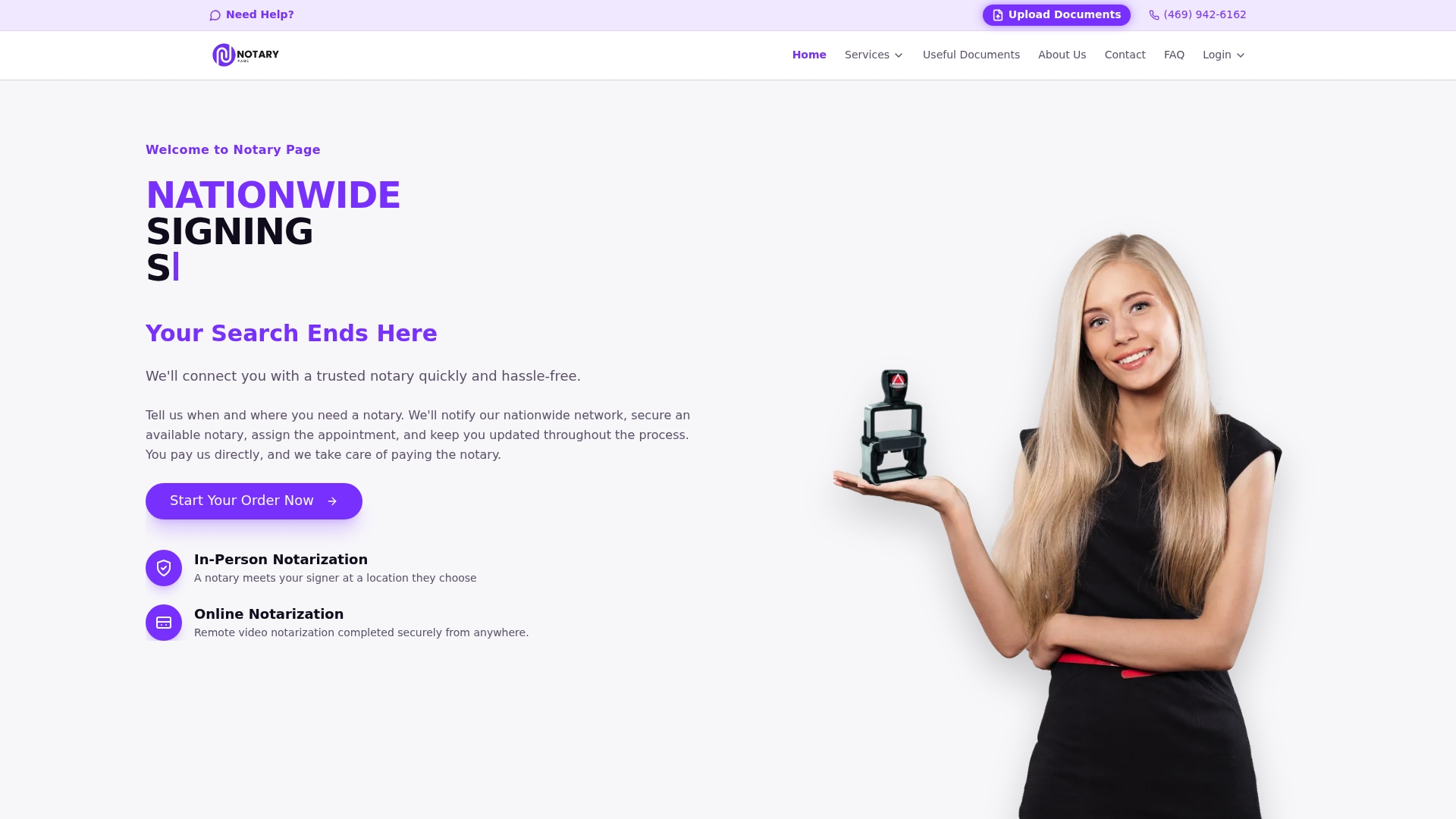
Notarypage covers that coordination. The platform connects you with certified notaries nationwide for in-person, mobile, and RON appointments, with secure document upload and order tracking so you know exactly where things stand. E&O coverage through Hiscox backs every booking. Whether you need a mobile notary at a care facility for a homebound signer or a RON session for a POA with a family member in another state, the platform handles the scheduling. Book your estate signing appointment and get a confirmed notary without the phone-tag.
Sources
- National Notary Association – How to prepare for notarization
- Notarizing Estate Planning Documents: Requirements and Steps - LegalClarity
- Saul Ewing — professional notary guidance and commentary
This article is general information, not a substitute for advice from a qualified lawyer. Consult a qualified legal professional about your own circumstances before acting on anything here.