
How Notary Network Coverage Works: A Clear Guide
How Notary Network Coverage Works: A Clear Guide
Notary network coverage is a compliance-controlled system that connects signers with fully vetted notaries authorized to perform in-person and remote notarizations across multiple jurisdictions. Understanding how notary network coverage works matters because the quality of your notarization depends entirely on the infrastructure behind it, not just the individual notary you meet. A well-built network like those operated by Proof or Notarypage does far more than maintain a directory. It enforces credential standards, manages geographic coverage, and integrates technology platforms that make remote notarization legally valid. This guide breaks down every layer of that infrastructure so you can make confident decisions about which notary service to trust.
How notary network coverage works: the core mechanics
A notary network is a curated pool of commissioned notaries organized and managed by a platform or organization to deliver notarization services at scale. The term “notary network coverage” refers to the geographic reach, document-type eligibility, and compliance status of that pool at any given moment. Coverage is not static. It expands or contracts based on notary credential status, state authorization rules, and technology availability.
The most important thing to understand is that notary network coverage enables convenient, scalable, legally valid notarization tailored to customer needs, whether that means a single power of attorney or thousands of mortgage closings per month. Networks achieve this by layering three systems on top of each other: a vetting and onboarding process, a technology platform for remote delivery, and a compliance monitoring engine that runs continuously. Each layer depends on the others. A notary who passes onboarding but later lets a commission lapse gets flagged and paused automatically. That is what separates a network from a simple referral list.

Named entities matter here. Platforms like Proof (formerly Notarize), Notarypage, NotaryCam, and DocVerify each operate their own networks with distinct coverage footprints and compliance standards. Knowing which platform backs your notary service tells you a great deal about the reliability of the coverage you are actually getting.
How notary networks vet and onboard notaries
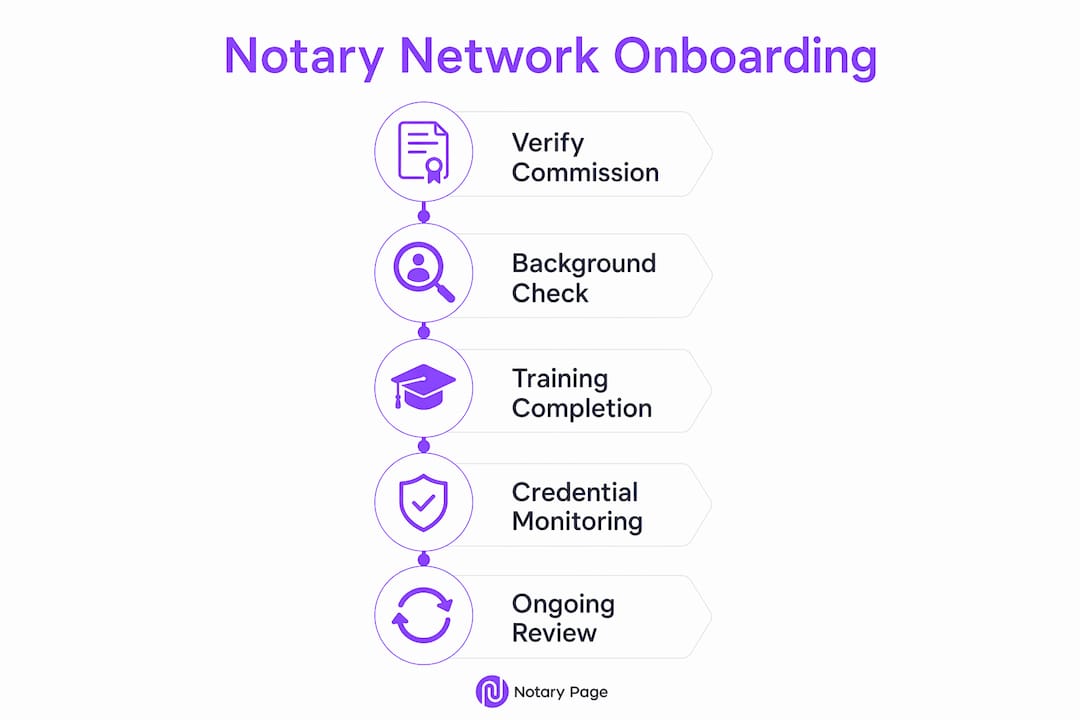
Onboarding is the first compliance gate, and it is far more rigorous than most signers realize. Networks do not simply accept any commissioned notary who applies. The process functions as a gating mechanism that filters out unqualified candidates before they ever interact with a client.
A standard onboarding sequence at a major platform includes the following steps:
- Commission verification. The network confirms the notary holds a valid state commission in the jurisdiction where they intend to operate.
- Background screening. Criminal background checks are standard. Proof’s Notarize Network requires NNA training completion and background screening status verification before any notary serves a client.
- Skills assessment. Notaries must pass a platform-specific test. Proof Academy assessments require an 80% minimum score to certify notaries for platform use, with continual compliance adherence expected afterward.
- Insurance documentation. Errors and omissions (E&O) insurance covering at least $25,000 is typically required for notaries on on-demand platforms. Proof mandates uploading valid insurance documents before a notary account is activated. Notarypage goes further, carrying $1,000,000 in E&O coverage through Hiscox for added signer protection.
- Technology training. Remote online notarization platforms require notaries to demonstrate proficiency with audio-video tools, electronic journals, and digital certificate workflows.
Pro Tip: When evaluating a notary service, ask specifically whether notaries carry E&O insurance and what the coverage limit is. A platform that cannot answer that question clearly has not built a real compliance infrastructure.
Onboarding is not a one-time event. The credential compliance process operates as a dynamic gating mechanism, meaning credential updates automatically trigger re-verification to maintain continuous network integrity.
How remote online notarization integrates into notary network coverage
Remote online notarization, universally abbreviated as RON, is the technology layer that allows a notary to serve clients anywhere in the country without being physically present. RON has evolved from emergency pandemic measures into permanent legal frameworks in most U.S. states by 2026, signaling broad adoption across network coverage models. This shift fundamentally changed what “coverage” means for a notary network.
RON is legal in 51 jurisdictions by 2026 in some form, with California’s full authorization effective 2030. That near-universal adoption means a notary network with RON capability can theoretically cover the entire continental United States, subject to document-type restrictions and interstate recognition rules.
The technology requirements for RON are specific and non-negotiable:
- Multi-factor identity verification using knowledge-based authentication (KBA) and credential analysis
- Secure audio-video sessions recorded and stored for the legally required retention period
- Digital certificates tied to the notary’s electronic signature
- Tamper-evident seals applied to the finalized document
Most states maintain approved technology platform lists. Common approved platforms include Notarize and NotaryCam, both of which integrate directly into larger notary network ecosystems. Pavaso and DocVerify also appear on multiple state-approved lists, particularly for real estate closings.
RON coverage: what the technology enables vs. what it cannot fix
| Capability | RON Enables | RON Does Not Solve |
|---|---|---|
| Geographic reach | Nationwide notarization from one location | Interstate recognition gaps for specific document types |
| Signer convenience | Notarization from any device with a camera | Documents requiring physical wet signatures |
| Compliance recording | Automatic session archiving | Apostille requirements for international use |
| Identity verification | KBA and biometric credential checks | Signers without government-issued ID |
The table above reflects the practical reality that RON expands coverage dramatically but does not eliminate all jurisdictional friction. For international documents requiring an apostille, for example, the notarization must still comply with the destination country’s recognition rules, which RON does not automatically satisfy. Understanding this distinction prevents costly document rejections.
How notary networks maintain compliance across jurisdictions
Geographic coverage in a notary network is not a single on/off switch. Networks segment coverage into geographic or functional subzones, enabling tailored notary pools to meet jurisdiction-specific parameters and compliance requirements. A notary commissioned in Texas cannot perform notarizations governed by New York law simply because they joined a network. State-specific commissioning directly affects a notary’s eligibility within the network, influencing both geographic and document-type coverage.
Proof’s Network Integrity team receives alerts when notaries update credentials, triggering automatic profile reviews. This process makes credential compliance ongoing rather than periodic. If a notary’s commission expires or their E&O policy lapses, the system flags them and removes them from the active pool until the issue is resolved. Signers never see this process, but it is what prevents them from receiving a notarization that could later be challenged in court.
Pro Tip: Before scheduling a notarization for a high-stakes document like a real estate deed or a durable power of attorney, confirm that the notary’s commission is active in the state where the document will be filed, not just where the notary is located.
Networks also manage coverage through electronic journals, which create a permanent audit trail for every notarial act. This journal requirement exists in most RON-enabled states and serves as the primary compliance record if a document is ever disputed. Platforms that skip this step are operating outside legal requirements in most jurisdictions, which puts signers at risk.
Who benefits from notary network coverage
The practical applications of notary network coverage span a wide range of users and document types. Understanding who benefits and how clarifies why network infrastructure matters more than simply finding any available notary.
Individuals typically use notary networks for:
- Power of attorney documents, where legal validity is non-negotiable and errors can have serious financial or medical consequences
- Title transfers and vehicle sales, which require notarization to complete the transaction legally
- School and travel consent forms, often needed quickly and outside business hours
- Estate planning documents, including wills, trusts, and healthcare directives
Businesses embed notarization into operational workflows at a much larger scale. Mortgage lenders use notary networks for closing document workflows, processing hundreds of signings per month with consistent compliance standards. Insurance companies use notarization for claims affidavits. Law firms use it for deposition transcripts and settlement agreements.
The scalability benefit is significant. A single business can route all its notarization needs through one platform and receive consistent credential standards, audit trails, and insurance coverage across every transaction. That consistency is impossible to achieve by sourcing individual notaries independently. For international transactions, networks with RON capability and apostille guidance provide the most complete coverage, though users should always verify recognition rules with the destination country before proceeding.
Key takeaways
Notary network coverage works through layered compliance systems: rigorous onboarding, continuous credential monitoring, and technology-enabled remote delivery that together guarantee reliable, legally valid notarization at scale.
| Point | Details |
|---|---|
| Onboarding is a compliance gate | Networks verify commissions, run background checks, and require E&O insurance before activating any notary. |
| RON expands geographic reach | Remote online notarization is legal in 51 jurisdictions by 2026, enabling nationwide coverage from a single platform. |
| Credential monitoring is continuous | Platforms like Proof automatically flag credential changes and pause notaries who fall out of compliance. |
| Coverage is jurisdiction-specific | State commissioning rules create subzones within networks; a notary’s eligibility varies by document type and filing location. |
| Businesses gain scalability | Embedding notarization into workflows through a network delivers consistent compliance and audit trails across high-volume transactions. |
Why I think most people underestimate notary network infrastructure
People treat notarization like a commodity. They search “how to find a notary,” pick whoever is closest or cheapest, and assume the stamp makes the document valid. That assumption is wrong, and I have seen it create real problems.
The compliance infrastructure behind a notary network is what actually protects you. A notary whose commission lapsed three months ago can still physically stamp a document. Without a network actively monitoring credential status and pulling non-compliant notaries from the active pool, you have no way of knowing whether your notarization will hold up if it is ever challenged. That is not a hypothetical risk. It is a documented failure mode that affects real estate transactions, estate settlements, and legal proceedings every year.
What I find most interesting about the current moment is that RON adoption has outpaced public understanding. Most people still think of notarization as something that requires a physical meeting. The reality is that remote notarization services are now legally valid in nearly every U.S. state, and the technology behind them is more secure than a wet-ink signature in many respects. Multi-factor identity verification and tamper-evident seals create an audit trail that a paper document simply cannot match.
My advice: stop choosing a notary service based on proximity alone. Choose based on the compliance infrastructure behind the platform. Ask about E&O coverage, credential monitoring, and RON authorization status. Those three questions will tell you more about the reliability of your notarization than anything else.
— Amy
Get reliable notary coverage through Notarypage
Notarypage connects individuals and businesses with a nationwide network of notaries who have passed rigorous credential verification, background screening, and platform training. Every notarization through Notarypage carries $1,000,000 in E&O coverage through Hiscox, which is among the highest protection levels available from any notary platform. Whether you need an in-person signing for a real estate closing or a remote session for estate planning documents, Notarypage handles both with full compliance tracking and status updates throughout the process. If you need a vetted, insured notary without the guesswork, Notarypage is built for exactly that.
FAQ
What is a notary network?
A notary network is a curated, compliance-controlled pool of commissioned notaries managed by a platform to deliver consistent, legally valid notarization services across multiple jurisdictions and document types.
How does remote online notarization work within a network?
RON allows a notary to perform notarizations via secure audio-video technology using multi-factor identity verification, digital certificates, and tamper-evident seals. It is legally authorized in 51 jurisdictions as of 2026.
What credentials should a notary in a network have?
Network notaries should hold a valid state commission, pass a background check, complete platform-specific training with a minimum passing score, and carry E&O insurance. Proof requires at least $25,000 in E&O coverage before activation.
How do notary networks handle compliance across different states?
Networks segment coverage into jurisdiction-specific subzones and use automated credential monitoring to flag and pause notaries whose commissions or insurance lapse, keeping the active pool compliant at all times.
Can a notary network handle international documents?
Networks can notarize documents intended for international use, but apostille recognition and destination-country rules apply separately. Always verify the receiving country’s requirements before scheduling a notarization for cross-border documents.