
How Remote Notarization Helps Real Estate Closings
How Remote Notarization Helps Real Estate Closings
Remote online notarization (RON) speeds up real estate closings, tightens fraud controls through recorded audit trails and tamper-evident digital seals, and removes the geographic barriers that have long made in-person signings a logistical headache. If you’re preparing for a closing right now, your first move is to ask your title company or lender whether they accept RON and whether your county recorder accepts eRecording.
The three benefits that matter most in practice:
- Faster timelines. RON sessions typically run 15–30 minutes end-to-end, compared to multi-hour traditional closings when travel is factored in.
- Stronger identity and fraud controls. Forensic ID analysis, multi-factor authentication, and permanent session recordings create a verifiable chain of custody that paper closings simply cannot match.
- Fewer logistical touchpoints. Buyers, sellers, and notaries can be in different states or countries and still execute a legally valid closing without a single in-person meeting.
Table of Contents
- What RON, RIN, and eClosing actually mean
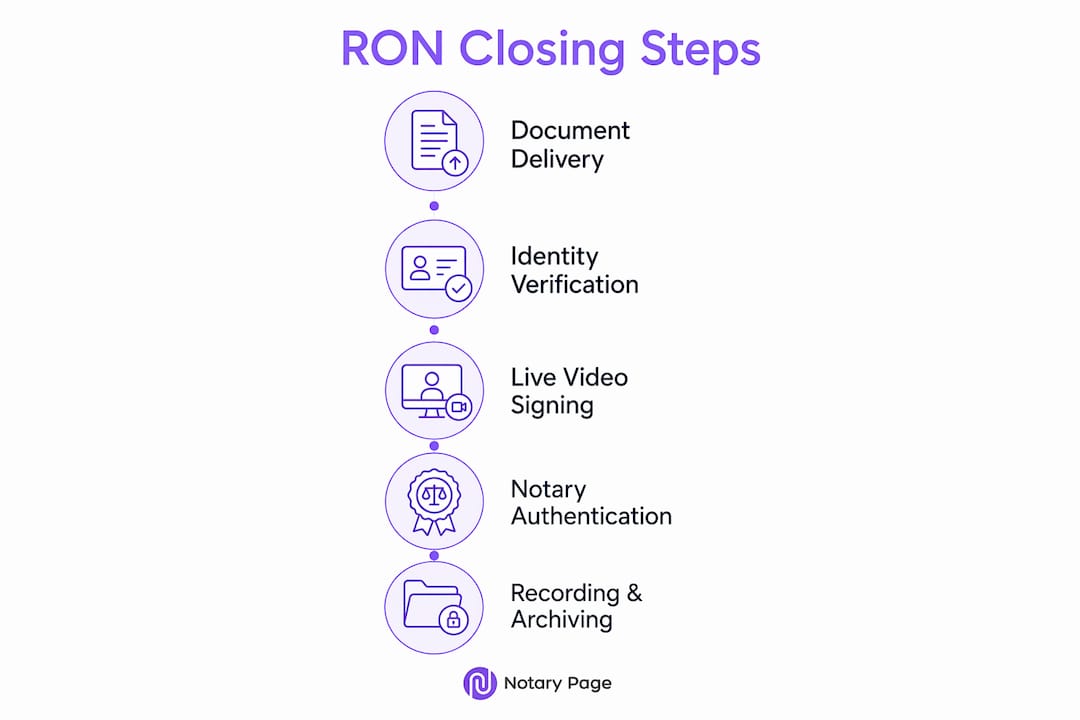
- How a RON closing works, step by step
- How RON benefits each party at the closing table
- What to check in your state before scheduling a RON closing
- What title companies and lenders need to get right operationally
- How buyers and agents should prepare for a RON closing
- How RON’s identity checks actually reduce fraud risk
- Key Takeaways
- The briefing I’d give any client before a remote closing
- Notarypage connects you with RON-ready notaries nationwide
- Authoritative sources for state status, eNotary standards, and lender guidance
What RON, RIN, and eClosing actually mean
The terminology around digital closings trips up even experienced agents, so here’s a quick map of the terms you’ll encounter.
Remote Online Notarization (RON) is the fully digital version: the signer and notary meet over a live audio-visual session, identity is verified electronically, and documents are eSigned and eNotarized with a digital seal. First American describes RON eClosings as processes where identity verification, eSigning, and eNotarization all happen within a single online session.
Remote Ink-signed Notarization (RIN) is a hybrid: the signer uses wet ink on paper documents, but the notary witnesses the signing over video rather than in person. Some lenders require RIN when their underwriting policy doesn’t yet accept an eNote.
Hybrid eClosings split the difference. The buyer eSign most documents electronically but wet-signs the promissory note and deed. This is currently the most common format in markets where lenders accept eSigning but haven’t moved to full eNote workflows.
eSigning vs. eNotarization is not the same thing. eSigning is the electronic equivalent of a signature. eNotarization adds the notary’s digital seal and credential, which is what makes a document legally notarized. You can have eSigning without eNotarization, but not the reverse.
eNote and eVault come into play on the lender side. An eNote is a promissory note in electronic form registered on the MERS eRegistry. An eVault is the secure repository that holds it. Without eVault infrastructure, a lender can’t hold or sell an eNote on the secondary market, which is why lender readiness is a prerequisite for a full RON closing.
The distinction between these types matters because a lender that accepts hybrid eClosings may not accept a full RON eNote, and a title underwriter may have different requirements than the lender. Confirm which type your transaction qualifies for before scheduling.
How a RON closing works, step by step
-
Document preparation and eDelivery. The title company or settlement agent prepares the closing package and uploads it to the RON platform. The signer typically receives documents well in advance for review, which cuts down on surprises during the session itself.
-
Identity verification. Before the session begins, the signer completes a multi-step identity check. This usually includes uploading a government-issued photo ID for forensic analysis, answering knowledge-based authentication (KBA) questions drawn from public records, and in some platforms, a biometric selfie match. This step takes a few minutes.
-
Live audio-visual session. The signer and the RON-commissioned notary connect over a secure video call. The notary confirms identity, witnesses each signature, and applies a tamper-evident digital seal to each notarized document. A full signing session for a residential closing typically runs 15–30 minutes.
-
eNotarization and session recording. The notary’s digital seal is applied in real time. The platform simultaneously creates an immutable session recording and an audit trail that logs every action, timestamp, and identity check. This recording is stored permanently and is available for post-closing review or fraud investigation.
-
Document distribution and eVaulting. Signed and notarized documents are distributed electronically to the lender, title company, and relevant parties. If the transaction includes an eNote, it is registered on the MERS eRegistry and stored in the lender’s eVault. Paper documents, if any wet-ink items exist, are couriered separately.
-
eRecording. The deed and any other recordable instruments are submitted electronically to the county recorder where eRecording is accepted. Turnaround for eRecording is often same-day or next-day, compared to several days for paper recording. Not every county accepts eRecording yet, so confirm this step with your title company before scheduling.
Common variations: If the promissory note must be wet-ink (because the lender hasn’t adopted eNote), the closing defaults to a hybrid format. Cross-border signers, including expatriates and international investors, can participate in RON sessions without visiting a U.S. embassy or consulate, a significant practical advantage noted by the American Financial Services Association.
How RON benefits each party at the closing table
Every stakeholder in a closing has a different relationship with RON. The benefits are real across the board, but so are the operational adjustments.
| Party | Primary benefit | Key trade-off |
|---|---|---|
| Buyer | Sign from anywhere; more time to review docs in advance | Must pass ID-proofing steps; needs stable internet and a compatible device |
| Seller | Faster signoff; no travel required | May need validated digital copies; wet-ink items require courier |
| Agent / Attorney | Fewer cancellations; easier scheduling across time zones | Must verify vendor trust signals; may need to coach clients on tech setup |
| Lender | Faster turn times; better signature quality control | Underwriting policy must align with RON/eNote acceptance |
| Title / Settlement | Fewer missed signatures; cleaner post-closing workflow | Vendor vetting required; county eRecording readiness must be confirmed |
Buyers gain the most visible benefit: the ability to sign from home, a hotel, or another country without rescheduling around a title office’s calendar. The advance document review window, typically 24–48 hours before the session, gives buyers time to flag questions before the notary is on the clock. The trade-off is real: buyers who haven’t done a KBA check before will find the identity-proofing step unfamiliar, and a poor internet connection can derail a session.
Pro Tip: Buyers should run a camera, microphone, and ID-photo test 24–48 hours before the appointment. A failed KBA on closing day is one of the most avoidable delays in a RON workflow.
Sellers benefit from speed. A seller who has already vacated a property doesn’t need to drive back to a title office. The catch is that if any document in the package requires a wet-ink signature, those pages need to be printed, signed, and couriered, which adds a day or two back into the timeline.

Agents and attorneys see fewer last-minute cancellations because geography is no longer a reason to reschedule. The operational adjustment is training clients on the platform before the appointment, not during it.
Lenders gain tighter signature quality control. eClosing workflows reduce missed signatures and post-closing cleanup when lender and title processes are aligned. The prerequisite is underwriting policy alignment: a lender whose secondary market investors don’t accept eNotes can’t run a full RON closing regardless of what the title company offers.
Title and settlement companies benefit from cleaner post-closing packages. Fewer missing pages, fewer wet-ink corrections, and faster eRecording all reduce the cost of post-closing remediation. The operational investment is vendor vetting and staff training, which is covered in the next section.
What to check in your state before scheduling a RON closing
RON is authorized in 49 states and the District of Columbia as of 2026, with California operating under different rules that limit certain RON applications. State adoption accelerated sharply after 2020, building on the model standards the National Association of Secretaries of State adopted in February 2018.
At the federal level, the SECURE Notarization Act has been introduced in Congress to establish a national standard for RON and require interstate recognition of RON-notarized documents. As of 2026, it has not been enacted into law, which means interstate recognition still depends on individual state statutes. For multi-state transactions or cross-border signers, this matters: a RON performed in one state may or may not be recognized in the recording jurisdiction.
State-check checklist before scheduling:
- Notary authorization. Confirm your state’s secretary of state website lists RON as an authorized notarial act and that the notary you’re using holds a RON commission in that state.
- eRecording acceptance. Check with the county recorder’s office whether they accept electronically submitted deeds and instruments. Not every county in an RON-authorized state accepts eRecording.
- Lender eNote acceptance. Confirm your lender’s underwriting guidelines explicitly allow eNotes. Fannie Mae and Freddie Mac have endorsed remote notarization for mortgage closings, but individual lender overlays vary.
- Identity-proofing limits. Some states set specific requirements for KBA question sources or biometric checks. Verify that your RON vendor’s identity-proofing stack meets your state’s standards.
- Special circumstances. Cross-border signers and international investors can use RON to avoid consular visits, but the notary must be commissioned in a state that authorizes RON for signers located abroad. California’s separate rules under SB 696 are worth reviewing if the property or a party is in California.
| State scenario | What to verify |
|---|---|
| Standard RON state | Notary commission, eRecording at county, lender eNote policy |
| California | Check current SB 696 status and applicable notarial act rules |
| Cross-border signer | Notary’s authority to serve overseas signers; consular alternative |
| Multi-state transaction | Recording state’s recognition of out-of-state RON |
What title companies and lenders need to get right operationally
RON doesn’t reduce risk automatically. Poorly deployed RON can increase underwriting exposure if duress, elder financial abuse, or cognitive impairment aren’t screened adequately. First American warns that weak process design raises risk for title insurers and consumers, and points to model standards from ALTA and the Mortgage Bankers Association as the baseline for mitigation.
Vendor evaluation checklist:
- Multi-factor identity proofing: forensic ID analysis, KBA, and biometric options
- Permanent session recording with tamper-evident audit trail
- E&O coverage and evidence of professional liability insurance
- SOC 2 Type II or equivalent security attestation
- eVault and eNote compatibility (MERS eRegistry integration)
- References from title underwriters, not just technology reviewers
Internal process requirements:
- Staff training on the RON platform before go-live, not during the first live closing
- Pre-closing document QC: confirm all required pages are in the package before the signer connects
- Lender underwriting alignment: written confirmation that the lender accepts the RON vendor’s output
- Exception handling protocol: a written procedure for what happens when a wet-ink document is required mid-session
The ALTA Digital Closings guidance is the industry’s most practical reference for title companies building RON workflows. It covers vendor trust signals, audit trail requirements, and credential analysis standards that title underwriters expect to see.
Pro Tip: Run your first 20–30 RON closings as hybrid sessions rather than full RON. This gives your staff time to build confidence with the platform while keeping a wet-ink fallback available if a document or lender exception arises.
How buyers and agents should prepare for a RON closing
Preparation is where most RON delays actually originate. A signer who hasn’t tested their camera or can’t locate their ID on closing day costs everyone time.
Buyer pre-closing checklist:
- Acceptable government-issued photo ID (passport or driver’s license) that is not expired
- Stable internet connection, ideally wired or strong Wi-Fi, not mobile data
- A device with a working camera and microphone (laptop or desktop preferred over phone)
- An account created on the RON platform before the day of closing
- Documents reviewed at least 24 hours in advance; questions sent to the title company before the session
- Power-of-attorney arrangements confirmed in writing with the title company at least 48 hours ahead
Agent pre-closing checklist:
- Written confirmation from the lender and title company that RON is accepted for this transaction
- eDocs sent to the buyer at least 24 hours before the session
- Signing slot scheduled with buffer time (don’t book back-to-back)
- Identity-proofing options confirmed with the signer: does the platform use KBA, biometric, or both?
- Client briefed on what to expect during the session, including the ID upload step
Quick tech test (run 24–48 hours before the appointment):
Ask the signer to log into the RON platform, test their camera and microphone, and upload a photo of their ID. This 5–10 minute check catches the most common failure points: outdated browser, camera permission blocked, or an ID that the platform’s forensic scanner flags as low-resolution. Catching these issues a day early is far less disruptive than discovering them at the start of a live session.

For transactions involving geographically remote clients or real estate situations with added complexity, confirming tech readiness early is especially important.
How RON’s identity checks actually reduce fraud risk
The identity-proofing stack in a properly deployed RON session is meaningfully stronger than what happens at a traditional closing table. A notary reviewing a paper ID in person can spot obvious fakes but has no forensic tools. RON platforms run government IDs through automated forensic analysis that checks security features, holograms, and document integrity against known templates.
Multi-factor authentication adds a second layer: KBA questions draw from credit bureau and public records data that only the genuine signer should know. Some platforms add a biometric selfie match, comparing the signer’s live image to the photo on the submitted ID. The NASS model standards require identity verification to include credential analysis and KBA as a baseline.
The session recording and tamper-evident digital seal create a permanent, immutable record. Every action in the session is timestamped and logged. If a fraud claim surfaces months after closing, investigators have a complete audit trail rather than a notary’s memory and a paper journal entry. This is the feature that makes RON particularly valuable for document audit and verification workflows downstream.
RON doesn’t replace every form of human judgment. Detecting duress, undue influence, or cognitive impairment over video is harder than in person, and no technology fully closes that gap. Process controls matter here: scheduling sessions during business hours, requiring the signer to appear alone on camera, and training notaries to pause and escalate when something seems off are all part of a responsible RON workflow.
Key Takeaways
Remote online notarization reduces closing time, strengthens fraud controls through immutable audit trails, and is now authorized in 49 states and D.C., making it the practical default for most U.S. real estate transactions.
| Point | Details |
|---|---|
| RON is nearly universal | Authorized in 49 states and D.C. as of 2026; confirm your state’s specific rules and county eRecording status before scheduling. |
| Sessions run 15–30 minutes | RON appointments typically complete in 15–30 minutes, far shorter than traditional closings when travel is included. |
| Lender alignment is the prerequisite | Confirm eNote acceptance and underwriting policy before scheduling; lender readiness determines which closing type is possible. |
| Identity proofing is layered | Forensic ID analysis, KBA, and biometric checks create a fraud-resistant chain of custody that paper closings cannot replicate. |
| Notarypage covers both options | Notarypage provides nationwide RON-capable and in-person notary sessions with $1,000,000 E&O coverage, supporting closings of either type. |
The briefing I’d give any client before a remote closing
Most agents undersell RON to their clients and then oversell it to their lenders. The honest briefing is simpler than either approach.
What I’d say to a buyer in two sentences: “You’ll connect with a licensed notary over a secure video call, verify your identity with your government ID and a few security questions, and sign your documents electronically. The whole session takes about 15–30 minutes, and you’ll get a recorded copy of everything.” That’s it. Clients who understand the process don’t panic when the KBA questions feel personal.
The realistic timeline for a full RON closing: documents delivered 24–48 hours before the session, identity verification completed in 5–10 minutes before the call, signing session 15–30 minutes, eRecording same-day or next-day where accepted. The buyer, notary, and title company never share a physical space. The lender gets a cleaner package faster.
When to choose full RON versus hybrid: if the lender accepts eNotes and the county accepts eRecording, go full RON. If either condition isn’t met, a hybrid closing captures most of the scheduling and accessibility benefits while keeping a wet-ink fallback for the note. Pushing for full RON when the lender infrastructure isn’t ready creates delays, not savings.
The piece most professionals miss is that RON is an operational change, not just a technology swap. The title company, lender, and notary all need to be running compatible systems and aligned on underwriting requirements. When that coordination happens before the closing is scheduled, the session itself is almost always uneventful.
Notarypage connects you with RON-ready notaries nationwide
Finding a notary who is both RON-commissioned and experienced with real estate closings is harder than it sounds. Notarypage solves that directly: a nationwide network of certified notaries available for both remote video sessions and in-person appointments, with $1,000,000 E&O coverage through Hiscox backing every engagement.
For real estate closings specifically, that E&O coverage matters. It’s the difference between a vendor you can vet and one you’re taking on faith. Notarypage also provides session recording options and operational transparency throughout the process, so title companies and lenders get the audit trail documentation their underwriters require.
Whether your transaction calls for a full RON session or an in-person signing, request a notary through Notarypage and confirm RON availability for your state and closing type. Operations teams managing volume can place orders directly through the platform.
Authoritative sources for state status, eNotary standards, and lender guidance
These are the primary sources worth bookmarking if you’re building or auditing a RON workflow.
- National Association of Secretaries of State (NASS) — The authoritative source for state-by-state notary authorization and model standards. Check here first for your state’s RON commission requirements.
- American Land Title Association (ALTA) — ALTA’s digital closings guidance covers vendor trust signals, audit trail requirements, and title underwriter expectations. The most practical operational reference for title companies.
- American Financial Services Association (AFSA) — AFSA’s RON white paper covers cross-border transaction benefits, expatriate use cases, and the business case for RON in financial services.
- Mortgage Bankers Association (MBA) — MBA tracks state legislative activity on RON and publishes lender-focused guidance on eNote and eVault adoption.
- SECURE Notarization Act (Congress.gov) — The full text of the federal legislation that would establish a national RON standard and require interstate recognition. Useful for understanding where federal policy may be headed.
- Uniform Law Commission — Tracks the Revised Uniform Law on Notarial Acts (RULONA) amendments, including provisions for overseas U.S. citizens using remote notarization.
When you visit these sources, look specifically for: state authorization lists and commission requirements, eRecording acceptance by county, vendor certification or approval lists, and any lender overlay guidance that may restrict which RON platforms are accepted for secondary market transactions.
This article is general information, not legal or professional advice. Confirm current state authorization, lender requirements, and recording rules with a qualified professional or the relevant primary source for your specific transaction.