
What a Mobile Notary Actually Costs in 2026
What a Mobile Notary Actually Costs in 2026
A standard mobile notary appointment in the U.S. typically runs $75 to $125 total, according to pricing data compiled by Notarystyle, while loan signings often land between $100 and $175. The bulk of that bill isn’t the notarization itself: state-capped notarial act fees are usually just $2 to $15 per signature, and travel or convenience fees make up the rest. Before booking, check your state’s rules and insist on an itemized quote so you know exactly what you’re paying for.
TL;DR:
- State regulation tightly caps notarial act fees at $2 to $15 per signature, but travel or convenience fees often make up the majority of the cost.
- Travel fees are discretionary and vary based on distance, time, document complexity, and additional services like printing or ID verification.
- Nevada allows hourly travel charges with minimum two-hour billing, unlike states that restrict travel fees to actual and reasonable expenses.
- Expect higher costs for appointments at hospitals, jails, or weekend, after-hours, or rush requests, which can increase fees by 20 to 50 percent.
- Request an itemized, written quote beforehand to avoid surprise charges, as price transparency in the industry is inconsistent.
Table of Contents
- What Makes Up Mobile Notary Cost
- How Do State Rules Affect Mobile Notary Fees?
- How Do You Estimate Your Total Mobile Notary Cost?
- When Do Mobile Notary Fees Run Higher Than Usual?
- How Do You Avoid Surprise Charges When Booking?
- How Nationwide Booking Platforms Handle Notary Pricing
- Get a Transparent Mobile Notary Quote
- Where to Verify Mobile Notary Fees Yourself
- Why Pricing Confusion Persists in This Industry
- Sources
What Makes Up Mobile Notary Cost
Every mobile notary bill has two separate pieces, and confusing them is where most sticker shock comes from. One piece is regulated. The other isn’t.
The notarial act fee is the amount a state allows a notary to charge for the actual notarization: stamping and signing an acknowledgment, administering an oath, or witnessing a signature. States cap this fee by statute, and the caps are small. Pennsylvania, for example, permits notaries to charge for the act itself plus separately list “customary and reasonable” clerical or administrative fees, which is a useful model for how the two charges get split apart on an invoice. You can look up your own state’s exact per-signature maximum on the NNA’s notary fees by state table.
The travel fee, sometimes called a convenience fee or mobile fee, is where the real money is. Unlike the notarial act fee, it’s discretionary in most states, meaning the notary sets it based on their own costs and market rates. Several factors drive how high it climbs:
- Distance traveled from the notary’s base location to your address, hospital room, or office
- Time spent, including drive time, waiting for signers, and any parking or building check-in delays
- Document complexity, since a stack of loan documents takes longer to review and process than a single power of attorney
- Add-on services like printing documents on-site or verifying identity when a signer lacks standard ID
- Liability exposure, since notaries carrying more risk on a transaction (large financial documents, elder signers, contested estates) sometimes price accordingly
A $10 notarial act can sit next to a $90 travel charge on the same invoice, and that’s normal, not a red flag.
How Do State Rules Affect Mobile Notary Fees?
State law controls the notarial act fee tightly. Travel fees are a different story, and they fall into four broad policy categories used across the country, according to the National Notary Association.
Some states set a specific travel-fee maximum in statute. Others tie the allowable charge to a mileage rate, echoing the logic of the federal mileage benchmark. A third group offers general guidelines without hard numbers, leaving room for “reasonable and actual” cost language. The fourth, and largest, group simply lets notaries set their own travel rates with no statutory ceiling at all.
| Policy category | What it means for you | Representative states |
|---|---|---|
| Fixed travel-fee maximum | State law sets a dollar cap on what can be charged for travel | Idaho, Virginia |
| Mileage-based or hourly rules | Travel fee is tied to mileage or time, sometimes with minimums | Nevada |
| General “reasonable and actual” guidance | No fixed number, but travel cost must be justifiable | District of Columbia, Idaho, Virginia |
| Notary sets their own rate | No statutory ceiling on travel fees | Most remaining states |
Nevada is worth knowing about specifically because its rules go further than most: notaries there can charge on an hourly basis for travel, with the rate depending on time of day, and the law allows a minimum two-hour charge plus advance payment. Washington, D.C., Idaho, and Virginia take the opposite approach, limiting travel charges to “actual and reasonable” expenses rather than letting notaries name a flat convenience fee.
None of this means you’re stuck guessing. Your state’s secretary of state or notary regulating office publishes the exact statutory language, and it’s worth five minutes to check before you book, especially if you’re paying for a same-day appointment where fees tend to run higher anyway.
How Do You Estimate Your Total Mobile Notary Cost?
You can build a reasonably accurate estimate with three steps and a bit of arithmetic, rather than waiting to be surprised by an invoice.
- Look up your state’s statutory notarial act maximum. This is your fixed floor cost, usually somewhere between $2 and $15 per signature depending on the state and the type of act.
- Identify which travel pricing model the notary uses. Most professionals default to one of three structures: a flat minimum trip fee (common for anything under 10 to 15 miles), a zone or radius model (a set price per mile bracket), or a base fee plus a per-mile rate beyond a set distance. Notarystyle’s guidance on mobile notary pricing notes that most experienced mobile notaries lean toward the flat minimum or zone model rather than strict per-mile billing, since pure mileage pricing undercompensates short trips that still eat up 30 to 45 minutes of a notary’s day.
- Apply a mileage benchmark and add time. The IRS standard mileage rate currently sits at $0.67 per mile, and it’s a practical stand-in for fuel and vehicle wear even though notaries aren’t required to use it.
Pro Tip: Ask the notary directly which pricing model they use before you accept a quote. “Flat fee under 15 miles, then $1 per mile after that” tells you far more than a vague “travel fee varies.”
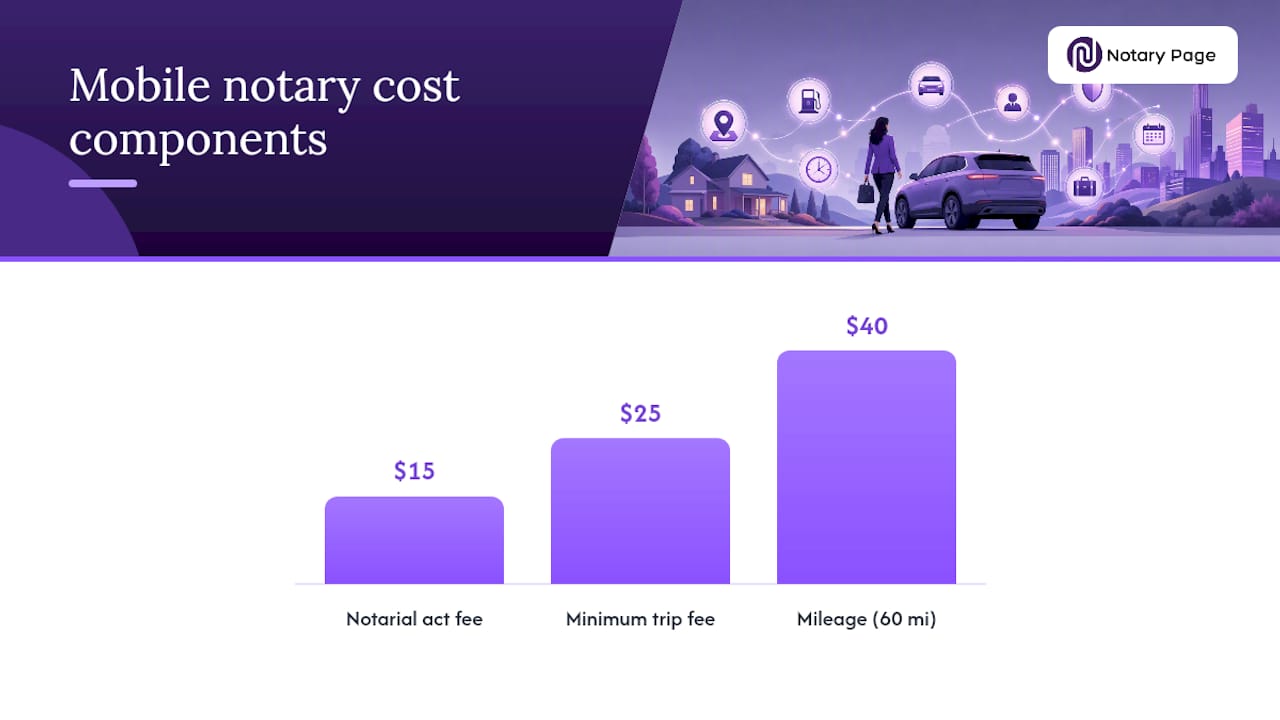
Here’s the math in practice. A short trip of 8 miles round-trip might run a $25 minimum trip fee plus a $15 notarial act fee, landing around $40 total. A long-distance trip of 60 miles round-trip at $0.67 per mile adds roughly $40 in mileage alone, plus a base fee and the act fee, which is exactly how a rural appointment can climb past $100 even with no surcharges involved.
When Do Mobile Notary Fees Run Higher Than Usual?
Certain appointments almost always cost more, and knowing why helps you budget instead of feeling blindsided.
- Hospitals, jails, and hospice visits involve security check-ins, ID verification hurdles, and unpredictable wait times, so notaries commonly add $25 to $75 on top of a standard travel fee for these locations.
- After-hours and weekend appointments frequently carry a premium of 20% to 50% over daytime pricing, since the notary is rearranging personal time to accommodate you.
- Rush or same-day requests can add a flat surcharge, often in the $20 to $50 range, because the notary has to reshuffle an existing schedule.
- Printing, extra ID verification, and I-9 employment verifications are common add-ons that show up as separate line items rather than being folded into the base fee.
- Loan signings carry a higher baseline fee across the board, typically $100 to $175 and sometimes up to $200 for experienced signing agents, because the document package is large, timing is compliance-driven, and errors carry real financial consequences.
How Do You Avoid Surprise Charges When Booking?
Lock in the full price before anyone gets in a car. That’s the entire game.
- Request an itemized quote that separates the state notarial fee, the travel fee, and any anticipated surcharges into distinct line items.
- Get it in writing, even if that’s just a text message or email confirming the total, before the notary leaves for your appointment.
- Confirm the payment method upfront: some notaries require payment before travel, others accept card or digital payment on-site.
- Ask about printing and ID-verification costs specifically, since these are the line items most often left off a verbal quote.
Pro Tip: A notary who won’t give you a number in writing before showing up is the single biggest red flag in this entire process. Legitimate professionals quote first, travel second.
How Nationwide Booking Platforms Handle Notary Pricing
A locally sourced mobile notary can be excellent, but pricing transparency varies wildly from one independent notary to the next. Nationwide platforms tend to standardize what a one-person operation often handles ad hoc.
Notarypage displays itemized quotes before booking is confirmed, breaking out the notarial fee, travel charge, and any known surcharges so you’re not decoding a vague number over the phone. The platform also carries $1,000,000 in errors and omissions coverage through Hiscox, which matters more than most people realize when a document error could affect a real estate closing or an estate plan. The typical flow runs request, itemized quote, booking confirmation, and order tracking, whether you need someone at a hospital bedside or a remote online notarization session from your kitchen table.
Get a Transparent Mobile Notary Quote
You’ve seen how much travel fees vary between a notary who charges $25 flat and one running hourly rates with a two-hour minimum. That inconsistency is exactly what an itemized quote is supposed to fix, and it’s the first thing Notarypage puts in front of you before you commit to anything.

Notarypage runs a nationwide network covering both in-person mobile appointments and remote online notarization, so you’re not limited to whoever happens to be closest. Every quote breaks out the statutory notarial fee separately from travel and any surcharges, and every session is backed by the platform’s $1,000,000 E&O coverage. For anyone juggling a payment dispute with a local notary over undisclosed fees, a platform like BrokerPay offers useful context on how payment friction between service providers tends to get resolved. If you need someone at a hospital, a nursing home, or your own front door this week, request a quote through Notarypage and get the full price in writing before anyone travels.
Where to Verify Mobile Notary Fees Yourself
- NNA’s guide to notary travel fees breaks down the four state policy categories in detail.
- NNA’s notary fees by state table lists statutory maximums for notarial acts.
- IRS standard mileage rates gives the current federal benchmark for travel cost math.
- Pennsylvania’s notary fee page shows how one state documents allowable clerical and travel charges.
Why Pricing Confusion Persists in This Industry
The mobile notary market has a structural transparency problem, and it’s not because notaries are trying to hide anything. Most are solo operators without a booking system, a published fee schedule, or any obligation to standardize how they quote travel. That leaves every phone call as a fresh negotiation, and it means the same appointment can cost $60 with one notary and $140 with another, for reasons that have nothing to do with document complexity.
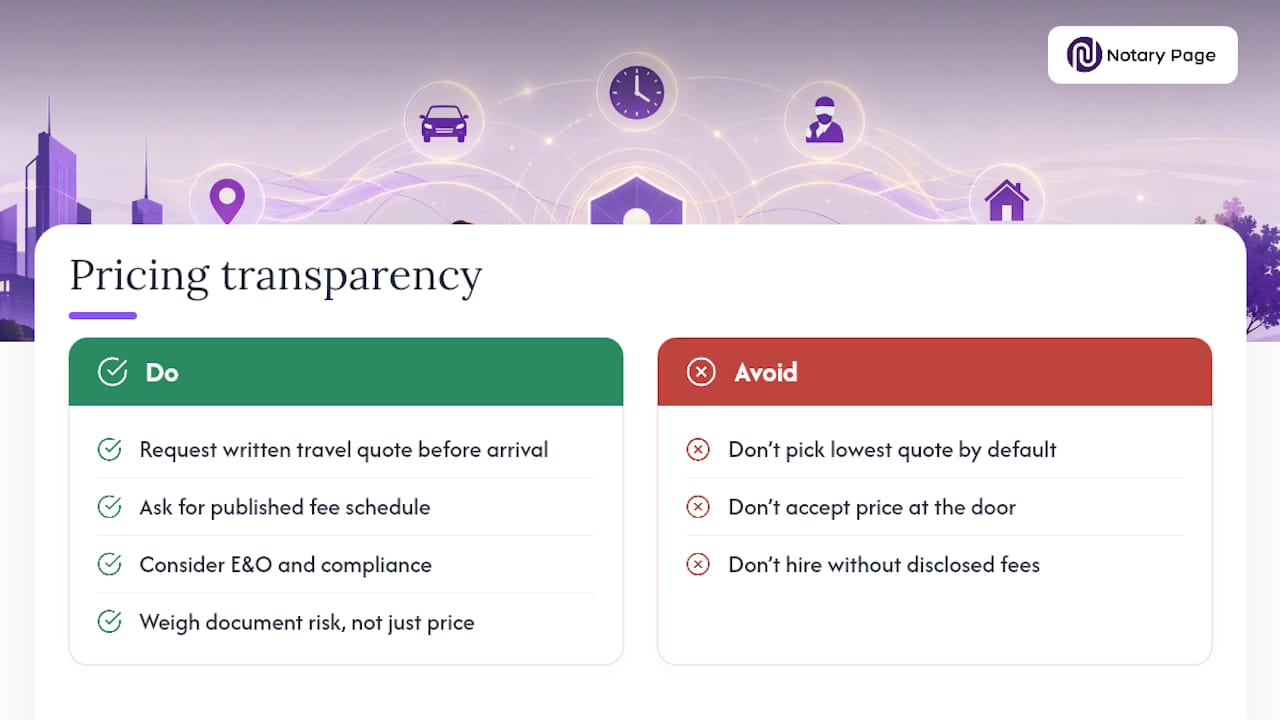
What gets lost in most advice on this topic is that the fix isn’t asking notaries to charge less. It’s asking them to disclose more, before travel, in writing. A notary charging $90 for a 40-mile round trip in a rural area isn’t overcharging. A notary who won’t tell you the number until they’re standing at your door is the actual problem, regardless of what that number turns out to be.
I’d also push back gently on the instinct to chase the cheapest quote by default. A rock-bottom travel fee sometimes signals a notary cutting corners on E&O coverage or compliance knowledge, and for something like a loan signing or a power of attorney, that’s a bad trade for saving $20. Price matters, but it should never be the only variable you’re weighing against a document that has real legal consequences if it’s handled wrong.
— Amy