
Notarized Document Explained: What You Need to Know
Notarized Document Explained: What You Need to Know
What is a notarized document?
A notarized document is one formally authenticated by a state-commissioned notary public who verifies the signer’s identity, confirms they are signing willingly, and records the act officially. The notary then completes a notarial certificate, signs it, and affixes an official seal. That seal serves as prima facie evidence in court of the signature’s authenticity.
The core elements of any notarized document include:
- Notarial certificate: A written statement the notary completes confirming the act performed
- Notary signature and seal: Official proof of the notary’s commission and authority
- Signer identity verification: Confirmed through government-issued photo ID
- Record of the act: Logged in the notary’s official journal, and in some states, a thumbprint is required for added security
The three most common notarial acts are acknowledgments, jurats, and certified copies. An acknowledgment confirms the signer appeared voluntarily before the notary. A jurat requires the signer to swear the document’s contents are true, as in an affidavit. A certified copy attests that a copy matches the original exactly.
Why does notarization matter legally?

Notarization is one of the most reliable fraud deterrents in the American legal system. A notary acts as a neutral third party who checks identity, willingness, and mental competency before witnessing a signature. That neutrality is what gives notarized documents their legal weight.
Certain documents legally require notarization:
- Real property deeds: Transfers of real estate almost universally require notarized signatures
- Powers of attorney: Courts and financial institutions demand notarization to prevent abuse
- Wills and trusts: Notarization strengthens validity and reduces the risk of contested probate
- Affidavits: Sworn statements must be notarized to carry evidentiary weight
Beyond legal requirements, notarization transforms private documents into verifiable public records that courts and institutions trust. It reduces the risk of coercion, identity theft, and outright forgery. One important limitation: notaries do not verify the legal accuracy of a document’s content or provide legal advice. They certify only that the right person signed willingly.
How do you get a document notarized in the United States?
The process is straightforward, but a few missteps can force you to start over. Here is what to bring and what to expect.
What you need:
- A valid, current government-issued photo ID (driver’s license, passport, or state ID)
- The document, unsigned
- Any required witnesses, depending on the document type and state
The single most common mistake is signing the document before you meet the notary. Notaries refuse pre-signed documents because they can only certify signatures made in their presence. Bring a blank signature line and sign only when the notary instructs you.
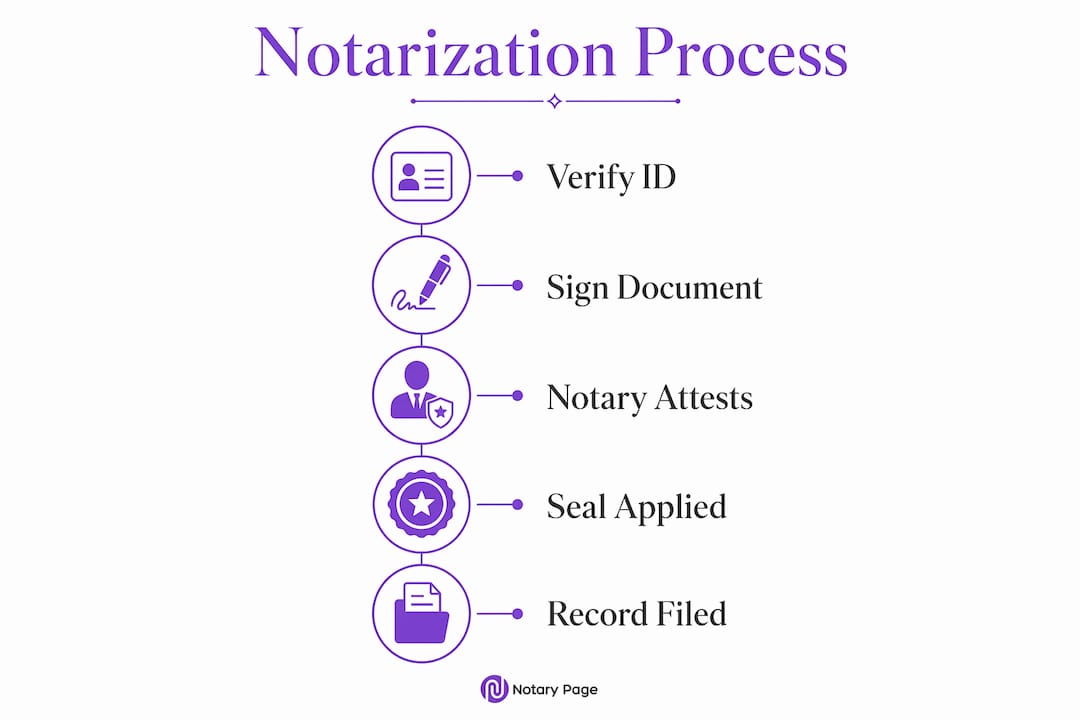
Once you arrive, the notary will check your ID, watch you sign, complete the notarial certificate, and apply the official seal. The whole appointment is generally brief for a standard document.
Where to find a notary:
- Banks and credit unions (often free for account holders)
- Public libraries
- Shipping and postal stores like UPS or FedEx locations
- Online platforms offering remote notarization
Fees for in-person notarization are capped by state law. Many banks offer the service free to account holders, while independent notaries charge a per-signature fee set by their state. Call ahead to confirm availability, since not every branch or location keeps a notary on staff at all times.
Pro Tip: Bring a second form of ID if your primary ID is expired or about to expire. Notaries can and do turn away signers whose identification does not meet state requirements.
What are your options for online and mobile notarization?
Technology has made notarization far more accessible than it was a decade ago. Two alternatives to the traditional in-person appointment now cover most situations.
Mobile notaries travel to your location, whether that is your home, office, or hospital room. They are especially useful for real estate closings, where multiple parties need to sign in one place, or for signers who cannot travel. Mobile notaries typically charge a travel fee on top of the standard per-signature rate.
Remote online notarization (RON) takes the process entirely digital. The signer and notary connect via video call, identity is verified through knowledge-based authentication and credential analysis, and the notary applies a digital seal. RON is available in over 45 states as of 2026, though the specific rules vary by state.
Key considerations before going the online route:
- Recipient acceptance: Not every institution accepts electronically notarized documents. Confirm with the receiving party before scheduling
- Document eligibility: Certain documents, including some wills and real estate instruments, may be excluded from RON depending on the state
- Higher fees: Online and mobile options usually cost more than a standard in-person appointment due to technology platform charges or travel costs
- State-specific rules: Some states impose additional requirements on RON platforms, such as specific software standards or audio-visual recording retention periods
Notarypage connects you with certified notaries for in-person, mobile, and remote appointments nationwide, backed by $1,000,000 in errors and omissions coverage through Hiscox. Whether you need a deed notarized at a closing table or a power of attorney signed from your living room, the platform routes you to a qualified professional without the usual phone-tag and scheduling friction.
Key Takeaways
A notarized document is legally authenticated by a state-commissioned notary public who verifies identity and willing consent, making it a trusted record in courts and institutions across the United States.
| Point | Details |
|---|---|
| Core function of notarization | A notary verifies identity and willing consent, then seals the document as prima facie court evidence. |
| Never pre-sign | Signing before the notary witnesses it will get your document rejected; always sign in the notary’s presence. |
| Common document types | Deeds, powers of attorney, wills, trusts, and affidavits most often require notarization by law. |
| RON availability | Remote online notarization is available in over 45 states as of 2026, but recipient acceptance varies. |
| Notary limitations | Notaries certify signatures only; they do not verify legal content or provide legal advice. |