
Notary Public vs Commissioner of Oaths: 2026 Guide
Notary Public vs Commissioner of Oaths: 2026 Guide
A notary public is a state-commissioned official with broader legal authority than a commissioner of oaths, including the power to notarize documents for international use and apply an official seal. The notary public vs commissioner of oaths distinction matters most when your document crosses borders, requires certified copies, or must meet court standards. Both roles involve identity verification and witnessing signatures, but their scope, tools, and legal reach differ significantly. The National Notary Association recognizes notaries as state-appointed officials, while commissioners of oaths operate under narrower, often provincial or local authority. Choosing the wrong official can invalidate your document entirely.
What are the primary duties of a notary public?
A notary public performs a defined set of notarial acts with specific legal implications, including acknowledgments, jurats, oaths, affirmations, copy certifications, and signature witnessing. Each act carries procedural requirements. An acknowledgment confirms that a signer voluntarily executed a document. A jurat requires the signer to swear or affirm the truthfulness of the document’s contents under oath.
Notaries verify identity using government-issued photo ID, confirm the signer’s mental competence, and witness the signature in person. They then apply an official seal containing their name, commission number, and commission expiration date. That seal is legally required for many notarizations and for documents used internationally. Without it, foreign governments and institutions may reject the document outright.

Notaries also certify true copies of original documents. This requires physically inspecting the original, making a copy, and attaching a certificate confirming the copy’s accuracy. Commissioners of oaths cannot perform this function.
The commissioning process itself involves meeting eligibility criteria set by state authority. Requirements typically include minimum age, state residency, and a clean criminal record. Some states require an exam or training course before issuing a commission. Commission terms commonly run four years, and fees range between $11 and $60 depending on the jurisdiction.
Key notary public functions include:
- Verifying signer identity with government-issued photo ID
- Administering oaths and affirmations
- Witnessing and authenticating signatures on legal documents
- Certifying true copies of original documents
- Applying an official seal with commission details
- Notarizing documents intended for international use
- Completing acknowledgments and jurats for real estate, financial, and legal transactions
Pro Tip: Always confirm your notary’s commission expiration date before signing. An expired commission invalidates the notarization, and some institutions will reject documents without checking, creating problems months later.
What are the roles and limitations of a commissioner of oaths?
A commissioner of oaths is authorized to administer oaths and affirmations and to witness signatures on affidavits and statutory declarations. Their authority is narrower than a notary’s and is typically limited to local or provincial documents. They do not use an official notary seal, and their authentication carries no weight for international documents.
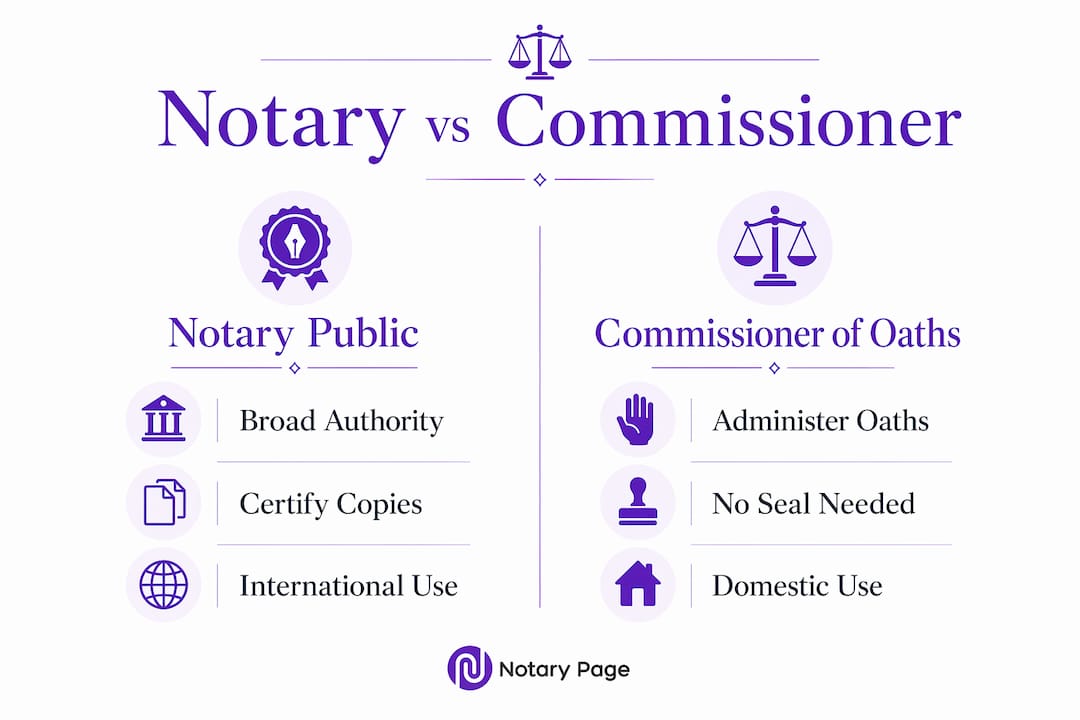
Commissioners cannot certify true copies or handle documents that require a notary’s seal for legal effect. This is the most misunderstood limitation. Many people assume a commissioner can substitute for a notary on any document. That assumption leads to rejected filings and wasted time.
Common settings where commissioners of oaths operate include courts, government agencies, and public service offices. Documents they typically handle include:
- Affidavits for court proceedings
- Statutory declarations for government filings
- Sworn statements for insurance or employment purposes
- Declarations of identity or marital status for local use
- Internal business affidavits that do not require notarization
Commissioners do not need to apply a seal, but they must sign the document and include their title and jurisdiction. Their role is to confirm that the person swearing or declaring did so voluntarily and understood the content. That confirmation carries legal weight within the jurisdiction where the commissioner is authorized.
The commissioner of oaths role is not lesser in importance. For domestic affidavits and declarations, a commissioner is fully sufficient and often easier to access than a notary. The problem arises only when someone uses a commissioner for a task that legally requires a notary.
How do the processes of notarization and commissioning compare?
Both processes begin the same way. The official verifies the signer’s identity using a government-issued photo ID, confirms mental competence and willingness to sign, and witnesses the signature. These steps are standard for both roles as of 2026. The procedural paths diverge after that point.
A notary completes the act by applying an official seal and completing a notarial certificate. The certificate specifies the type of notarial act performed, the date, and the notary’s commission details. For copy certifications, the notary must physically inspect the original document before certifying the copy. No remote substitute exists for this step.
A commissioner of oaths signs and dates the document and adds their title and jurisdiction. No seal is required. The process is faster and involves less paperwork, which is why commissioners are common in high-volume settings like courts and government offices.
Remote options differ sharply between the two roles. Remote commissioning of affidavits may be permitted under specific regulations if conducted through secure electronic platforms with real-time interaction. Remote notarization requiring physical document inspection and sealing remains prohibited in several jurisdictions, including Ontario, as of 2026. That distinction matters for professionals handling documents across provincial or state lines.
| Feature | Notary public | Commissioner of oaths |
|---|---|---|
| Identity verification | Required (photo ID) | Required (photo ID) |
| Official seal | Required | Not required |
| Certifies true copies | Yes | No |
| Remote options | Limited by jurisdiction | Permitted under specific rules |
| Administers oaths | Yes | Yes |
| Legal scope | State-wide, international | Local or provincial |
Pro Tip: If your document will be used outside the country, always use a notary public. A commissioner’s signature will not satisfy foreign authentication requirements, even if the document is otherwise valid domestically.
When should you choose a notary public vs a commissioner of oaths?
The right choice depends entirely on where the document will be used and what it needs to accomplish. Using the wrong official does not just delay your filing. It can void the document’s legal effect entirely.
Choose a notary public when:
- The document will be used internationally. Passports, adoption papers, business contracts for foreign entities, and immigration documents all require notarization. A commissioner’s signature will not satisfy foreign government requirements.
- You need certified true copies. Academic transcripts, birth certificates, and financial records often need certified copies for legal proceedings or foreign applications. Only a notary can produce a legally valid certified copy.
- The document involves real estate. Deeds, mortgage documents, and title transfers require notarization in most U.S. states. Real estate closings are one of the most common uses of notary public services.
- The document requires an official seal. Any filing that specifies “notarized” or “notary seal required” needs a notary public. A commissioner cannot fulfill this requirement.
- You are dealing with financial or estate planning documents. Powers of attorney, wills, and trust documents often require notarization to be legally enforceable.
Choose a commissioner of oaths when:
- The document is an affidavit for local court use. Sworn statements for domestic court proceedings typically require only a commissioner’s witness.
- You are filing a statutory declaration with a government agency. Many government forms require a sworn declaration, not a full notarization.
- Speed and accessibility matter more than international validity. Commissioners are often more widely available and faster to access for routine domestic documents.
Both roles are prohibited from practicing law, giving legal advice, or drafting documents. Their function is strictly witnessing and authentication. If a notary or commissioner offers to explain what a document means or advises you on whether to sign, that crosses into unauthorized practice of law.
Key Takeaways
A notary public holds broader legal authority than a commissioner of oaths, making the right choice between them critical for any document intended for international use, certified copy requests, or real estate transactions.
| Point | Details |
|---|---|
| Notary vs commissioner scope | Notaries handle international documents and certified copies; commissioners are limited to local oaths and affidavits. |
| Official seal requirement | Only notaries use an official seal, which is legally required for many notarizations and all international documents. |
| Remote options differ | Remote commissioning is permitted under specific rules; remote notarization requiring physical inspection is often prohibited. |
| Both roles have hard limits | Neither notaries nor commissioners may give legal advice, draft documents, or practice law in any form. |
| Match the official to the document | Using a commissioner for a task requiring a notary can void the document’s legal effect entirely. |
The confusion that costs people more than they expect
The most common mistake I see is treating these two roles as interchangeable. People assume that any official who witnesses a signature will satisfy any legal requirement. That assumption is wrong, and it tends to surface at the worst possible moment, like when a foreign embassy rejects a document the day before a visa appointment.
What surprises most professionals is how jurisdiction-specific these roles are. A commissioner of oaths authorized in one province may have no standing in another. A notary commissioned in one U.S. state cannot notarize documents in another state. These are not technicalities. They are the legal foundation of the entire authentication system.
The growing availability of remote commissioning is genuinely useful for routine affidavits. But it has also created a false sense that all document authentication can now happen online. Physical inspection for certified copies and sealed notarizations still requires in-person presence in most jurisdictions. Professionals who skip that step because remote options exist elsewhere end up with documents that fail legal review.
My strongest advice: read the document’s requirements before you book an appointment. If it says “notarized,” it means a notary with a seal. If it says “sworn before a commissioner,” a commissioner is sufficient. That five-minute check prevents hours of rework.
— Amy
Notarypage connects you to the right official, fast
Finding a qualified notary public or commissioner of oaths used to mean calling around, checking hours, and hoping someone was available. Notarypage removes that friction entirely.
Notarypage operates a nationwide network of certified notary professionals covering real estate closings, estate planning, and general notary work. The platform offers both in-person and remote notarization options, so you can get documents handled at home or on a video call when your jurisdiction permits it. Every notary on the platform is vetted, and the service carries $1,000,000 in errors and omissions coverage through Hiscox. Whether you need a quick affidavit witnessed or a full real estate closing notarized, find a notary through Notarypage and get it done correctly the first time.
FAQ
What is the main difference between a notary public and a commissioner of oaths?
A notary public has broader authority, including the power to certify true copies and notarize documents for international use with an official seal. A commissioner of oaths is limited to administering oaths and witnessing signatures on local or provincial documents.
Can a commissioner of oaths certify a true copy of a document?
No. Certifying true copies requires a notary public who physically inspects the original document and applies an official seal. A commissioner of oaths does not have this authority.
Is remote notarization available in 2026?
Remote commissioning of affidavits is permitted under specific electronic platform rules in some jurisdictions. Remote notarization requiring physical document inspection and sealing remains prohibited in several jurisdictions, including Ontario, as of 2026.
Can a notary public give legal advice?
No. Both notaries public and commissioners of oaths are prohibited from practicing law, giving legal advice, or drafting documents. Their role is strictly witnessing and authentication.
How long is a notary public commission valid?
Notary public commissions commonly run four years, though term lengths vary by state. Notaries must meet eligibility requirements including age, residency, and a clean criminal record, and some states require an exam before commissioning.