
Notary Services for Beneficiary Designation Documents
Notary Services for Beneficiary Designation Documents
Whether your beneficiary designation form needs notarization depends entirely on your plan or provider’s rules. If the plan requires it, the form is void without it — and the prior designation stays in effect. Check your plan administrator’s written instructions first, then get the form notarized before you submit it. Notarypage connects you with a certified notary for in-person, mobile, or remote appointments nationwide, and every booking carries $1,000,000 in E&O coverage through Hiscox.
Two facts worth knowing before you do anything else: some plans require notarization only when you submit a paper form, and allow online portal submissions to skip it entirely. And a beneficiary designation form on file with the institution controls who gets the money — overriding anything your will says.
Table of Contents
- Which accounts commonly use beneficiary designation forms?
- Do beneficiary designation forms legally require notarization?
- How to get a beneficiary designation form properly notarized
- Where can you get beneficiary designation forms notarized?
- What does notarizing a beneficiary form cost, and how long does it take?
- Common mistakes that invalidate beneficiary designation updates
- Quick checklist: what to bring and what to confirm before you leave
- How do you verify a notary’s credentials before you hire them?
- Key Takeaways
- Why professional notarization matters more than people think
- Ready to notarize your beneficiary designation form?
- Authoritative sources and where to check custodian rules
Which accounts commonly use beneficiary designation forms?
Beneficiary designations show up across more account types than most people realize. If you hold any of the following, you likely have at least one form on file that may require notarization when you update it:
- 401(k) and pension plans — employer-sponsored retirement accounts governed by ERISA; spousal consent and notarization are often required when naming a non-spouse beneficiary
- IRAs (Traditional and Roth) — held at banks, brokerages, or credit unions; notarization requirements vary by custodian
- Life insurance policies — notarization is less common but some insurers require it for paper change requests
- Annuities — similar to life insurance; check the contract and the provider’s form instructions
- Payable-on-death (POD) bank accounts — typically set at account opening; updates may require branch notarization
- Transfer-on-death (TOD) brokerage accounts — governed by state law and brokerage rules; some require notarized forms for changes
- Employer benefit plans — group life, disability, or pension supplements may have their own required forms
Why does this matter so much? A properly executed beneficiary designation bypasses probate entirely and pays directly to the named person, regardless of what your will says. That speed and certainty is the whole point — but only if the form was completed correctly and accepted by the plan before your death. If you’re also reviewing life insurance or annuity coverage alongside your beneficiary designations, it’s worth confirming both the policy terms and the form requirements at the same time.
Do beneficiary designation forms legally require notarization?
Not always — but when they do, there is no workaround. Some funds and plans explicitly require that the form be signed, notarized, and filed with the plan before a change is effective. Without notarization, the form may be rejected outright, and the prior designation remains controlling.
The most common scenario where notarization is mandatory: you are married and want to name someone other than your spouse as the primary beneficiary. TIAA’s beneficiary designation form, for example, requires a notary public or plan representative to witness the spouse’s signature on the consent section. That requirement comes directly from ERISA and some state community property laws — it is not optional.
Other plans require notarization only on paper submissions and waive it when you update through their online portal. Always confirm which submission method your plan accepts before you book a notary.
One misconception worth addressing directly: a will does not override a beneficiary designation. Only the most recent designation that is completed, signed, notarized (if required), and received by the plan before the account holder’s death controls the distribution. A notarized deposit instruction or other paperwork sent to a joint bank account will not override an older beneficiary designation on a retirement account. The form type matters as much as the notarization.
After filing any change, request written confirmation from the plan administrator. Do not assume the update is effective until you have it in writing.
How to get a beneficiary designation form properly notarized
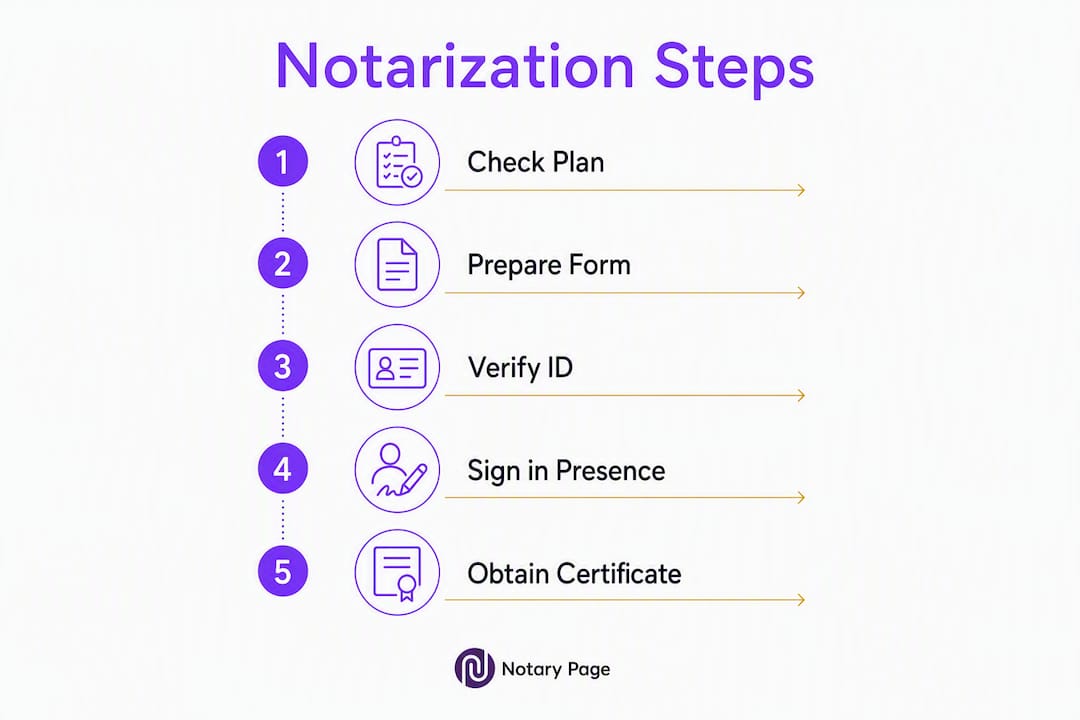
Follow this sequence to avoid the most common rejection reasons:
- Confirm requirements with the plan. Call or log into the plan portal and ask: Does this form require notarization? Do you accept remote online notarization (RON)? Do you need the original mailed, or will a scanned upload work?
- Get the correct form. Use only the plan’s official beneficiary-change form. A generic notarized letter or a deposit instruction will not substitute for it.
- Complete the form — but do not sign it yet. Fill in every field: full legal name, Social Security Number, date of birth, address, relationship to you, and the percentage allocated to each beneficiary. Leave the signature line blank.
- Gather what you need to bring. Government-issued photo ID (driver’s license or passport), the unsigned completed form, your account or policy number, and any spousal-consent form if required. If the plan requires a witness, arrange that person to attend.
- Sign in the notary’s presence. The notary will verify your identity, watch you sign, and complete the notarial certificate — either an acknowledgment or a jurat, depending on the form’s language. They will then affix their seal and commission number.
- Verify every page before you leave. Confirm the notary signed and stamped every page that requires it, all dates are correct, and you have a copy for your records.
- File the notarized form with the plan administrator. Submit by the method the plan requires — original by mail, certified mail, or electronic upload — and request a written confirmation or receipt.
Pro Tip: Never pre-sign a beneficiary form at home. A signature made outside the notary’s presence invalidates the notarization, and the plan will reject the form. Bring the form blank and sign only when the notary instructs you to.
What the notary actually does
The notary verifies your identity against your photo ID, witnesses your signature, and completes a notarial certificate. For most beneficiary forms, this is an acknowledgment (you declare you signed voluntarily) rather than a jurat (you swear the contents are true). The certificate includes the notary’s commission number, expiration date, and official seal. It does not validate the accuracy of the information you wrote — that is your responsibility.

Where can you get beneficiary designation forms notarized?
You have several realistic options, each with trade-offs:
Bank branch notaries are free or low-cost and convenient if you already bank there. The downside: they may be unfamiliar with estate-related forms, and availability is limited to branch hours. Some branches have eliminated notary services entirely.

Public libraries and municipal centers often offer free or low-cost notary services and list beneficiary designations among the documents they handle. Availability varies by location and appointment scheduling can take a few days.
Mobile in-person notaries travel to your home, office, or care facility. They typically charge a travel fee on top of the standard per-signature fee, but the convenience is hard to beat when you are managing multiple estate documents at once. Many mobile notaries specialize in estate and real estate work and are comfortable with complex forms.
Remote online notarization (RON) lets you complete the appointment over a video call. The notary verifies your identity through knowledge-based authentication and credential analysis, witnesses your electronic signature, and applies a digital seal. RON is legal in most U.S. states, but acceptance by the plan custodian is not guaranteed — confirm before you book. TIAA, for instance, has directed participants to a third-party RON vendor for spousal-consent notarizations.
Notarypage brings all three options together in one booking. You can search for a mobile notary near you or schedule a RON appointment, with order tracking and documentation built into the platform.
When the document affects estate planning, prefer a notary who has handled beneficiary or estate forms before. Ask directly. A notary who has never seen a TIAA spousal-consent section or an ERISA-governed pension form may miss a required field.
What does notarizing a beneficiary form cost, and how long does it take?
Costs and timelines vary more than most people expect:
- Bank branch notary: Often free for account holders; no appointment premium
- Library or public notary: Free to a few dollars per signature in most jurisdictions
- Mobile notary: State-set per-signature fee (often a state-set per-signature fee plus a travel fee that varies by distance and time of day
- RON session: Usually $25–$50 per session through a third-party platform; some plans direct you to a specific vendor
Processing time after you submit the notarized form is a separate question. Online portal updates at some custodians take effect quickly. Paper submissions to pension plans or ERISA-governed funds may take several days to weeks to process and confirm. A few plans hold the change in pending status until they verify the notarization and all required fields.
Ask the plan administrator two things before you submit: what proof do they need to accept the change (original wet-ink form by certified mail, or will a scanned PDF upload work?), and how will they confirm the update is on file?
Common mistakes that invalidate beneficiary designation updates
Most rejections trace back to a handful of avoidable errors:
Signing before the notary. This is the single most common reason a notarized form gets rejected. The notary must witness the signature. A pre-signed form cannot be retroactively notarized.
Incomplete fields. Missing Social Security Numbers, dates of birth, or percentage allocations cause delays or outright rejections. Plans need complete beneficiary information to locate and pay the right person.
Name mismatches. The beneficiary’s name on the form must match their legal name exactly. A nickname or maiden name creates ambiguity that can delay or complicate a claim.
Using the wrong form. A generic notarized letter, a deposit instruction, or an old version of the plan’s form will not substitute for the current official beneficiary-change form. A notarized deposit instruction will not override an existing beneficiary designation — the form type is what matters.
Missing spousal-consent section. If you are married and naming a non-spouse beneficiary, the spousal-consent section must be completed in front of a notary or plan representative. Skipping it voids the designation for ERISA plans.
Expired or out-of-state notary commission. A notarization performed by a notary whose commission has expired, or who is not commissioned in the state where the signing occurred, is legally defective.
If a form is rejected, contact the plan administrator immediately to find out exactly what was missing. Get the correct current form, correct the errors, re-notarize if required, and resubmit. Some plans will ask for an affidavit explaining the correction.
Quick checklist: what to bring and what to confirm before you leave
Before the appointment — bring:
- Original completed form (unsigned)
- Government-issued photo ID (driver’s license or passport)
- Account or policy number
- Spousal-consent form, if required by the plan
- Witness contact information, if the form requires a witness in addition to the notary
At the appointment — confirm before you leave:
- Notary signed, dated, and stamped every page that requires it
- Your signature and date match what the notary recorded
- All beneficiary fields are complete (name, SSN, DOB, relationship, percentage)
- You have a copy of the fully executed form
- You know exactly how and where to file the original with the plan
Questions to ask before you finish:
- “Will you notarize this exact form?” (Some notaries decline unfamiliar estate forms.)
- “Does the plan accept RON, or do they require wet-ink?” (Confirm with the custodian, not the notary.)
- “Do you need the original mailed, or is an electronic upload sufficient?”
- “Can you provide a signed receipt or confirmation of notarization?”
How do you verify a notary’s credentials before you hire them?
A defective notarization can revert your assets to an older designation or send them to your estate through probate. Vetting the notary takes five minutes and prevents that outcome.
Check the commission. Every state maintains a public registry of commissioned notaries. Ask the notary for their commission number and expiration date, then verify it against your state’s notary public database. An expired commission means the notarization is invalid.
Confirm E&O coverage. Errors and Omissions insurance protects you if the notary makes a procedural mistake that causes financial harm. Not all notaries carry it. Ask for proof of coverage before the appointment.
Verify RON authority. If you plan to use remote online notarization, confirm the notary is authorized to perform RON in your state. RON authorization is separate from a standard notary commission in most states.
Ask about estate document experience. A notary who regularly handles beneficiary forms, trust documents, and ERISA-governed pension paperwork will recognize the spousal-consent section, the correct certificate language, and any plan-specific requirements. That experience reduces the chance of a procedural error that triggers rejection.
Notarypage vets every notary on its platform for active commission status and carries $1,000,000 in E&O coverage through Hiscox — so you are not doing this credential check yourself from scratch.
Key Takeaways
Notarization of a beneficiary designation form is required only when the plan or custodian mandates it — but when it is required, a missing notarization voids the change and leaves the prior designation in force.
| Point | Details |
|---|---|
| Notarization is plan-dependent | Check the plan administrator’s written instructions first; online portal submissions often skip notarization entirely. |
| Designation overrides your will | A properly executed and accepted beneficiary form controls distribution, regardless of what your will states. |
| Sign only in front of the notary | Pre-signing at home invalidates the notarization; bring the form blank and sign when instructed. |
| Verify commission and E&O | Confirm the notary’s commission is active, check E&O coverage, and verify RON authority before a remote appointment. |
| Notarypage for estate documents | Notarypage offers in-person, mobile, and RON options nationwide with $1,000,000 E&O coverage through Hiscox. |
Why professional notarization matters more than people think
Most people treat notarization as a bureaucratic checkbox. For beneficiary designation documents, that attitude is genuinely dangerous. The stakes are not abstract: if the form is rejected because of a defective notarization, the assets go to whoever was named last — which could be an ex-spouse, a deceased parent, or your estate itself, triggering probate.
What practitioners see repeatedly is not fraud or negligence. It is small procedural errors: a pre-signed form, a notary whose commission expired two months earlier, a spousal-consent section left blank because nobody explained it was required. These are fixable mistakes — but only before the account holder dies. After that, the plan honors whatever is on file.
The other underappreciated risk is the will-versus-designation confusion. Families spend money on estate attorneys drafting careful wills, then discover that the 401(k) — often the largest asset — goes somewhere else entirely because the beneficiary form was never updated after a divorce or remarriage. A professional notary experienced with estate documents will not catch that strategic error, but they will catch the procedural ones. And catching procedural errors is exactly what the notarization process is designed to do.
Using a vetted platform with documented E&O coverage also creates a paper trail. When a plan administrator questions whether a notarization was properly performed, you have a timestamped record of the appointment, the notary’s credentials, and the completed certificate. That documentation resolves disputes faster than anything else.
Ready to notarize your beneficiary designation form?
When your estate planning depends on a form being executed correctly, the notary you choose matters. Notarypage gives you access to a nationwide network of certified notaries for in-person, mobile, and remote online notarization — so you can get your beneficiary designation form notarized at home, at the office, or over a video call, whichever the plan accepts.
Every booking through Notarypage is backed by $1,000,000 in E&O coverage through Hiscox. The platform handles scheduling, order tracking, and documentation so you have a clear record to present to the plan administrator when you file. Before booking a RON session, confirm with your custodian that they accept remote notarization — then book your appointment and bring the unsigned form, your photo ID, and your account number. That is all you need to get started.
Authoritative sources and where to check custodian rules
Always start with your plan administrator’s written instructions — they are the controlling authority on whether notarization is required for your specific account. From there, your state’s notary public office can confirm commission status and RON authorization rules.
| Source | What it covers | Why consult it |
|---|---|---|
| LABF Beneficiary Designation Form | Pension fund form requirements, notarization rules | Shows when notarization is explicitly required by a fund |
| Harrisburg NC 401(k) Beneficiary Form Instructions | Plan-specific notarization and online submission rules | Illustrates how online portals can waive notarization |
| Pierce Law: Beneficiary Designation Q&A | Whether notarized deposit instructions override designations | Clarifies a common and costly misconception |
| LegalClarity: How to Set Up a Beneficiary | General beneficiary designation process and probate bypass | Background on why designations override wills |
| Nashville Public Library Notary Service | Free/low-cost public notary options | Reference for low-cost notarization alternatives |
After you file a notarized beneficiary change, request written acknowledgment from the plan custodian and keep a copy of the executed form. That confirmation is your proof the change is on file and effective.