
Avoid Surprise Bills: U.S. Notary Signing Agent Fees $50 to $200
Avoid Surprise Bills: U.S. Notary Signing Agent Fees $50 to $200
A standard mobile notary signing typically runs $50 to $100 for one to three signatures, while a full loan signing appointment often lands between $75 and $200. Remote online notarization sessions usually total $25 to $75. The final number always comes down to three things: the state-capped notarial act fee, travel or time charges, and any platform, printing, or technology fees layered on top. State caps almost never touch those last two.
TL;DR:
- Notarial act fees are regulated by state law; all other charges like travel, printing, and platform fees are set by the notary or platform.
- Loan signings typically cost between $75 and $200, while remote notarizations range from $25 to $75, with higher fees for after-hours or special requests.
- State fee caps apply only to the notarial act itself and vary widely, with California capping at $15 and Pennsylvania at $5 per act.
- The total cost depends on the number of signatures, travel distance, document complexity, and any rush or after-hours surcharges, often leading to wide quotes.
- Asking for an itemized, total upfront quote before booking helps avoid surprises and enables better cost comparison across providers.
Table of Contents
- What Does a Notary Signing Agent Fee Actually Cover?
- How Much Do Notaries Charge for Different Services?
- How Do State Fee Caps on Notary Services Work?
- How Do You Calculate Your Total Notary Cost?
- What Should You Ask Before Booking a Signing?
- Why Booking Through a Marketplace Reduces Pricing Surprises
- A Notary Broker’s Honest Take on What Drives the Price
- How to Book a Notary Signing With Clear, Upfront Pricing
- Sources
What Does a Notary Signing Agent Fee Actually Cover?
A quoted price is rarely one charge. It’s a stack of smaller fees, and knowing what each one represents is the fastest way to compare two quotes that look nothing alike on paper.
The notarial act fee is the only piece regulated by state law. It’s the amount charged per signature, seal, or acknowledgment, and every state sets its own maximum. Everything else, the appointment or flat signing fee, the travel or convenience fee, and time on site, is set by the notary or the platform dispatching them.
Here’s how a typical invoice breaks down:
- Notarial act fee: the state-capped charge per signature or seal
- Travel/convenience fee: mileage or a flat rate for coming to you, unregulated in nearly every state
- Time on site fee: covers document review, waiting for signers, and administrative handling
- Printing and scan-back fee: charged when the notary prints your package or scans signed documents back to a title company or lender
- After-hours, rush, or special-location surcharge: applies to evenings, weekends, hospitals, jails, or same-day requests
- Platform or technology fee: covers identity verification, video session hosting, and audit-trail storage for remote online notarization
None of these line items are hidden by law. They’re just rarely explained before a signer books an appointment, which is exactly why quotes vary so widely from one notary to the next.
How Much Do Notaries Charge for Different Services?
Mobile notary visits, loan signings, and remote sessions each carry their own pricing logic, and knowing which bucket your document falls into tells you what a fair quote looks like.
Mobile in-person visits for a handful of signatures, a power of attorney or a single affidavit, typically total $50 to $100. That figure usually combines a $25 to $75 travel fee with the state’s capped per-act charge.
Loan signings cost more because the document package is larger and the liability is higher. Flat fees commonly run $75 to $200 per appointment, with direct assignments from title companies usually landing at the higher end ($125 to $200) and dispatched signing-service offers often coming in lower ($75 to $125).
Remote online notarization (RON) sessions usually total $25 to $75, built from the state’s per-act cap plus a platform fee of roughly $5 to $30 and witness fees around $10 each when a session needs additional participants.
Fee snapshot: Industry reporting in 2026 puts working signing-agent rates around $75 to $175 for many assignments, with fee compression pushing some refinance offers as low as $75 in competitive metro markets. That spread is exactly why two quotes for the same job can differ by $100 or more.
Fees spike hard in a few predictable situations: hospital and jail signings, same-day or after-hours requests, reverse mortgage packages (which run longer and require extra explanation time), and remote locations that add significant drive time. Any of these can push a $75 job north of $150 fast.
How Do State Fee Caps on Notary Services Work?
State caps regulate one thing only: the fee charged for the notarial act itself, meaning each stamp, seal, or acknowledgment. They do not touch travel charges, printing fees, appointment fees, or technology fees, which is the single most common source of confusion when people compare quotes.
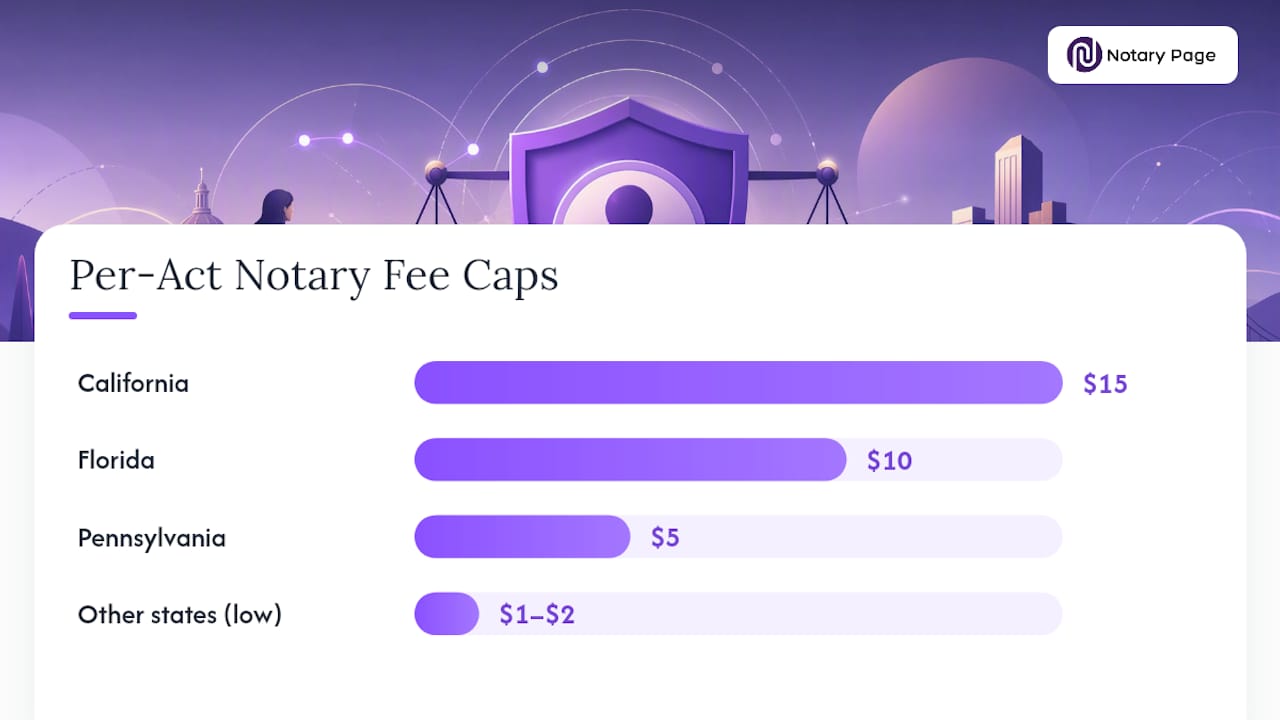
Cap amounts vary sharply by state. California caps the notarial act at $15, Florida at $10, and Pennsylvania at $5, with several other states setting maximums as low as $1 or $2 per act. Because these figures change and vary by act type, check your state’s Secretary of State website for the exact current cap rather than relying on a number from an old blog post.
If you suspect you were overcharged for the notarial act specifically, request an itemized receipt first. The Secretary of State’s office (or equivalent commissioning authority) typically handles complaints about notaries exceeding the statutory cap on the act itself, though it has no authority over travel or convenience pricing.
How Do You Calculate Your Total Notary Cost?
Most of the confusion around notary pricing disappears once you have a formula to run the numbers yourself:
- Start with the per-act fee (state cap) multiplied by the number of signatures or seals needed.
- Add the travel or convenience fee for in-person visits.
- Add any time-on-site fee for lengthy document reviews or waiting periods.
- Add printing and scan-back costs if the notary handles your paperwork.
- Add platform or technology fees for RON sessions.
- Add any applicable surcharge for after-hours, rush, or special-location requests.
Worked example A: a 100-page refinance package, in-person, two signers, one notarial act each. State cap of $10 per act ($20 total) plus a $50 travel fee, $25 for printing the closing package, and no rush surcharge scheduled during business hours. Total: roughly $95.
Worked example B: a two-signature RON session. State per-act cap of $10 ($20 total), a $20 platform fee, and one witness fee at $10. Total: roughly $50, squarely inside the $25 to $75 range typical for remote sessions.
Three habits keep costs down: combine multiple documents into a single appointment whenever possible, schedule during standard business hours to avoid after-hours premiums that commonly run 1.5 to 2 times the base rate, and confirm upfront whether printing is included or billed separately.
What Should You Ask Before Booking a Signing?
A five-minute conversation before you book prevents almost every billing surprise that shows up after the fact.
Ask for the total price, not just the notarial act fee, and get it itemized: travel, time, printing, and any technology charge listed separately. Confirm the number of notarial acts included in that quote, since packages with multiple signers or multiple documents can carry more acts than you expect. Ask about the printing and scan-back policy, whether there’s a no-show or no-sign fee, and whether the notary or platform carries E&O (errors and omissions) coverage, since that protects you if a mistake in the notarization causes a problem later.
Watch for these red flags:
- A quote that’s a single round number with no breakdown
- Refusal to provide an itemized receipt after service
- An offer noticeably below the $75 to $175 range typical for comparable work, which often signals corners will be cut
- No written cancellation or no-show policy stated before the appointment
Pro Tip: Take a photo or screenshot of your itemized quote before the appointment. If the final invoice doesn’t match, you have a clean paper trail for a dispute.
Why Booking Through a Marketplace Reduces Pricing Surprises
The biggest source of notary billing disputes isn’t overcharging. It’s ambiguity: a signer who never saw a real total before the notary showed up.
Notarypage addresses that directly by combining in-person mobile notarization and remote online notarization under one nationwide network, with order tracking that gives you status updates instead of guesswork about when your notary will arrive. Every professional in that network carries E&O coverage, and pricing is presented as a total before you confirm the booking, not assembled after the fact from separate line items a notary mentions on-site.
That’s the standard every notary platform should meet: an itemized total upfront and proof of insurance on request. When a service can’t produce either, that’s your signal to look elsewhere.
A Notary Broker’s Honest Take on What Drives the Price
Here’s what the fee breakdown doesn’t fully capture: most pricing disputes aren’t about the notary being greedy. They’re about nobody setting expectations before the appointment starts.
The industry has a structural problem that conventional advice rarely names. Signing services dispatch jobs to notaries at a fixed rate, the notary absorbs gas, printing, and time regardless of what they’re offered, and in dense metro markets that’s compressed some refinance assignments to $75 when they used to pay $125. That downward pressure doesn’t disappear. It just shows up later as a rushed appointment, a notary who won’t print your package, or a request for an extra fee you weren’t told about upfront.

The fix isn’t finding the cheapest quote. It’s finding the clearest one. A $95 quote with every line item spelled out beats a $65 quote that turns into $110 once printing, travel, and a “convenience charge” get added at your kitchen table. State caps only protect you on the notarial act itself, so the real leverage you have as a buyer is asking for an itemized total before you agree to anything, and walking away from anyone who won’t give you one.
That’s not a knock on independent notaries, most are straightforward about pricing when asked directly. It’s a case for asking the question every single time, regardless of who you’re booking with.
— Amy
How to Book a Notary Signing With Clear, Upfront Pricing
If you’re ready to schedule, Notarypage gives you a nationwide network of certified notaries for real estate closings, estate planning documents, and general notarization, whether you need someone at your kitchen table or a remote online session from your laptop. Every professional in the network is backed by $1,000,000 in E&O coverage through Hiscox, so you’re protected if something goes wrong with the notarization itself.

Before you book, have your document type, number of signers, and preferred timing ready. Notarypage shows your total, including the notarial act fee, travel or platform charges, and any applicable surcharges, before you confirm the appointment, so there’s no invoice surprise waiting at signing time. Head to the Notarypage booking page to check availability in your area and get a clear price before you commit to a date.
Sources
- Mobile Notary 2026 August — 📝 Services, Fees & Career Guide
- How Much Is an Online Notary? Fees and State Caps - LegalClarity
- How to Set Your Notary Fees and Pricing Strategy
- What to charge as a notary signing agent 2026 — Signbrief