
5 Questions U.S. Signers Must Ask About Online Notary Security
5 Questions U.S. Signers Must Ask About Online Notary Security
A properly executed remote online notarization can be as secure as an in-person signing, sometimes more so, when the platform uses tamper-evident digital certificates, layered identity checks, and a recorded audit trail. Security still depends on the provider’s specific controls, and on whether the receiving party, a title company, court, or bank, will actually accept the finished document. High-value transactions deserve extra verification beyond the notarial act itself.
TL;DR:
- Multiple identity-proofing layers, including credential analysis, knowledge-based questions, and liveness checks, enhance security, though none are foolproof against sophisticated attacks.
- Recordings capturing audio, video, and verification artifacts are crucial for dispute resolution but require upfront retention requests, as policies vary widely.
- Proper encryption, role-based access, and incident response plans are essential; beware providers that cannot specify their encryption standards or security procedures.
- Acceptance of remote notarizations depends on each receiving entity’s policies; confirm with them beforehand because legal validity doesn’t guarantee acceptance.
Table of Contents
- What Makes Online Notary Security Different From a Rubber Stamp?
- How Do Platforms Verify Who’s Actually Signing?
- What Do Notary Recordings and Audit Trails Actually Capture?
- Is Your Document Actually Encrypted and Private?
- Can Online Notarization Still Be Hacked or Faked?
- What Should You Ask a Provider Before Booking?
- When Should You Choose In-Person Over Remote Notarization?
- What Should a Trustworthy Provider’s Documentation Show You?
- Is Your State’s RON Law Enough to Guarantee Acceptance?
- Does Your Online Notary Comply With UETA, ESIGN, and Data Standards?
- Who’s Actually Responsible for Security in an Online Notarization?
- How Are Sessions Secured From Login to Sign-Off?
- What Happens If a Notary Platform Gets Breached?
- Amy’s Take: What This Actually Means for Your Next Signing
- Ready to Book a Notarization You Can Actually Verify?
- Sources
What Makes Online Notary Security Different From a Rubber Stamp?
Digital signatures on a remotely notarized document rely on x.509 certificates, the same public key infrastructure standard used to secure banking sites and government portals. A commissioned notary’s certificate binds their identity to a private key issued by a licensed certificate authority, and that key generates a cryptographic signature embedded in the final PDF.
Here’s what actually happens after the notary applies their seal: the platform runs the document through a hashing algorithm, producing a unique digital fingerprint. Change a single character, a date, a signature line, anything, and the hash no longer matches. That mismatch is what makes the file tamper-evident rather than just tamper-resistant. Recipients can typically check this through a verification portal tied to the certificate, which confirms the signature is intact and traces back to a valid, unrevoked credential.
According to NASS, a large majority of U.S. states, including the District of Columbia, require that a notary’s electronic seal be independently verifiable and cryptographically linked to the document as of 2026.
What to ask a provider before you rely on this:
- Does the platform use x.509 certificates issued by an accredited certificate authority?
- Is there a public verification portal recipients can use without creating an account?
- What happens to the certificate’s validity if the notary’s commission lapses?
How Do Platforms Verify Who’s Actually Signing?
Identity proofing on remote online notarization (RON) platforms typically stacks three separate checks rather than relying on one. Credential analysis software scans the signer’s driver’s license or passport, reading the machine-readable zone (MRZ), barcodes, and UV or holographic security features to flag forgeries. Knowledge-based authentication (KBA) then asks questions pulled from credit bureau or public records data, things like a previous address or an old auto loan, that a stranger with a stolen ID likely couldn’t answer.

KBA has critics. Data breaches have put much of that same background information into circulation, which weakens its reliability as a standalone gate. Most platforms treat it as one layer among several rather than the deciding factor.
Liveness and anti-spoofing checks round things out, comparing a live selfie against the ID photo and watching for blinks, head turns, or depth cues that a photo or pre-recorded video can’t replicate. Combined, these methods form a multifactor identity verification process that legal experts often consider more rigorous than a notary glancing at a driver’s license across a table.
- Credential analysis reads security features a human eye would miss.
- KBA cross-references data the signer should uniquely know.
- Liveness checks catch simple spoofing but weren’t built to catch every synthetic-media trick.
Pro Tip: Ask any provider whether their identity-proofing vendor publishes third-party audit results. A vendor that won’t share testing data is a red flag worth weighing.
What Do Notary Recordings and Audit Trails Actually Capture?
A completed RON session generates more paperwork than most signers realize. The recording itself typically bundles audio, video, the electronic journal entry, and the identity-proofing artifacts (ID scans, KBA results, liveness check outputs) into one package tied to that specific transaction.
- Audio-video recording of the entire session, not just the signature moment, capturing questions, objections, or hesitation that might matter later.
- Electronic notary journal logging the transaction details: date, time, document type, and identity verification method used.
- Retention policy, which varies significantly. Some states mandate that recordings be kept for a statutory period; others leave retention length entirely to the platform’s own policy.
That last point matters more than people assume. If you anticipate a dispute, real estate closings and estate documents are the usual candidates, ask the notary or platform for a preservation letter before the session, or request a certified copy of the recording immediately after. Waiting until a conflict arises can mean the recording has already aged past a platform’s retention window.
Is Your Document Actually Encrypted and Private?
Encryption standards matter here in a very literal sense. A legitimate RON platform should run TLS encryption during the live video session and AES-level encryption for documents sitting in storage afterward. If a provider can’t name their encryption standard when asked, that’s worth treating as a warning sign rather than a technicality.
Beyond encryption itself, look for:
- Role-based access controls, so only authorized staff can open a given file, not the entire company directory.
- A stated retention limit, rather than indefinite storage of your ID scans and signed documents.
- A documented incident-response process, so you know what happens if the platform itself gets breached.
For transactions involving especially sensitive personal information, an estate plan listing account numbers, a business agreement with trade secrets, ask whether the provider will sign a data-processing addendum. It’s a fair request, and a provider confident in its own security posture shouldn’t hesitate to provide one.
Can Online Notarization Still Be Hacked or Faked?
Here’s the honest part most marketing pages skip. Synthetic media, deepfaked video, voice cloning, is a real and growing threat category, and no liveness check on the market today catches every version of it. Anti-spoofing tools reduce risk from pre-recorded video loops and simple photo swaps, but they don’t fully eliminate sophisticated synthetic-media attacks.
Account takeover is the other practical risk. Someone with a stolen driver’s license and enough personal data to pass KBA could, in theory, get through the identity gate. Platform controls mitigate this, layered verification makes it harder, but they can’t promise it’s impossible.
Law enforcement tracks these patterns closely. The IC3 documents account takeover and identity fraud as recurring online crime vectors, and the FBI’s elder fraud enforcement work shows how identity theft and wire fraud schemes specifically target vulnerable signers in high-value transactions.
- Deepfake and voice-cloning risks aren’t fully solved by current liveness tech.
- Stolen credentials can sometimes pass automated checks.
- Legal RON in your state doesn’t guarantee the recipient will accept your specific document.
That last point trips up more people than fraud does. A document notarized in perfect compliance with your state’s RON law can still bounce if the receiving county recorder or out-of-state bank has its own acceptance rules.
What Should You Ask a Provider Before Booking?
Run through this before you commit, especially for anything tied to real estate, estate planning, or a business transaction with real money on the line.
- Request their identity-proofing standards. Ask which third-party vendors handle credential analysis and liveness detection, and whether those vendors publish audit or testing data.
- Confirm the certificate format. It should be x.509, with a stated tamper-evidence method and a public verification portal recipients can use.
- Get retention timelines in writing. Ask how long recordings and journal entries are kept, who can request access, and what their data-access process looks like.
- Ask about incident response. A provider should have a stated plan for what happens if their systems are breached, not a vague assurance.
- Confirm recipient acceptance before you book, not after. Call the title company, court, or receiving institution and ask directly whether they’ll accept a remotely notarized document from your state.
Pro Tip: Save the provider’s answers in writing, even a screenshot of a chat response counts. If a dispute surfaces months later, having their stated policies on file is far more useful than trying to reconstruct a phone call from memory.
When Should You Choose In-Person Over Remote Notarization?
Recipient acceptance comes first, always. A remotely notarized document being legal in your state means nothing if the county recorder, court, or receiving bank has its own rules that exclude RON. Confirm that before anything else.
Beyond acceptance, a few situations call for showing up in person:
- The document requires a wet-ink original, common with certain court filings and some international transactions.
- Witnesses need to be physically present alongside the notary, which some estate documents still require.
- The receiving party wants a physical inspection of the signer or document that a webcam can’t replicate.
For high-value transfers, wiring money for a home purchase, transferring business ownership, layer in independent verification regardless of which modality you choose. A trusted callback to a known phone number, or an independent title check, catches fraud that neither remote nor in-person notarization is designed to catch on its own.
What Should a Trustworthy Provider’s Documentation Show You?
A provider’s website claims are a starting point, not proof. What you want is documentation that maps directly onto the checklist above: named identity-proofing vendors, a stated certificate standard, a clear retention policy, and contact information for security questions.
Some providers run both remote and in-person notarizations through a nationwide network of certified professionals, which matters if your transaction later needs an in-person signer, a witness, or a document type that RON doesn’t cover in your state. Some providers may carry substantial errors and omissions coverage through insurance companies. That figure is worth verifying directly rather than taking at face value, and any reputable provider should be able to point you to their insurance documentation on request.
Match what you’re told against the checklist from earlier: certificate format, identity-proofing vendors, retention timeline, and incident-response process. A provider that answers those questions specifically, rather than with general reassurance, is one worth trusting with a real estate closing or an estate plan.
Is Your State’s RON Law Enough to Guarantee Acceptance?
Legal authorization and practical acceptance are two different things, and conflating them is where most RON confusion starts. As of 2026, 47 states and the District of Columbia have enacted laws authorizing remote electronic notarization, which means the notarial act itself is legally valid in nearly every jurisdiction in the country.
That widespread legality doesn’t mean every recipient will process your document without friction. A title company in one state may have internal policies requiring in-person notarization for deeds, regardless of what state law permits. A bank might accept RON for some account types and not others. Courts vary even more, some accept remotely notarized filings without hesitation, others require original wet-ink signatures for specific document classes.
The safest approach treats state law as a floor, not a ceiling. Confirm your state authorizes RON for your document type, then separately confirm the receiving party accepts it. Skipping that second step is the single most common reason a properly executed remote notarization still gets rejected. Real estate transactions crossing state lines deserve particular attention here, since the notary’s commissioning state and the property’s location state may have different rules about which documents qualify for remote treatment.
Count your state’s RON statute as a green light to proceed, not a guarantee the document will land where it needs to.
Does Your Online Notary Comply With UETA, ESIGN, and Data Standards?
Two federal frameworks form the legal backbone of every electronic signature in the country: the Uniform Electronic Transactions Act (UETA), adopted by nearly every state, and the federal ESIGN Act. Together they establish that an electronic signature carries the same legal weight as a handwritten one, provided the process meets specific requirements around consent, record retention, and the signer’s ability to access the final document.
RON-specific state statutes build on top of that foundation, adding notary-specific requirements: commissioning rules, technology standards for the audio-video session, and mandates around tamper-evident sealing.
Beyond signature law, look at how a platform handles the data itself. SOC 2 compliance signals that a company has undergone independent auditing of its security controls, covering access management, encryption practices, and incident monitoring. It’s not a legal requirement for notarization specifically, but it’s a meaningful signal for any platform handling sensitive identity documents and financial paperwork at scale.
GDPR matters less for most domestic transactions but becomes relevant if a signer is located in the European Union or if a platform processes data for international clients. A provider serving any international signers should be able to explain how they handle data subject rights and cross-border data transfer.
None of these frameworks alone guarantees a specific document will be accepted downstream. Together, they establish the baseline that legitimate providers should meet, and a provider unfamiliar with any of these terms probably hasn’t invested much in compliance infrastructure.
Who’s Actually Responsible for Security in an Online Notarization?
Security in a remote notarization isn’t one party’s job. It’s split across three roles, and understanding each one helps you know where to direct questions when something feels off.
The notary carries the core legal responsibility: verifying identity through the platform’s tools, confirming the signer understands the document, and applying their certificate-backed seal correctly. Their commission is on the line if the process is mishandled, which gives them real incentive to follow procedure carefully.
The platform builds and maintains the technical infrastructure, encryption, identity-proofing integrations, recording storage, and certificate issuance. When something goes wrong technically, a breach, a failed verification, a corrupted recording, responsibility typically traces back here.
The signer has a role too, one people underestimate. Signers control what device and network they use to join the session, whether they’re in a private space free from coercion, and whether they’ve prepared their identity documents correctly beforehand. A signer joining from a public network on an outdated browser introduces risk the platform can’t fully control.
Add a fourth participant when relevant: the receiving institution, a title company, court, or bank, which sets its own acceptance policies independent of what the law or platform allows. Knowing which party owns which piece of the security chain makes it much easier to figure out who to call when a document gets flagged or rejected.
How Are Sessions Secured From Login to Sign-Off?
The security work starts before the signer ever appears on camera. Session initiation typically requires the signer to authenticate through a unique, time-limited link tied to their specific document and identity verification results, not a generic login. Some platforms add a secondary confirmation, a text message code or email verification, before the video session opens.
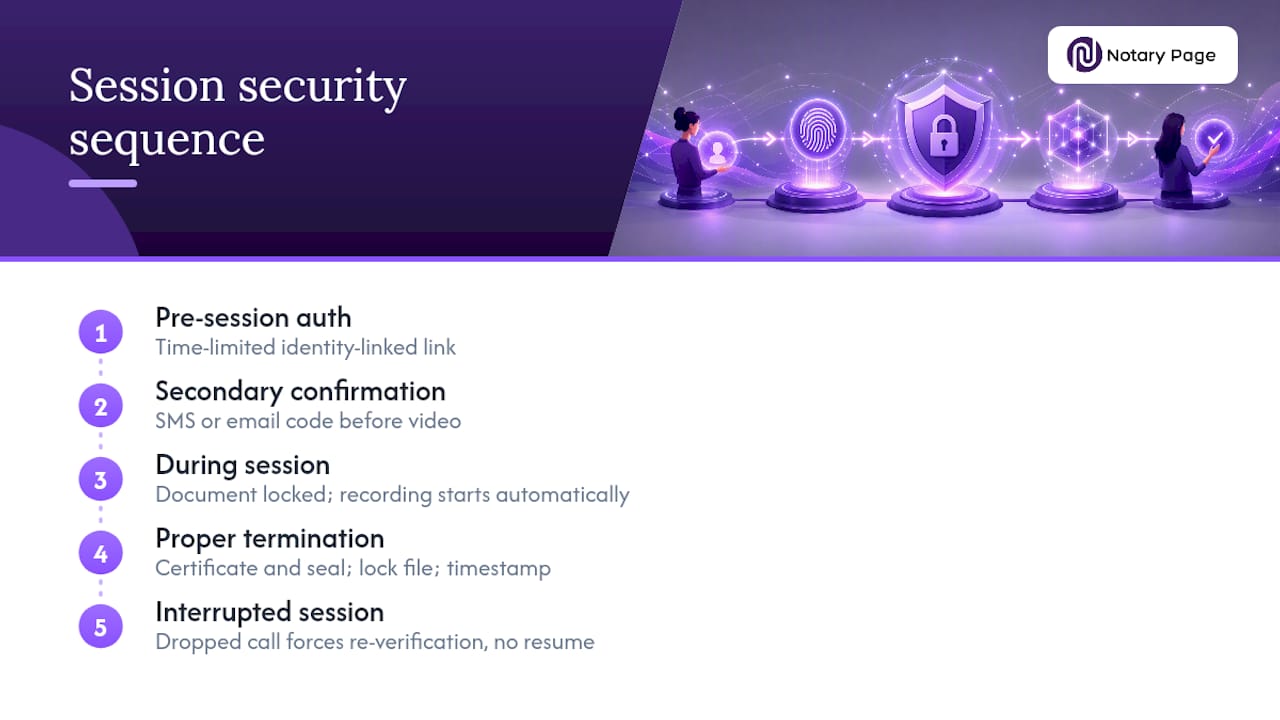
Once the session begins, the platform should lock the document against edits for anyone but the assigned notary, and the recording should start automatically rather than depending on someone remembering to hit record. A gap in recording coverage, even a few missed seconds, can undermine the entire evidentiary value of the session later.
Termination matters just as much as initiation. A properly closed session finalizes the document with the notary’s certificate and seal, locks the file against further edits, and closes out the electronic journal entry with a timestamp. The recording should be sealed and routed to storage immediately, not left in a temporary state that could be altered or lost.
Ask a provider directly how they handle interrupted sessions, a dropped connection, a signer who needs to step away. A dropped call mid-signing should force a restart of the identity verification, not a quiet resume from where things left off. That single detail separates a platform built with security in mind from one that prioritized convenience over rigor.
What Happens If a Notary Platform Gets Breached?
Every platform handling identity documents and financial paperwork is a target, and the honest question isn’t whether a breach could happen but whether the provider has a real plan for when one does.
A credible incident-response process includes a few concrete elements: a defined timeline for notifying affected signers, a process for determining exactly which records were exposed, and a commitment to work with law enforcement when the breach involves identity theft or fraud. Federal resources like the IC3 exist specifically to track and respond to these online crime patterns, and a provider’s incident plan should reference cooperation with such channels rather than treating a breach as purely an internal matter.
Ask a provider what their notification window looks like, some jurisdictions impose legal deadlines for breach disclosure, and whether they carry cyber liability insurance separate from their general errors and omissions coverage. The two aren’t interchangeable. E&O coverage typically addresses mistakes in the notarial act itself, while cyber liability addresses data breaches and security failures.
If you’re a signer on a document tied to a large financial transaction, ask one more question before booking: what happens to your identity documents and recording if the platform itself goes out of business? Data custodianship doesn’t always transfer cleanly, and a provider without a clear answer here is one worth reconsidering, particularly for estate or real estate paperwork you may need to reference years down the road.
Amy’s Take: What This Actually Means for Your Next Signing
Remote notarization earns trust when the platform’s controls are documented and the recipient has confirmed acceptance, not before. For routine paperwork, proceed with confidence. For real estate closings or large transfers, verify the provider’s documentation first, save your confirmation records, and call a lawyer or the receiving institution directly when the stakes justify it.
— Amy
Ready to Book a Notarization You Can Actually Verify?
Some providers run both remote online notarizations and in-person signings through a nationwide network of certified professionals, so you’re not locked into one modality if your document or recipient requires something specific.
That flexibility matters more than it sounds. A real estate closing might start as a remote booking and then need an in-person witness for one document in the stack, and switching providers mid-transaction is the last thing you want during a closing deadline. Some providers carry errors and omissions coverage through insurance providers, and you can request specifics on retention and security documentation directly through support before you commit to a booking.
If you’re weighing whether a specific transaction needs remote or in-person handling, or you just want your recipient’s acceptance confirmed before you schedule anything, start a booking on the Notary Page platform and get your questions answered before the session, not after.