
Avoid Rejected Closings: U.S. Wet Ink Notarization, RIN vs RON
Avoid Rejected Closings: U.S. Wet Ink Notarization, RIN vs RON
Wet ink notarization means signing a document by hand while a commissioned notary watches, checks your ID, and stamps the page with a physical seal. You need it when your state’s law or the office receiving the document, whether a county recorder, court, or title company, won’t accept an electronic signature. Before scheduling anything, confirm with the receiving office and check your state’s rules on Remote Online Notarization (RON) or Remote Ink Notarization (RIN).
TL;DR:
- Wet ink notarization is still necessary for documents like wills, estate filings, and real estate deeds where local offices demand a physical signature and seal.
- Remote Ink Notarization involves live video signing followed by mailing the original document, adding 1-3 days to the process due to mailing logistics.
- Nearly all states permit Remote Online Notarization, but acceptance at the county or recording office may vary, making prior confirmation essential.
- In-person notarizations are typically quicker and cheaper, but mobile services are useful for those unable to travel, with costs varying by distance and urgency.
- Always verify with the receiving office before notarizing to ensure the method and document type meet their acceptance criteria and avoid re-signing.
Table of Contents
- Wet Ink, RON, RIN: What’s the Difference?
- How Does Remote Ink Notarization (RIN) Actually Work?
- Which Documents Still Require Wet Ink?
- How Do You Get a Document Wet Ink Notarized?
- How Do You Confirm a Notarization Method Is Accepted?
- What Does Wet Ink Notarization Cost and How Long Does It Take?
- What Should You Ask a Notary Before Booking?
- Why Notary Page Handles Both Routes Without the Runaround
- Wet Ink Isn’t Going Away, and That’s Not a Bad Thing
- Book a Verified Notary Without the Guesswork
- Sources
- FAQ
Wet Ink, RON, RIN: What’s the Difference?
The National Notary Association recognizes five notarization methods, but four matter for most people: traditional wet-ink notarization (sometimes shortened to TWIN), in-person electronic notarization (IPEN), Remote Online Notarization (RON), and Remote Ink Notarization (RIN).
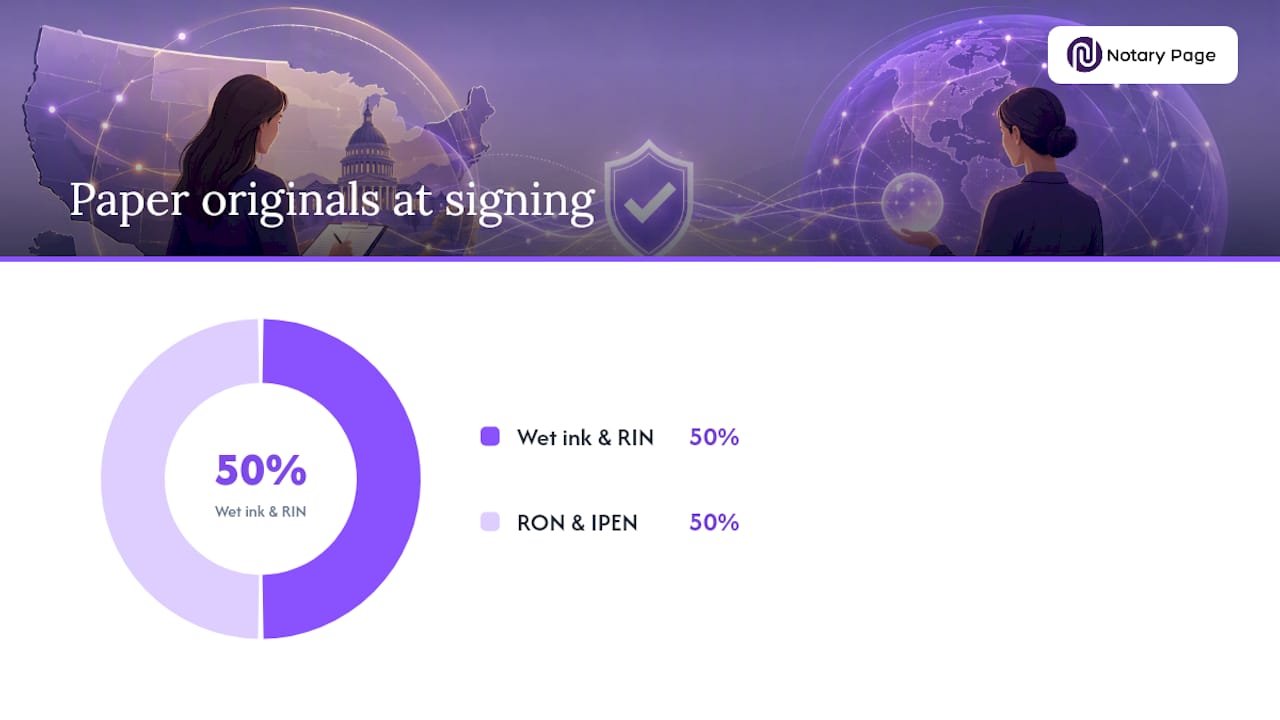
Traditional wet-ink notarization is the version most people picture: you sit across from a notary, sign a paper document in ink, and the notary applies a physical stamp and signature on the spot. IPEN also happens in person, but the signature and seal are captured electronically on a tablet or screen rather than on paper. RON moves the entire transaction online through audiovisual technology, with an electronic signature and an electronic seal, and no paper ever changes hands during the session. RIN sits in between: a notary observes you sign on paper over live video, then you mail the physical document so the notary can add a wet seal once it arrives.
Only two of these produce a paper original at the moment of signing: traditional wet ink and RIN (eventually). That distinction drives everything else in this article.
- Traditional wet ink: Physical presence, physical signature, and physical seal.
- IPEN: In-person, but signed and sealed electronically.
- RON: Fully remote, fully electronic, no physical document.
- RIN: Remote signing observed live, followed by a mailed paper original and a wet seal.
How Does Remote Ink Notarization (RIN) Actually Work?
RIN exists to solve a specific problem: you can’t get to a notary in person, but the document still needs a wet signature and a physical seal because of ESIGN exclusions or a recorder’s paper requirement. It bridges that gap, though not instantly.
Here’s the sequence most RIN transactions follow:
- You schedule a video session with a notary authorized to perform RIN in your state.
- During the call, you show your ID and the blank document on camera, and the notary confirms your identity.
- You sign the paper document in ink while the notary watches live over video.
- The notary retains an audiovisual recording of the session, which serves as legal proof of the signing in most authorizing states.
- You mail the signed original to the notary, typically by trackable overnight courier.
- Upon receipt, the notary compares the document to the recording, then applies the physical wet seal and signature.
- The notary mails or delivers the completed original to the receiving party.
That mailing step is where RIN earns its reputation as the slower cousin of RON. It also depends entirely on your state authorizing it. Some states approved RIN temporarily during the pandemic and let that authorization lapse afterward, so a method that worked in 2021 may not be legal in your state today.
Pro Tip: Include a signed checklist inside the mailing envelope that matches what the notary saw on the recording, and ask the notary to log the recording’s file ID in their journal entry. Title companies and recorders reject RIN paperwork far less often when that documentation trail exists.
Which Documents Still Require Wet Ink?
The ESIGN Act cleared the way for electronic signatures on most contracts back in 2000, but it carved out specific exceptions that still apply today. Wills and testamentary trusts are the clearest example: most states require a physical, wet-ink signature for a will to be valid, regardless of how permissive that state is about RON for other documents. Certain family court filings, adoption papers, and documents involving the transport or handling of hazardous materials also fall outside ESIGN’s coverage.
Beyond the legal exclusions, plenty of county recorders and title companies simply prefer, or outright require, a paper original with a physical stamp before they’ll record a deed or mortgage document. That’s a practical constraint layered on top of the legal one.
RON is authorized in the majority of U.S. states, including Washington, D.C., but authorization at the state level doesn’t guarantee acceptance at the county level. A recorder can still reject an electronically notarized document for reasons that have nothing to do with whether your state allows RON.
- Wills, codicils, and certain trust documents.
- Family court and adoption filings in many jurisdictions.
- Hazardous materials shipping and handling paperwork.
- Real estate documents where the local recorder mandates a paper original.
Before you sign anything, call the receiving office directly and ask what they’ll accept. A five-minute phone call beats redoing a closing.
How Do You Get a Document Wet Ink Notarized?
The right route depends on how urgent the document is and whether you can travel. Here’s what each path actually involves.
In-person notarization checklist:
- Bring the unsigned document (most notaries won’t notarize something you already signed alone).
- Bring valid government-issued photo ID.
- Sign in front of the notary, in ink, using the color they request (usually blue or black).
- The notary completes a notarial certificate, applies a physical seal, and logs the transaction in their journal.
Mobile notary specifics: A mobile notary travels to your home, office, or a closing table, which matters if you’re signing loan documents or handling an estate matter for someone who can’t easily leave the house. Expect to pay the standard state-set notarization fee plus a travel fee, which varies by distance and how quickly you need someone there.
RIN operational checklist:
- Confirm your state authorizes RIN before booking.
- Set up your camera so both your face and the signature page are visible.
- Sign in ink during the live session, not before or after.
- Ship the original via trackable overnight courier the same day if possible.
- Confirm the notary’s deadline for receiving the document; missed windows can void the session.
How Do You Confirm a Notarization Method Is Accepted?
Skipping this step is how people end up re-signing documents. Run through this before you book anyone.
- Check your state’s Secretary of State notary page, like Michigan’s notary services page, for official confirmation of which methods your state authorizes and to verify a specific notary’s commission status.
- Call the county recorder or receiving office directly and ask whether they accept RON, RIN, or only traditional wet ink for your document type.
- During the session, confirm the notary’s commission state, since a notary generally must be commissioned in the state whose law governs the notarization and often must physically remain in that state while performing it.
- Ask whether the notary keeps a journal entry for the transaction, which matters if the notarization is ever challenged later.
Five minutes of verification here can save you a re-signing appointment and a delayed closing.
What Does Wet Ink Notarization Cost and How Long Does It Take?
Costs and timelines shift depending on which route you take, and RIN’s mailing step is the biggest variable of all.
- In-person notarization: Usually the fastest and cheapest option, often completed the same day at a bank, shipping store, or law office for a standard state-set fee per signature.
- Mobile notary: Adds a travel fee on top of the standard fee, but saves you the trip, useful for elderly clients or time-crunched closings.
- RIN: Add one to three days for mailing on top of the video session itself, depending on courier speed. Overnight or trackable courier is worth the extra cost for anything tied to a closing date or court deadline.
The hidden cost nobody budgets for is reexecution. If a recording office rejects your notarized document for missing elements or an illegible stamp, you may need to redo the entire signing, sometimes in person, which can blow past a tight escrow deadline.
What Should You Ask a Notary Before Booking?
A few pointed questions up front separate a smooth notarization from a rejected one.
- Are you commissioned to notarize in the state that governs this document?
- Does the county or office receiving this document accept your notarization method?
- For RIN, what’s your deadline for receiving the mailed original, and do you retain a recording of the session?
- Do you keep a journal entry for every notarization you perform?
Watch for red flags: a notary who won’t disclose their commission details, a RIN provider who skips the recorded video session, anyone asking you to sign blank pages, or a notary who keeps no journal at all. Legitimate notaries expect these questions and answer them without hesitation.
Pro Tip: Ask to see the notary’s commission certificate before the session starts. A hesitant answer or a certificate that’s expired or from the wrong state is your signal to book someone else.
Trust signals worth confirming: an active commission you can verify through the state lookup tool, a journal entry for your transaction, and errors and omissions (E&O) insurance covering the notary’s work.
Why Notary Page Handles Both Routes Without the Runaround
A nationwide network of certified notaries offers in-person, mobile, and remote options, so you’re not stuck guessing which method your document needs before you book. Real estate closings, estate planning documents, and general business paperwork all move through the same platform, with status updates sent as your order progresses instead of leaving you to chase down your notary for confirmation.
Sessions are backed by errors and omissions coverage, which matters if a document’s validity is ever questioned later. You can also verify a completed document after the fact, which gives title companies, attorneys, and closing coordinators a way to confirm a notarization actually happened the way it was supposed to.
Wet Ink Isn’t Going Away, and That’s Not a Bad Thing
RON adoption will keep expanding, and more states will likely loosen RIN restrictions as courts and recorders catch up with the technology. But wet ink isn’t disappearing anytime soon. Wills, several categories of court filings, and a long list of stubborn county recorders will keep demanding a physical signature and seal for years, not months.
The practical move for professionals is to stop treating notarization method as an afterthought. Build it into your process maps. If you’re coordinating a closing or an estate signing, confirm county acceptance before the appointment, keep a clear chain of custody for the original once it’s signed, and always have an in-person backup slot ready in case a recorder rejects an electronic or RIN document at the last minute.
— Amy
Book a Verified Notary Without the Guesswork
You can book whichever notarization method your document needs, in-person, mobile, or remote, instead of piecing together a solution from separate services. Every notary in the network is certified, and transactions carry errors and omissions coverage, so you’re covered if a question about the notarization ever comes up later.
If you’re not sure which method fits your document, this kind of service can route you to the right option instead of leaving you to research state statutes on your own. Once a document is notarized, you can verify it to confirm the transaction is on record. Ready to schedule? Book your notary and get a confirmed appointment instead of another afternoon of phone calls to your county recorder.
Sources
- Understanding Different Methods of Notarization | National Notary Association
- Remote Ink-Signed Notarization (RIN) explained - LegalClarity
- Michigan Secretary of State — Notary services
FAQ
Which States Allow Remote Online Notarization?
RON is authorized in 47 states and Washington, D.C., though the specific requirements and technology vendors each state permits still vary, so check your state’s current statute before relying on it.
Can You Perform Remote Notarizations in Texas?
Texas allows Remote Online Notarization, but a notary must be commissioned in Texas and follow the state’s specific technology and recording requirements. Availability of RIN specifically has shifted as temporary pandemic-era authorizations have lapsed, so confirm current status before booking.
Which State Has the Hardest Notary Exam?
Requirements vary widely by state, with some states requiring no exam at all and others, like California, requiring a state-administered exam plus background checks and continuing education. Check your state’s notary licensing page for its specific requirements.
Can You Do Notary Work as a Side Hustle?
Yes, many commissioned notaries work part-time or on the side, performing mobile signings or occasional RIN sessions around a primary job. Income and demand vary heavily by location and whether you also become a loan signing agent for real estate closings.
Do I Need Wet Ink or Can I Use RON for My Document?
It depends on the document type and where it’s going. Wills, some court filings, and many county recorders still require a wet-ink original, so verify with the receiving office before choosing an electronic method, or use a platform like Notary Page that can route you to whichever method your document requires.