
What Is a Corporate Notary Account for Businesses?
What Is a Corporate Notary Account for Businesses?
A corporate notary account is a dedicated service arrangement that allows businesses to centralize, manage, and authenticate official company documents through authorized notarial processes. Unlike a one-off notarization visit, this account structure bundles multiple notarial acts, apostille services, and document authentication into a single managed relationship. Business owners and executives use these accounts to reduce administrative delays, cut per-transaction costs, and maintain consistent legal compliance across high-volume document workflows. Platforms like Notarypage support both in-person and remote online notarization, giving companies flexible access to certified professionals nationwide.
What is a corporate notary account and what services does it include?
A corporate notary account gives businesses structured, ongoing access to notarial services rather than requiring a new vendor search for every document. The account typically covers a defined set of document types, service tiers, and pricing terms negotiated upfront.
Corporate notary services commonly authenticate the following document categories:
- Certificates of Incorporation and Articles of Association for regulatory filings
- Powers of Attorney authorizing executives or agents to act on behalf of the company
- Commercial contracts requiring notarial certification for cross-border enforceability
- Board resolutions and shareholder agreements for governance transactions
- Apostille processing for documents destined for foreign governments or courts
Apostille services deserve special attention because international transactions depend on them. Standard apostille turnaround runs 3–5 business days, with rush processing available in as little as 24 hours. For a company closing a cross-border acquisition, that 24-hour option can be the difference between meeting a deadline and losing a deal.
Corporate accounts also increasingly include Remote Online Notarization, or RON. RON is an authorized service with state-specific requirements, meaning your legal team must confirm which states accept remotely notarized documents before routing them through a digital workflow. This matters most for companies with employees or counterparties in multiple states.

Pricing under a corporate account typically shifts from per-act fees to membership or contract models. That shift rewards volume. A company processing dozens of notarizations per month pays far less per document under a bundled agreement than it would on a transactional basis.
Pro Tip: Negotiate your corporate notary agreement to include mobile notary visits and RON in the same contract. Bundling both eliminates the need for separate vendor relationships and keeps your document workflow under one service-level agreement.
How does a corporate notary account differ from individual notary services?
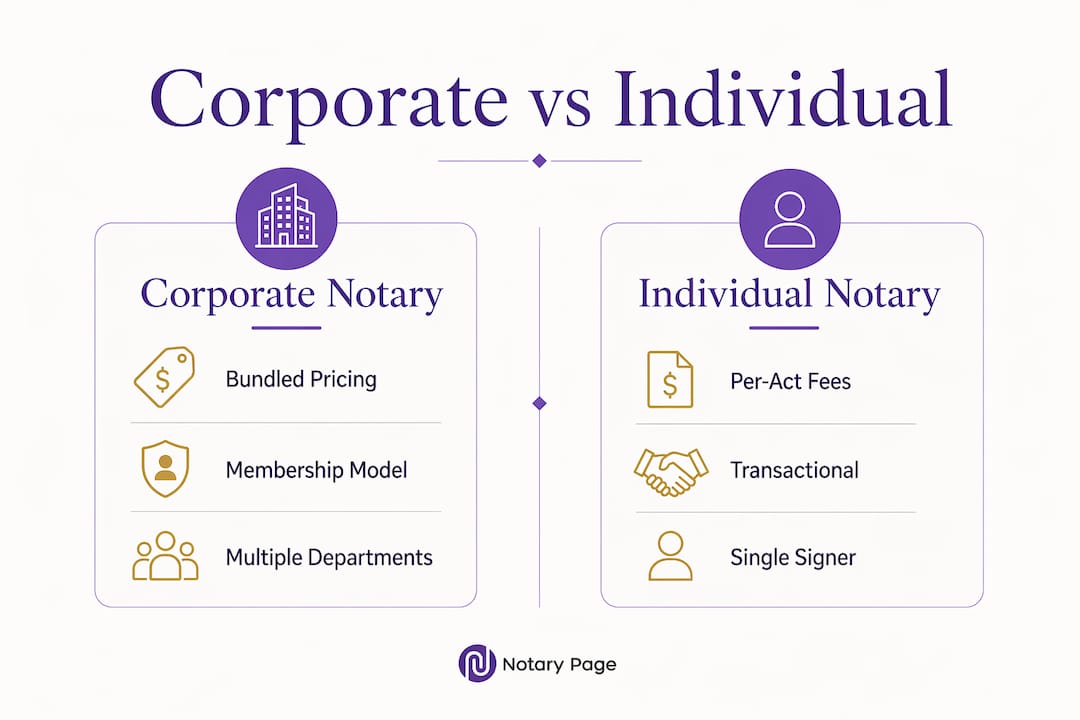
The distinction between a corporate notary account and a standard individual notary engagement comes down to three factors: scope, pricing structure, and operational integration.
A state-commissioned notary charges between $2 and $25 per notarial act, with fees set by state law. That fee cap works fine for a person notarizing a single affidavit. For a company processing contracts, board resolutions, and international filings every week, transactional pricing adds up quickly and creates unpredictable costs.
Corporate accounts replace that transactional model with bundled membership pricing. The company pays a fixed or tiered rate covering a defined volume of notarizations, mobile visits, apostille processing, and RON sessions. Predictable costs make budget planning straightforward.
The legal role of the notary does not change based on account type. Notaries verify signer identity and willingness to sign. They do not certify document content or provide legal advice. This is a ministerial function, not an interpretive one. Businesses must prepare legally sound documents before presenting them for notarization. The notary confirms who signed, not whether the agreement is enforceable.
The table below compares the two service models across key operational dimensions.
| Factor | Individual notary service | Corporate notary account |
|---|---|---|
| Pricing model | Per-act fees ($2–$25 per notarization) | Membership or contract bundling |
| Service scope | Single document, single visit | Volume agreements with multiple service types |
| Turnaround | Varies by availability | Defined service-level timelines |
| Remote access | Varies by notary | RON included in most corporate agreements |
| Administrative integration | None | Workflow tools and account management portals |
One compliance point that catches businesses off guard: notaries must remain impartial and cannot notarize documents in which they hold a personal or financial interest. If your company employs an in-house notary, that person cannot notarize documents that directly benefit them. Corporate accounts with external notary providers eliminate this conflict entirely.
How to set up and manage a corporate notary account
Setting up a corporate notary account follows a clear sequence. Skipping steps creates compliance gaps that surface at the worst possible time, usually when a document is already overdue.
-
Assess your document volume. Count how many notarizations your company processes monthly across all departments. Include legal, HR, finance, and operations. This number determines which pricing tier or contract structure fits your needs.
-
Identify document types and jurisdictions. List the document categories your company regularly notarizes and the states or countries where those documents will be used. International documents require apostille or consular legalization, which not all notary providers offer.
-
Select a provider with the right service mix. Choose a notary service that covers in-person, mobile, and RON options. Confirm that the provider operates in every state where your business has employees or counterparties.
-
Negotiate a service-level agreement. Define turnaround times, rush options, volume caps, and escalation procedures in writing. A signed agreement protects both parties and sets clear expectations.
-
Integrate the account into your legal workflow. Work with your internal legal team to establish a document preparation checklist. Documents must be complete and legally sound before reaching the notary. Collaboration with legal teams prevents rejected notarizations and wasted turnaround time.
-
Track notary commission expiration dates. Notary commissions last four to ten years depending on the state. If your provider’s notaries hold commissions in multiple states, build a tracking system to flag renewals before they lapse. A lapsed commission invalidates notarizations performed after the expiration date.
-
Monitor costs and report correctly. Notary fees constitute taxable income for the notary, reported on Schedule C. For your business, notary service costs are deductible as ordinary business expenses. Keep itemized records for each billing cycle.
Pro Tip: Assign one person in your legal or operations department as the corporate notary account manager. That person owns the vendor relationship, tracks commission dates, and routes documents correctly. Distributed ownership leads to missed renewals and compliance failures.
What are the main benefits of a corporate notary account?
The business case for a corporate notary account rests on four concrete advantages: cost control, speed, fraud prevention, and international reach.
-
Cost control through bundled pricing. Membership agreements bundle mobile visits, RON, and apostilles into a single contract, reducing per-document costs significantly for high-volume users. Predictable monthly or annual fees replace unpredictable per-act charges.
-
Faster document processing. Defined service-level agreements mean your team knows exactly when documents will be ready. Rush apostille processing in 24 hours supports time-sensitive transactions that transactional notary relationships cannot reliably deliver.
-
Fraud prevention and legal risk reduction. Notarization creates a verified record of signer identity and consent. For contracts, powers of attorney, and financial instruments, that verification deters fraud and strengthens enforceability in disputes. Corporate accounts with reputable providers add an additional layer of accountability through consistent record-keeping.
-
International document authentication. Companies operating across borders need apostilles and consular legalization for documents to be accepted by foreign governments. A corporate account with apostille capabilities removes the need to manage that process separately for each transaction.
-
Operational consistency. A corporate account delivers the same process, the same standards, and the same documentation every time. That consistency matters when documents are reviewed by courts, regulators, or foreign agencies that expect uniform authentication.
The combination of these benefits means that a well-structured corporate notary account pays for itself quickly in companies that process more than a handful of notarizations per month.
Key Takeaways
A corporate notary account reduces document authentication costs, speeds up international filings, and eliminates the compliance gaps that come with ad hoc notary arrangements.
| Point | Details |
|---|---|
| Core definition | A corporate notary account bundles notarization, apostille, and RON services under one managed agreement. |
| Pricing advantage | Membership pricing replaces per-act fees of $2–$25, cutting costs for high-volume document workflows. |
| Notary role is ministerial | Notaries verify identity and consent only; legal teams must prepare and validate document content. |
| Setup requires legal integration | Assign an account manager and align document preparation with internal legal workflows before notarization. |
| International reach | Apostille turnaround of 3–5 business days, with 24-hour rush options, supports cross-border transactions. |
Why most executives underestimate the notary function
The most persistent misconception I encounter is that notarization is a rubber-stamp formality. Executives treat it as the last step before filing, something to handle in five minutes. That mindset creates real problems.
A notary’s job is strictly ministerial. The notary confirms who you are and that you signed willingly. The notary does not confirm that your contract is enforceable, that your power of attorney is correctly drafted, or that your board resolution meets state corporate law requirements. I have seen deals delayed because a company sent an incomplete document to a notary expecting the notary to catch the error. That is not how it works.
The second mistake is treating corporate notarization as a cost center rather than a risk management tool. A properly notarized power of attorney or commercial contract is far harder to challenge in court than an unwitnessed signature. For companies operating internationally, an apostille-authenticated document is often the only form a foreign court or agency will accept. The cost of a corporate notary account is trivial compared to the cost of a rejected filing or a disputed contract.
My recommendation: treat your corporate notary account the same way you treat your legal retainer. Vet the provider, negotiate clear terms, and build the relationship before you need it urgently.
— Amy
Notarypage makes corporate notarization straightforward
Managing document authentication across multiple departments and jurisdictions does not have to be complicated. Notarypage connects businesses with a nationwide network of certified notary professionals, covering both in-person and remote online notarization under one platform.
Notarypage backs its service with $1,000,000 in Errors and Omissions coverage through Hiscox, giving corporate clients a meaningful layer of protection on every notarized document. Whether your team needs a mobile notary for an executive signing or a remote notarization session for a time-sensitive contract, Notarypage handles the logistics. Visit Notarypage to set up your corporate account and get consistent, reliable notarization coverage wherever your business operates.
FAQ
What is a corporate notary account?
A corporate notary account is a managed service agreement that gives businesses ongoing access to notarization, apostille processing, and remote online notarization under bundled pricing terms. It replaces ad hoc notary visits with a structured, volume-based relationship.
What does a notary do for a corporation?
A notary verifies the identity and willingness of signers on corporate documents such as powers of attorney, board resolutions, and commercial contracts. Notaries do not review or certify document content; that responsibility stays with the company’s legal team.
How much do corporate notary services cost?
Individual notarizations cost between $2 and $25 per act under state fee schedules. Corporate accounts use membership or contract pricing that bundles multiple services, reducing the effective per-document cost for businesses with regular notarization needs.
How long does apostille processing take through a corporate account?
Standard apostille turnaround runs 3–5 business days. Rush processing is available in as little as 24 hours, which supports time-sensitive international transactions and cross-border filings.
Can a corporate notary account include remote online notarization?
Yes. Most corporate notary agreements include Remote Online Notarization as part of the service bundle, subject to state-specific authorization requirements. Your legal team should confirm which states accept RON-authenticated documents before routing filings through a digital workflow.