
What Is a Dedicated Signing Service? A Clear Guide
What Is a Dedicated Signing Service? A Clear Guide
A dedicated signing service is a professional system designed specifically to manage the secure execution, notarization, and return of important documents for individuals and businesses. The term covers two distinct but related categories: traditional notary signing agents who handle physical loan and mortgage packages, and digital platforms like QuickSigner that collect legally compliant electronic signatures with full audit trails. Both models share one defining trait. They exist solely to get documents signed correctly, completely, and in compliance with applicable law. Notarypage operates in this space, offering both in-person and remote notarization options backed by $1,000,000 E&O coverage through Hiscox.
What is a dedicated signing service and what does it actually do?
A dedicated signing service is not a general notary office or a basic PDF tool. It is a specialized workflow built around one purpose: executing documents with legal precision. The industry term for the human side of this service is notary signing agent (NSA), while the digital side is typically called an eSignature service or signature service.
Notary signing agents are commissioned notaries with specialized training who manage the execution, notarization, and secure return of multi-page loan or mortgage packages to lenders or title companies. That specialization matters because a standard notary may witness a signature, but a signing agent coordinates the entire package: correct signing order, proper dating, notarization of every required page, and secure delivery back to the originating party. On the digital side, eSignature services send signing requests, collect legally compliant electronic signatures, and create audit trails that meet U.S. e-signature laws including ESIGN and UETA.

The core insight is this: a dedicated signing service removes the burden of execution management from the parties involved in a transaction and places it in the hands of a trained specialist or a purpose-built system.
Key actors and components in a signing service
Understanding who does what inside a dedicated signing service clarifies why these systems are more reliable than ad-hoc arrangements.
In traditional physical workflows, the notary signing agent is the central actor. The agent travels to the signer, verifies identity, walks through the document package, witnesses signatures, applies notarial seals, and returns the completed package to the lender or title company. The agent does not provide legal advice or explain loan terms. Their specialized role is executing documents correctly and preventing fraud, nothing more.
In digital workflows, the architecture is more distributed. A federated signing model separates roles across five distinct actors: the signer, the service provider (the business requesting the signature), the signature service itself, an identity provider, and a certification authority. The signature service is the central component. It manages the process, creates the cryptographic signature, and coordinates identity authentication. This separation of duties is what makes digital signing services more secure than simply emailing a PDF.
| Actor | Role |
|---|---|
| Notary signing agent | Verifies identity, executes and notarizes physical documents |
| Signature service | Manages digital signing process and creates cryptographic signatures |
| Identity provider | Authenticates the signer’s identity via eID, SMS, or KYC methods |
| Certification authority | Issues the digital certificate that validates the signature |
| Service provider | The business or platform requesting the signed document |
How does a signing service work step by step?
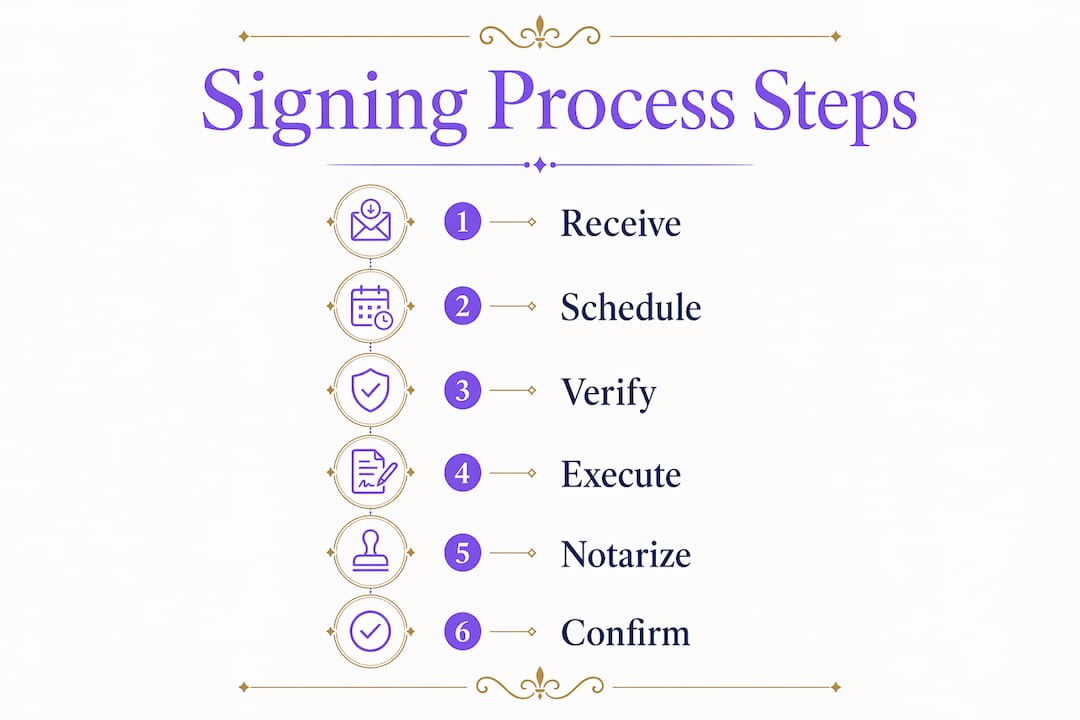
The process differs depending on whether you are using a physical notary signing agent or a digital platform, but both follow a structured sequence designed to produce a legally defensible result.
For physical notary signing agent workflows:
- The lender or title company sends the document package to a signing service or agent.
- The signing agent contacts the borrower to schedule a time and location.
- At the appointment, the agent verifies the signer’s government-issued ID.
- The agent presents each document in order, confirms correct signing and dating, and notarizes required pages.
- The completed package is returned to the lender or title company, typically within 24 hours.
For remote online notarization (RON) and digital workflows:
- The requesting party uploads the document to a signing platform.
- The signer receives a link and authenticates their identity using a method such as knowledge-based authentication, SMS code, or eID.
- The signer reviews and signs the document electronically, often in a live video session with a commissioned notary for RON transactions.
- The platform generates an audit trail recording every action: document sent, opened, viewed, and signed, with timestamps and metadata.
- A digital certificate is created and attached to the signed document for evidentiary use.
Remote Online Notarization differs from generic e-signing by requiring a commissioned notary to witness signatures in real time, often recording the session for compliance. Using a simple e-signing tool where notarization is legally required creates execution risk. The document may be unenforceable.
Pro Tip: When scheduling a signing appointment for a real estate closing, confirm that the signing service has reviewed the full document package in advance. Agents who arrive without prior familiarity with the package are the leading cause of appointment delays and incomplete executions.
What are the primary benefits of using a dedicated signing service?
The advantages of dedicated signing over generic alternatives are concrete and measurable, not theoretical.
- Fraud prevention. Signing agents verify signer identity, confirm correct execution, and apply notarial seals that create a legal record of authenticity. This directly reduces the risk of forged signatures or unauthorized signings.
- Compliance assurance. Digital signing services that comply with ESIGN and UETA produce audit trails with timestamps and metadata that courts accept as evidence. RON services add a recorded notary session for documents requiring notarization.
- Error reduction. A trained signing agent catches missing signatures, incorrect dates, and incomplete notarizations before the package leaves the table. Errors caught at signing cost nothing. Errors discovered at closing cost days of delay and legal exposure.
- Convenience for all parties. Mobile notary signing agents travel to the signer’s location. RON services allow signers to complete documents from any device with a camera and internet connection. Neither model requires the signer to travel to an office.
- Clear billing structure. According to the National Notary Association, signing agents are typically paid after completing assignments under contractual agreements with defined deliverables. This completion-based model gives clients predictable costs tied to outcomes.
Pro Tip: Match the service type to the transaction. A simple business contract can use a standard eSignature platform. A real estate closing, estate planning document, or power of attorney almost always requires a notary signing agent or a RON service with a commissioned notary present.
How do the different types of signing services compare?
Not all dedicated signing services are built for the same job. The right choice depends on transaction type, volume, legal requirements, and signer location.
| Service type | Best use case | Notarization included | Legal acceptance | Volume capability |
|---|---|---|---|---|
| Traditional notary signing agent | Real estate closings, mortgage packages | Yes, in person | All U.S. states | Low to medium, manual |
| Mobile notary | Estate planning, legal documents, field signings | Yes, at signer’s location | All U.S. states | Low to medium, manual |
| Remote Online Notarization (RON) | Real estate, legal docs, remote signers | Yes, via live video | Most U.S. states | Medium, session-based |
| Digital eSignature platform | Business contracts, HR documents, agreements | No (unless RON integrated) | U.S. federal and most states under ESIGN/UETA | High, automated |
| Automated high-volume signing | API-driven enterprise document workflows | No | Jurisdiction-dependent | Very high, requires HSM |
High-volume signing needs require integration with certificate and Hardware Security Module (HSM) management, which goes well beyond a standard “send a link to sign” user experience. Businesses processing thousands of documents monthly need a fundamentally different infrastructure than a law firm closing ten real estate deals a week.
The signer’s experience also varies significantly. A traditional signing agent appointment takes 60 to 90 minutes and requires physical presence. A RON session typically takes 20 to 30 minutes via video call. A digital eSignature workflow can be completed in under five minutes from a smartphone.
How to choose the right dedicated signing service
Selecting the right provider requires honest answers to a few practical questions before you start comparing platforms or calling agents.
- What type of document are you signing? Loan documents, powers of attorney, and deeds require notarization. Business contracts and HR agreements typically do not. Matching the service to the legal requirement prevents wasted spend and execution errors.
- Where are your signers located? If signers are in multiple states or countries, a RON service or digital eSignature platform with remote capability is more practical than dispatching mobile notaries.
- What volume do you need? Individual transactions fit manual workflows. Businesses processing large numbers of agreements monthly should evaluate platforms with API access and automated routing.
- What certifications does the provider hold? Notary signing agents should hold current state commissions and ideally certification from the National Notary Association. Digital platforms should demonstrate ESIGN and UETA compliance, and RON providers should be authorized in the states where they operate.
- What does the audit trail look like? Ask to see a sample completed document with its audit trail before committing to a provider. A credible audit trail includes timestamps, IP addresses, identity verification records, and a tamper-evident seal.
- How is billing structured? Completion-based billing tied to defined deliverables is the standard for signing agents. Subscription or per-envelope pricing is common for digital platforms. Understand what triggers a charge and what happens if a signing is incomplete.
Providers like Notarypage combine in-person and remote notarization options under one platform, which simplifies vendor management for businesses that need both capabilities depending on the transaction.
Key takeaways
A dedicated signing service is the most reliable way to execute legally sensitive documents because it combines trained human oversight or cryptographic security with a structured, compliance-driven process.
| Point | Details |
|---|---|
| Two distinct models exist | Traditional notary signing agents handle physical packages; digital platforms manage electronic workflows. |
| Fraud prevention is the core value | Identity verification, notarization, and audit trails work together to prevent unauthorized or incorrect signings. |
| RON is not the same as e-signing | Remote Online Notarization requires a commissioned notary in real time; basic e-signing does not satisfy notarization requirements. |
| Match service type to transaction | Real estate and legal documents need notarization; business contracts often only need a compliant eSignature platform. |
| Billing follows completion | Signing agents are typically paid after assignment completion, giving clients predictable, outcome-based costs. |
Why dedicated signing services matter more than most people realize
I have spent years watching individuals and businesses underestimate the execution phase of a transaction. They negotiate contracts carefully, hire attorneys, and then hand off the signing to whoever is available. That is where deals fall apart.
The most common mistake I see is treating notarization as a formality rather than a legal requirement with teeth. A document that needed notarization but only received an electronic signature is not just incomplete. It may be legally unenforceable, which means the entire transaction has to restart. That is an expensive lesson.
What I find genuinely interesting about the shift toward federated digital signing is that it makes security invisible to the signer. The separation of identity verification from signature creation means a signer authenticates once and the system handles the cryptographic work behind the scenes. The signer clicks a button. The infrastructure does the rest. That is a meaningful improvement over older models where security depended entirely on the agent’s diligence.
The trend I expect to accelerate is hybrid workflows: a RON session handled by a commissioned notary, backed by a digital platform that generates the audit trail and stores the signed package automatically. Businesses that adopt this model early will close faster and with fewer errors than those still coordinating physical packages by email.
My honest recommendation is to stop treating signing as an afterthought. Choose a provider with clear credentials, a documented audit trail, and the flexibility to handle both physical and remote transactions. The cost of getting it wrong is always higher than the cost of getting it right the first time.
— Amy
Notarypage: nationwide signing services for every transaction
Notarypage connects individuals and businesses with certified notary signing agents and remote online notarization options across the country. Whether you need a mobile notary at your home for a real estate closing or a video-based RON session for estate planning documents, Notarypage covers both. The platform provides real-time updates throughout the process and carries $1,000,000 E&O coverage through Hiscox, so every signing is backed by professional accountability. If you are ready to work with a trusted notary service that handles the full signing workflow from scheduling to secure document return, Notarypage is built for exactly that.
FAQ
What is a dedicated signing service?
A dedicated signing service is a professional system or trained specialist focused exclusively on managing the secure execution, notarization, and return of important documents. It covers both notary signing agents for physical transactions and digital eSignature platforms for electronic workflows.
How does a signing service work for real estate closings?
A notary signing agent receives the document package from the lender or title company, meets the borrower to verify identity and witness signatures, notarizes required pages, and returns the completed package. The entire process typically takes 60 to 90 minutes at the signing appointment.
Is remote online notarization the same as electronic signing?
No. Remote Online Notarization requires a commissioned notary to witness signatures in real time via video, often with session recording for compliance. Standard electronic signing does not include a notary and cannot satisfy legal notarization requirements.
What are the main dedicated signing service benefits?
The primary benefits include fraud prevention through identity verification, legal compliance via audit trails and notarization, error reduction from trained oversight, and convenience through mobile or remote options. These advantages make dedicated services more reliable than generic notary or basic e-signing alternatives.
How do I know if I need a notary signing agent or an eSignature platform?
If your document legally requires notarization, such as a deed, power of attorney, or mortgage package, you need a notary signing agent or a RON service. For business contracts, HR agreements, and similar documents that do not require notarization, a compliant eSignature service under ESIGN and UETA is sufficient.