
What Is a Notary Commission? Your 2026 Guide
What Is a Notary Commission? Your 2026 Guide
A notary commission is the official, state-granted authority that empowers an individual to act as an impartial public officer for witnessing legal document signings, administering oaths, and deterring fraud through identity verification. Without this commission, no individual can legally perform notarial acts in the United States. Commission terms typically range from 2 to 10 years, with four years being the most common term length. Secretaries of State or equivalent state offices issue these commissions, and the process involves more than simply filling out a form. Understanding what a notary commission means, what it authorizes, and how to obtain one protects you from costly legal mistakes.
What is a notary commission and what powers does it grant?
A notary commission is the formal credential that transforms a private citizen into a ministerial officer of the court with specific, limited legal powers. The commission does not make you a lawyer. It authorizes you to perform a defined set of notarial acts on behalf of the state.
Those acts include:
- Witnessing and authenticating signatures on contracts, deeds, affidavits, and other legal documents
- Administering oaths and affirmations for sworn statements and depositions
- Certifying true copies of original documents such as passports or diplomas
- Verifying the identity of signers to deter fraud and protect all parties
- Acknowledging documents to confirm a signer acted voluntarily and without coercion
A notary public acts as a ministerial officer of the court and must maintain strict impartiality at all times. That impartiality is the entire foundation of the commission’s legal value. A notary who favors one party, coaches a signer, or provides legal advice during a notarization crosses a line that can result in sanctions or permanent commission loss.
Pro Tip: Never explain what a document means to a signer or tell them whether they should sign it. That crosses into legal advice, which is prohibited for commissioned notaries.

The commission also carries geographic limits. Your authority exists only within the state that issued your commission. Performing a notarization in another state, even if the signer travels to you, is legally invalid.
How do you get a notary commission?
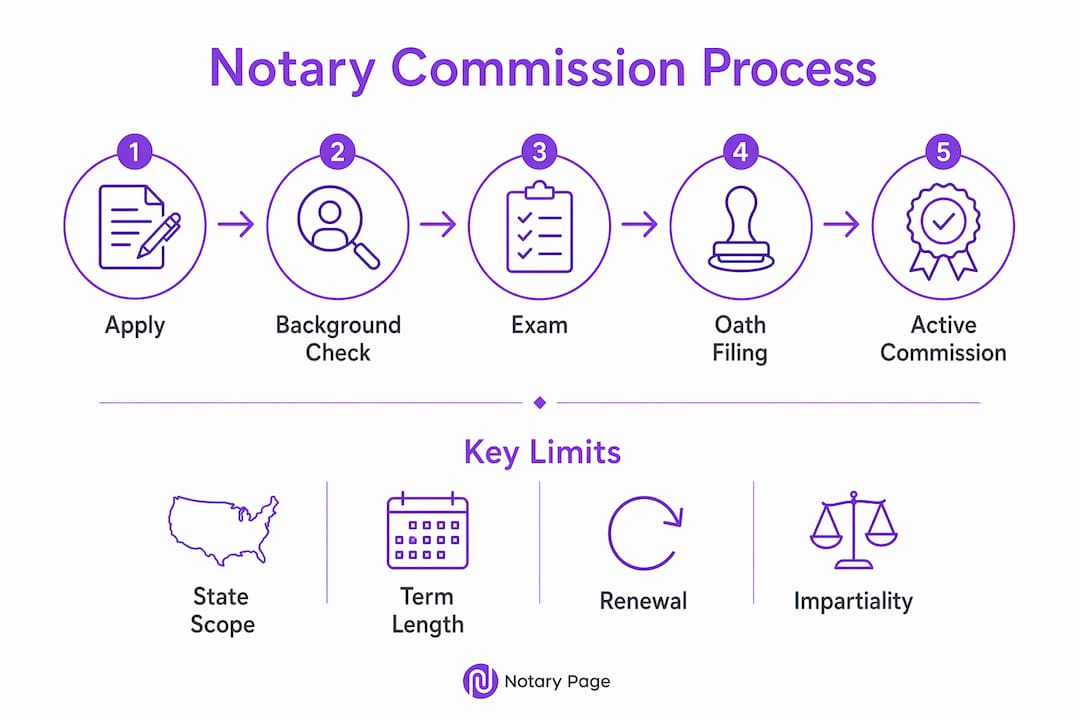
The notary commission application process varies by state, but the core steps follow a consistent pattern across most jurisdictions. Here is what the process looks like from start to finish.
-
Confirm eligibility. Most states require applicants to be at least 18 years old, a legal resident of the state, and free of felony convictions. Some states also require U.S. citizenship.
-
Complete pre-appointment education. About 22 jurisdictions require pre-appointment education, and 29 require a proctored exam before the state will consider your application. California, for example, mandates a state-approved course and a written exam.
-
Submit your application and pay fees. Application fees generally fall between $20 and $120 depending on the state. You submit the application to your Secretary of State or the designated state office.
-
Obtain a surety bond if required. About 29 of 51 jurisdictions require a surety bond, which protects the public from financial harm caused by notarial errors. Bond amounts vary widely by state.
-
Receive your commission certificate. Once approved, the state issues your official commission certificate. This is not the finish line.
-
File your oath and bond. Your notarization authority is not active until you file your sworn oath and bond with the proper government office. Missing this filing deadline, often within 30 days of commission issuance, voids the commission entirely and forces you to restart the application.
-
Purchase your notary seal and journal. Most states require a notary seal or stamp and a record-keeping journal before you begin performing notarizations.
The full timeline from application submission to active commission runs between one and eight weeks depending on the state. States with exam requirements and background checks take longer.
Pro Tip: Set a calendar reminder the day you receive your commission certificate. The oath and bond filing deadline starts immediately, and missing it is one of the most common and avoidable reasons new notaries lose their commission before they ever use it.
What is the difference between a notary and a commissioner of oaths?
The difference between a notary and a commissioner of oaths is a matter of legal scope, and choosing the wrong official for a document can invalidate the entire process.
A commissioner of oaths is authorized to administer oaths and witness signatures on sworn statements. That is where the authority ends. A notary public holds broader powers, including the ability to certify true copies of documents and prepare materials for international use with a recognized seal.
The distinction matters most in two situations: international documents and government forms. Only notaries can certify true copies and prepare documents for international use with a legally recognized seal. A commissioner of oaths cannot provide that service.
The Ontario example illustrates this clearly. In Ontario, a commissioner of oaths cannot notarize documents requiring a true copy certification or an official seal. Immigration, Refugees and Citizenship Canada (IRCC) forms and many institutional documents specifically require a notarial seal. Submitting those documents with a commissioner’s signature instead of a notary’s seal results in rejection and delays.
| Feature | Notary public | Commissioner of oaths |
|---|---|---|
| Administer oaths | Yes | Yes |
| Witness signatures | Yes | Yes |
| Certify true copies | Yes | No |
| Apply official seal | Yes | No |
| International document use | Yes | Limited or none |
| Government form acceptance (e.g., IRCC) | Yes | Often rejected |
When you are unsure which official a document requires, choose the notary public. The broader authority covers all situations a commissioner can handle, plus the ones a commissioner cannot.
Common mistakes that can cost you your notary commission
Prospective notaries often underestimate the responsibility that comes with the commission, treating it as a simple stamp-for-hire role rather than a public office with legal obligations. That misunderstanding is the root cause of most commission losses.
The most damaging mistakes include:
- Notarizing documents for relatives or close associates. This violates the impartiality requirement and constitutes a conflict of interest. Notarizing a relative’s documents or backdating a notarization can result in permanent commission revocation and criminal charges.
- Giving legal advice during a notarization. Explaining what a document means or advising a signer on whether to sign crosses into unauthorized practice of law.
- Skipping journal entries. Negligence in required record-keeping, such as failing to log notarizations in a journal, is a frequent cause of commission loss during audits or complaints.
- Missing oath or bond filing deadlines. As noted earlier, the commission certificate alone does not activate your authority. Filing late voids the commission.
- Notarizing incomplete documents. A notary must never notarize a document with blank spaces that could be filled in after the fact. This exposes both the signer and the notary to fraud liability.
The commission is a public trust, not a professional perk. State authorities can revoke it at any time for violations, and in serious cases, criminal penalties apply.
How long does a notary commission last, and what are its limits?
Commission terms typically range from 2 to 10 years, with four years being the most common term across U.S. states. Florida and California both use four-year terms. Some states, like Maine, issue commissions for seven years. Understanding your term length matters because notarizations performed outside the commissioning state are invalid, and an expired commission carries the same consequence.
Renewal follows a process similar to the initial application. Most states require you to reapply, pay a renewal fee, and in some cases retake an exam or complete continuing education. The renewal window typically opens 30 to 90 days before the commission expires. Waiting until the expiration date to begin renewal risks a gap in your authority.
The geographic limit is the rule most notaries overlook. Your commission is valid only within the borders of the state that issued it. If you are a Texas-commissioned notary and you travel to Oklahoma to notarize a document, that notarization has no legal standing. Remote Online Notarization (RON) laws complicate this further, as each state has its own rules about where the notary must be physically located during a remote session.
Pro Tip: Check your state’s notary commission renewal rules at least 60 days before your expiration date. Some states require a new bond and oath filing even for renewals, which adds time to the process.
Maintaining an active, current commission is the single most important administrative responsibility a notary holds. A lapsed commission means every notarization you perform during that gap is legally void.
Key takeaways
A notary commission is state-granted legal authority that activates only after filing your oath and bond, limits your powers to specific notarial acts within your state, and carries serious legal consequences if misused.
| Point | Details |
|---|---|
| Commission definition | A notary commission is official state authority to witness signatures, administer oaths, and certify documents. |
| Activation requirement | The commission certificate alone is not enough. You must file your oath and bond before performing any notarizations. |
| Notary vs. commissioner | A notary public can certify true copies and use an official seal. A commissioner of oaths cannot. |
| Geographic limits | Your commission is valid only in the state that issued it. Notarizations performed elsewhere are legally void. |
| Renewal timing | Begin the renewal process at least 60 days before expiration to avoid a gap in your notarial authority. |
Why I treat a notary commission as a public office, not a side gig
Most people who ask about getting a notary commission are thinking about the income or the convenience of offering a service. That is a reasonable starting point. But the commission changes the moment you file that oath. You are no longer acting for yourself. You are acting for the state.
I have seen professionals lose their commissions over mistakes that felt minor in the moment. A notarization for a family member. A journal entry skipped during a busy week. A document notarized while traveling out of state. None of those felt like serious violations at the time. All of them had serious consequences.
The most useful thing I can tell you is this: read your state’s notary handbook before you ever stamp a document. Most Secretaries of State publish one for free. It covers every rule specific to your jurisdiction, and it is the document that will be referenced if a complaint is ever filed against you. Knowing it cold is your best protection.
Stay current on renewal deadlines. Keep a thorough journal. Decline any notarization where you have a personal interest. Those three habits will protect your commission for its entire term and make you the kind of notary that clients and attorneys trust without question.
— Amy
Notarypage makes notarization straightforward
Getting a document notarized should not require a half-day search for a qualified professional. Notarypage connects individuals and businesses with a nationwide network of commissioned notaries for both in-person and remote sessions, covering real estate closings, estate planning, and general notary work.

Notarypage carries $1,000,000 in errors and omissions coverage through Hiscox, which means every notarization through the platform carries a professional guarantee. Whether you need a notary today or want to manage your own notary signing services through a trusted platform, Notarypage delivers verified professionals and real-time updates throughout the process. Visit Notarypage to find a commissioned notary near you or schedule a remote session on your schedule.
FAQ
What is a notary commission in simple terms?
A notary commission is the official state authorization that allows an individual to perform notarial acts such as witnessing signatures, administering oaths, and certifying documents as a public officer.
How long does it take to get a notary commission?
The process takes between one and eight weeks depending on the state, with states requiring exams and background checks taking the longest.
Does a notary commission expire?
Yes. Commission terms typically range from 2 to 10 years, with four years being the most common. Notarizations performed after expiration are legally void.
Can a commissioner of oaths do the same things as a notary public?
No. A commissioner of oaths can administer oaths and witness signatures but cannot certify true copies or apply an official seal, which many government and international documents require.
What happens if you notarize a document outside your state?
The notarization is legally invalid. A notary commission is state-specific, and any notarial act performed outside the commissioning state has no legal standing.