
3 Ways to Get Notarized: In Person, Mobile, or About 15 Minutes Online
3 Ways to Get Notarized: In Person, Mobile, or About 15 Minutes Online
For routine paperwork, your bank or a nearby shipping and office store usually gets the job done for free or under $25. If you’re housebound, working odd hours, or juggling multiple signers on a tight deadline, a mobile notary comes to you. For everything else, remote online notarization lets you finish from your couch in about 15 minutes.
TL;DR:
- Most routine notarizations can be done at banks, shipping stores, libraries, or courthouses, with lower costs and limited or no appointment required.
- Remote online notarization is fastest and most convenient for simple documents if your state permits it and you have reliable internet and a webcam.
- For complex, high-value, or legally sensitive notarizations like real estate closings, using vetted professionals with experience and proper insurance is highly recommended.
- Refusals typically stem from issues like mismatched ID or incomplete documents; fixing these problems usually resolves the refusal without dispute.
- Centralized booking platforms like Notary Page streamline the process, offering in-person, mobile, and online options with vetted professionals and guaranteed coverage.
Table of Contents
- Where to Get Notarized in Person: Banks, Stores, Libraries, and Law Offices
- How Do You Choose Between Walk-In, Mobile, and Online Notarization?
- What Should You Bring to a Notary Appointment?
- Mobile Notaries vs. Remote Online Notarization: What’s the Real Difference?
- When Do You Need a Specialized or Vetted Notary?
- What Happens If a Notarization Gets Refused?
- A Booking Platform Changes How This Whole Process Works
- Get Notarized Without the Runaround
- Sources
Where to Get Notarized in Person: Banks, Stores, Libraries, and Law Offices
Most people default to their bank, and that’s not a bad instinct. Many banks and credit unions notarize documents free for account holders, though plenty limit the service to customers only or cap it at certain document types. Some bank branches flat-out refuse walk-ins who don’t have an account there, so a two-minute phone call before you drive over saves you a wasted trip.
Shipping and office chains fill the gap nicely. Retail locations like The UPS Store offer walk-in notary services at thousands of storefronts, and you don’t need an account or membership to use them. The catch: not every location has a commissioned notary on staff during every shift, especially in smaller markets, so calling ahead still applies.
Public libraries and courthouses round out the free or low-cost tier, particularly useful for county-related paperwork or public records requests. Law offices and title companies handle more specialized documents, but they often reserve notary time for existing clients, so walk-in availability tends to be thinner.
Your realistic in-person options break down like this:
- Banks and credit unions: often free, sometimes customers-only
- Shipping and office stores: widely available, staffing varies by shift
- Libraries and courthouses: good for public records, hours are limited
- Law offices and title companies: specialized, usually by appointment
The National Notary Association’s directory is a reliable way to confirm a notary is commissioned and active near you before you head out.
Pro Tip: Call the specific branch or store, not a corporate customer service line, and ask directly: “Is there a notary on duty right now?” Corporate lines often don’t know shift-level staffing.
How Do You Choose Between Walk-In, Mobile, and Online Notarization?
The right route depends on four things: how complex the document is, how mobile you are, how many people need to sign, and how much you’re willing to pay for convenience. Run through this quickly before you pick:
- Is the document simple (a basic acknowledgment or affidavit)? A bank or retail notary handles it fine, usually for less than $25.
- Are you housebound, working nights, or coordinating several signers under a deadline (like a rush closing)? A mobile notary who travels to you is worth the added fee.
- Does your state authorize remote online notarization for this document type, and do you have reliable internet and a webcam? RON is often the fastest option, no driving required.
- Is cost the deciding factor? Walk-in notary services at a bank or store are typically the cheapest route.
Convenience matters, but document complexity and signer logistics should drive the decision more than which option feels easiest in the moment.
What Should You Bring to a Notary Appointment?
Show up unprepared and you’ll get turned away, appointment or not. Every signer named on the document needs to be physically present with state-acceptable photo ID, and you need every page of the document, not just the signature page.
Here’s what to have ready:
- All pages of the document, in order
- Valid photo ID for every signer (driver’s license, passport, or state ID)
- Any required witnesses, if your document or state calls for them
- Payment for the notary fee, since many locations don’t take cards for this specific service
One detail trips people up constantly: don’t sign or date the document before you arrive. Most states require you to sign in the notary’s actual presence, and a pre-signed document can force the notary to refuse the job entirely.
A typical in-person notarization takes about 30 minutes, assuming your paperwork is in order and every signer is present at once.
Mobile Notaries vs. Remote Online Notarization: What’s the Real Difference?
A mobile notary is exactly what it sounds like: a commissioned notary who drives to your home, office, or hospital room. You pay a travel fee on top of the standard per-signature charge, and that total cost should be disclosed and agreed upon before the notary ever leaves their house. If a mobile notary won’t give you a clear number upfront, that’s a red flag, not a quirk.
Remote online notarization (RON) skips travel entirely. You upload your document, verify your identity through a multi-step process, join a live video session with a commissioned notary, and the notary applies a digital seal. Identity verification for RON is often stricter than in-person checks, frequently combining an ID scan, automated credential analysis, and knowledge-based questions.
The catch with RON: not every state permits it, and not every document type qualifies even in states that do. Confirm both before you schedule anything.
Rough cost comparison:
- Mobile notary: per-signature fee plus a travel charge, often the priciest option
- RON: usually a flat per-session fee, competitive with retail pricing
- Walk-in retail or bank: cheapest, but zero flexibility on timing
Pro Tip: Before booking a RON session, check that your specific document type is permitted for remote notarization in your state. Some estate documents and certain real estate instruments still require ink-and-paper signatures.
When Do You Need a Specialized or Vetted Notary?
Real estate closings, estate planning documents like wills and trusts, and loan signings aren’t the place to gamble on a generalist; learning what to look for in an agent can help you choose the right professional for your property transaction. The NNA specifically recommends seeking vetted professionals for high-risk notarizations, because a retail notary who handles maybe one affidavit a week isn’t necessarily trained on the specific forms a title company requires.
Before booking a specialist, ask:
- How many closings or estate signings have you completed?
- Do you carry errors and omissions (E&O) insurance?
- Are you familiar with the specific forms my transaction requires?
- Can you accommodate my closing timeline, including evenings or weekends?
What Happens If a Notarization Gets Refused?
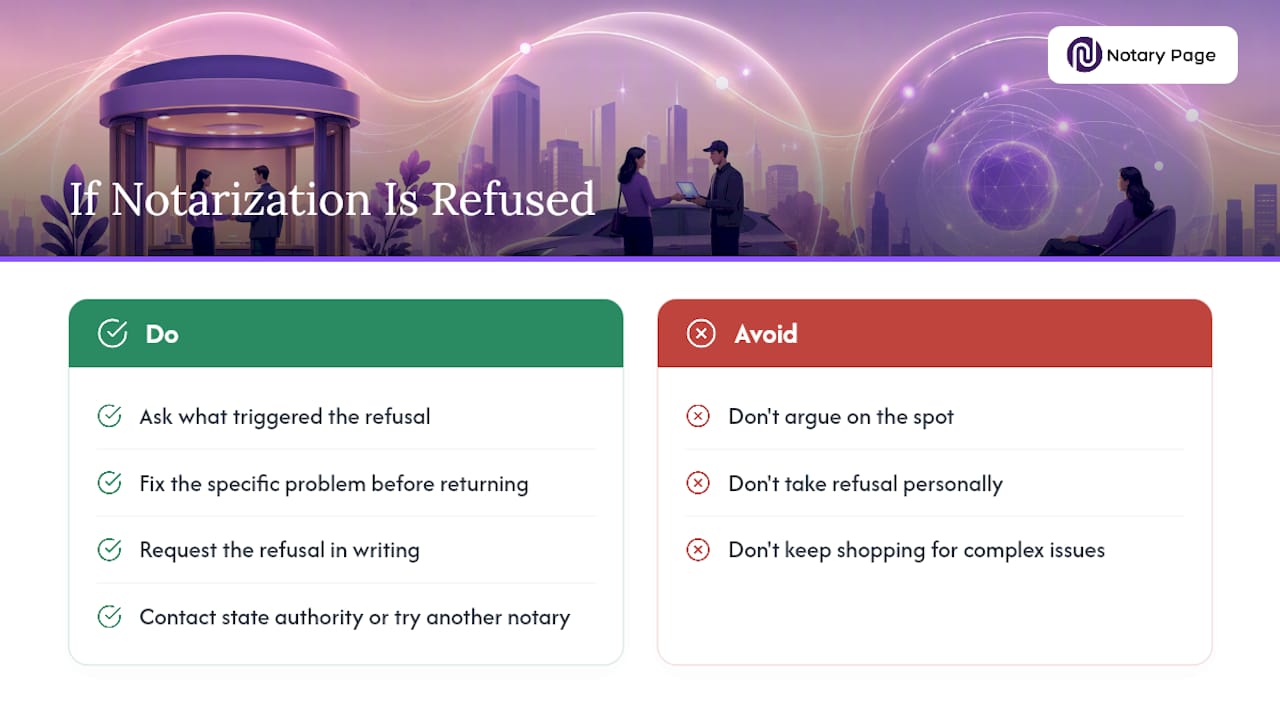
Refusals happen more often than people expect, and almost always for a fixable reason. The most common cause is expired or mismatched ID, where the name on your document doesn’t match your identification exactly. Missing pages, blank notarial fields, or documents that were already signed before the appointment are close behind.
If a notary refuses your document, don’t argue the point on the spot. Ask specifically what triggered the refusal so you can fix it before your next attempt. A missing witness or an ID that expired last month is a quick problem to solve once you know that’s the issue.
If you believe a notary refused improperly, meaning they declined for a reason that has nothing to do with legitimate identification or document requirements, you have options. You can ask for the refusal in writing, contact your state’s notary regulating authority, or simply try a different notary. Refusal isn’t personal. Notaries who ignore fraud red flags risk their commission, so a cautious notary is doing their job correctly even when it’s inconvenient for you.
For complex refusals tied to document wording or legal requirements, that’s usually the moment to stop notary-shopping and call an attorney or a specialized signing agent instead of trying five more locations hoping one says yes.
A Booking Platform Changes How This Whole Process Works
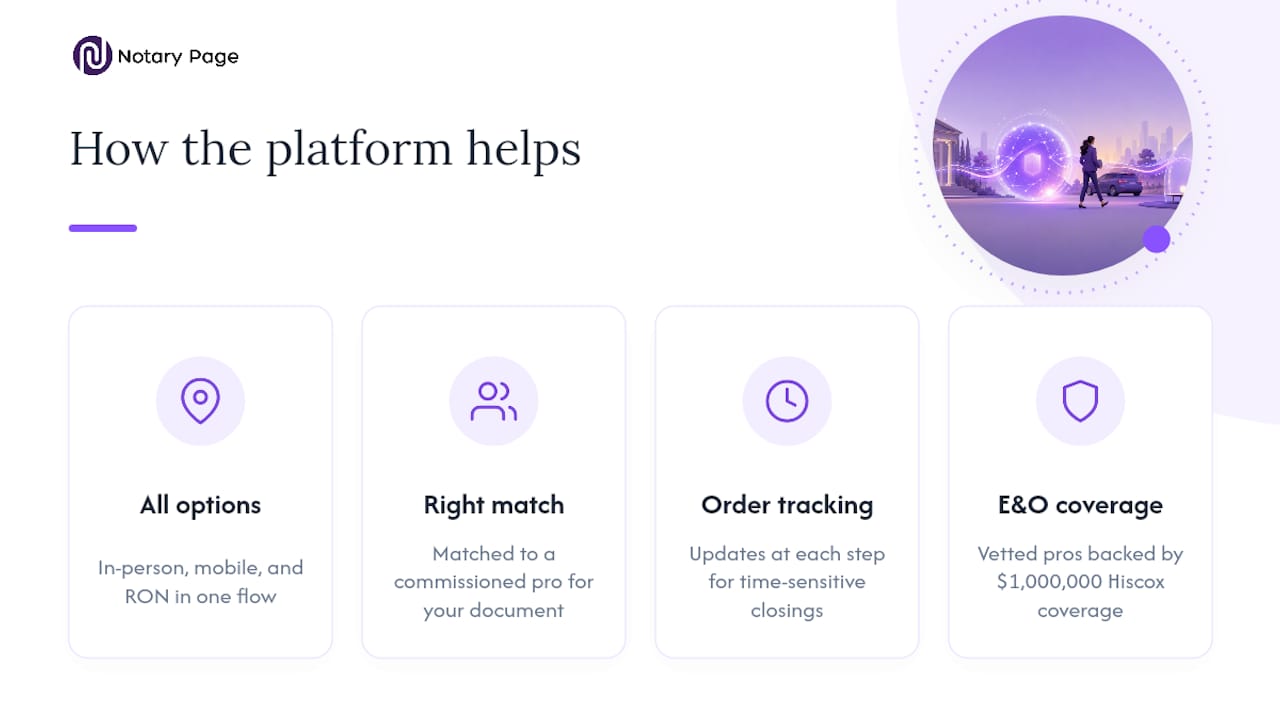
Most of the friction in finding a notary isn’t the notarization itself, it’s the phone tag: calling three banks, getting voicemail at two shipping stores, then discovering the one available notary can’t handle your estate document. That’s the exact gap a centralized platform closes.
Notary Page combines in-person, mobile, and RON options under one booking flow, so you’re matched with a commissioned professional suited to your document instead of guessing which storefront happens to have coverage today. Order tracking keeps you updated at each step, which matters most on time-sensitive closings where a missed signature holds up an entire transaction. Every session runs through vetted professionals backed by $1,000,000 in E&O coverage through Hiscox, which counts for something when the document in question is a deed or a trust.
— Amy
Get Notarized Without the Runaround
You’ve seen the options: call around to banks, hope a shipping store has staff on duty, or drive to a courthouse and hope for good hours. Notary Page skips that entirely by putting in-person, mobile, and remote online notarization into one nationwide booking flow, matched to whatever document you’re actually signing.
That matters most when the stakes are higher than a basic affidavit. Real estate closings, estate planning documents, and loan signings all move through Notary Page’s network of vetted professionals, each covered under the platform’s $1,000,000 E&O policy through Hiscox. You get order tracking from booking to completion, so you’re never wondering whether your notary is actually going to show up.
If your deadline is tight or your document is complicated enough that a generalist retail notary makes you nervous, book your notarization through Notary Page and get matched with someone qualified for exactly what you need.