
Why Businesses Need Verified Notary Credentials
Why Businesses Need Verified Notary Credentials
Verified notary credentials confirm that a notary holds an active, state-issued commission authorizing them to witness signatures, verify signer identity, and complete legally enforceable notarial acts. This distinction matters enormously for businesses: when you engage a notary, you are not simply paying for a stamp. You are buying the integrity of a state-authorized witness step that makes your contracts, deeds, and financial instruments legally defensible. Platforms like DocuSign Notary, certification bodies like the National Notary Association (NNA), and digital identity providers like IdenTrust have all built their services around this single principle. Without credential verification, every notarized document your business produces carries a hidden legal liability.
Why businesses need verified notary credentials for fraud prevention
A notary is a state-commissioned public officer, not a self-appointed witness. That distinction is the foundation of why verified notary credentials matter: the state commission is what gives the notarial act its legal weight. When a notary verifies a signer’s identity, confirms the signer is acting willingly, and completes the notarial certificate correctly, the resulting document carries a presumption of authenticity that courts and financial institutions recognize.
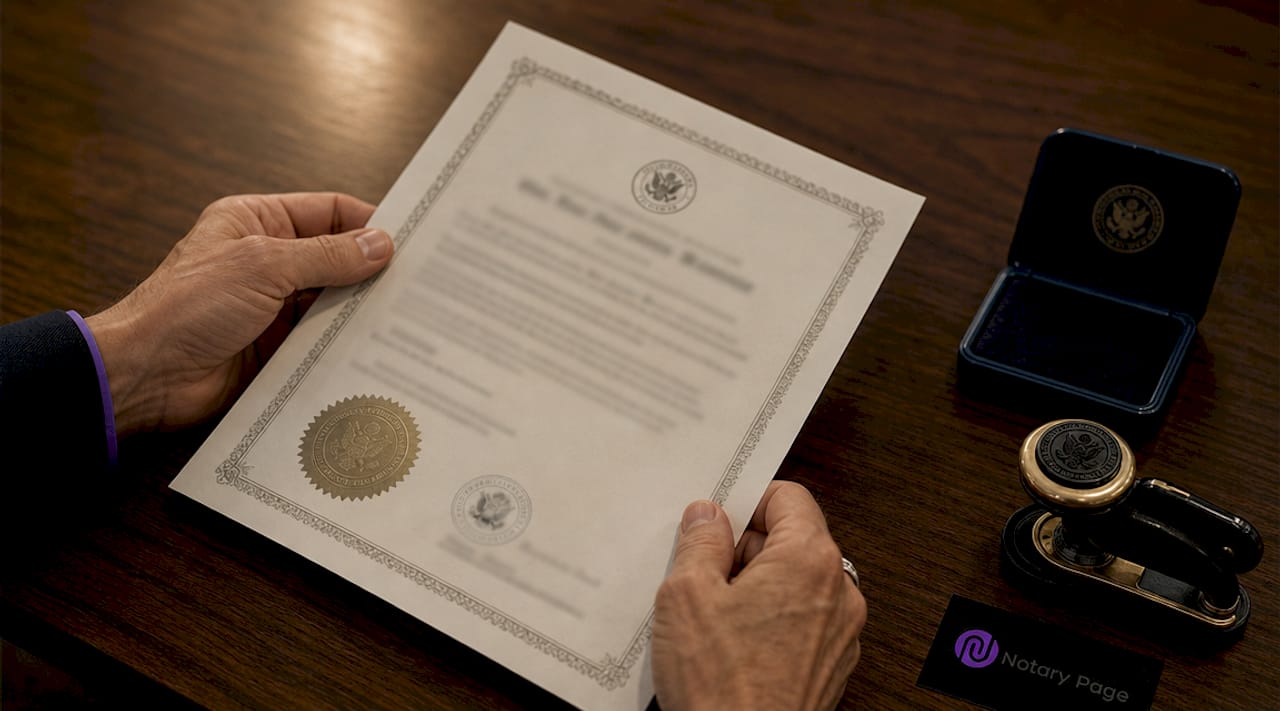
Fraud enters the picture the moment that chain of authority breaks. A notary who has let their commission lapse, who operates in a state where they were never commissioned, or who skips required identity checks cannot produce a legally valid notarial act. Businesses that rely on such documents face contract disputes, rejected loan closings, and title defects that can take months and significant legal fees to resolve.
The impartiality requirement compounds this risk. Notary impartiality must be free from conflicts of interest. A business that allows an employee to notarize documents in which that employee has a financial stake is creating grounds for invalidation. This is not a theoretical concern: courts have voided transactions precisely because the notary had a direct interest in the outcome.
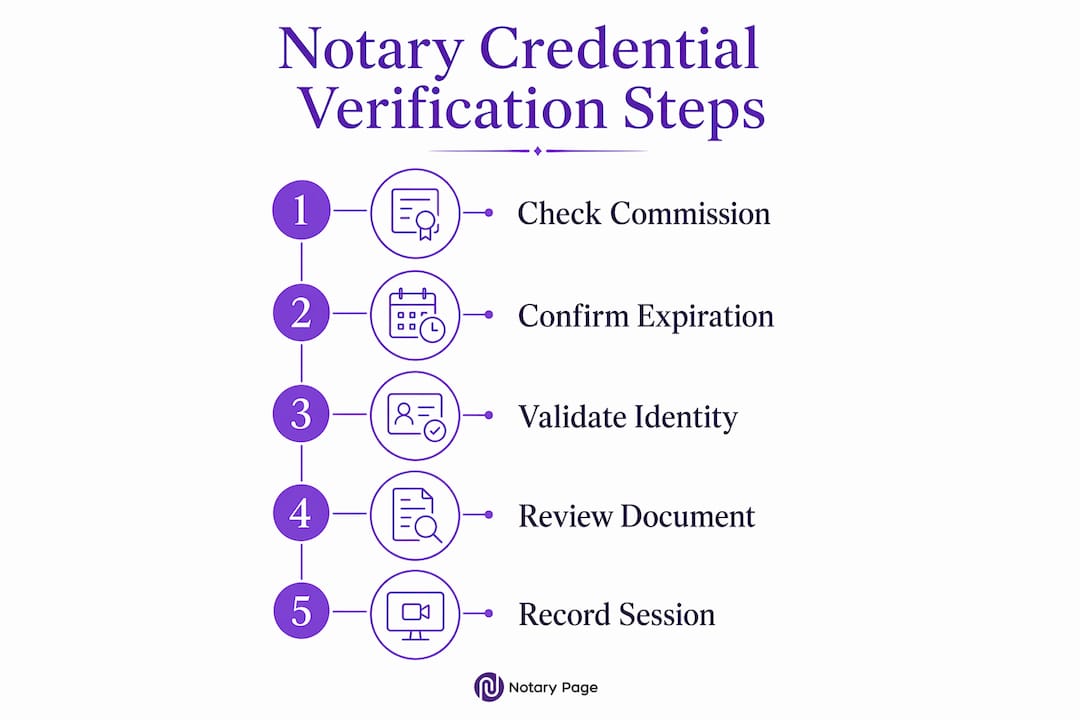
- Active commission status: Confirm the notary holds a current, unexpired state commission before any signing.
- Identity verification procedures: The notary must check government-issued photo ID and record it in a notary journal.
- Impartiality check: The notary cannot be a party to the transaction, a relative of the signer, or a direct beneficiary.
- Proper certificate completion: Every notarial certificate must include the correct venue, date, and notary signature with seal.
Pro Tip: Ask any notary you hire to show you their commission certificate and confirm their commission expiration date before the signing appointment. A credentialed professional will produce this without hesitation.
What happens when businesses skip notary credential checks
The consequences of skipping credential verification are not abstract. State officials increasingly identify notary errors that result in document rejection and disciplinary actions, and those errors flow directly downstream to the businesses that relied on those documents.
The most common errors state officials catch include missing official seals, incomplete notarial certificates, and failure to confirm personal appearance. Each of these defects can cause a document to be rejected by a county recorder, a title company, or a federal agency. For a business closing a commercial real estate deal, a rejected deed means a delayed closing, renegotiated terms, and potential loss of earnest money.
Consider a numbered breakdown of the risk chain:
- Business engages an unverified notary. The notary’s commission has expired or was never issued in the relevant state.
- Documents are signed and submitted. The defect is not visible on the face of the document.
- Rejection occurs downstream. A title company, court, or government agency flags the invalid notarization during review.
- Legal and financial damage accumulates. The business faces re-execution costs, legal fees, and potential liability if the original signer is no longer available or willing.
- Audit exposure increases. If the document was part of a regulated transaction, the business may face regulatory scrutiny for submitting improperly notarized records.
“Businesses should treat notary credential checks as critical compliance controls, not optional due diligence. Incorrect notarizations submitted for authentication risk document rejection and cause financial harm.”
The personal appearance requirement deserves special attention. A notary who allows a signer to appear via an unauthorized video call, or who notarizes a document without witnessing the signature at all, is committing a notarial act that is void from the start. Businesses handling high-stakes documents need verifiable evidence that proper procedures were followed, and that evidence begins with confirming the notary’s credentials before the appointment.
How traditional notarization compares to Remote Online Notarization
The rise of Remote Online Notarization (RON) has changed how businesses access notary services, but it has not reduced the importance of credential verification. It has made verification more technical and, in some ways, more rigorous.
| Feature | Traditional in-person notarization | Remote Online Notarization (RON) |
|---|---|---|
| Identity verification | Government-issued photo ID, in-person inspection | Knowledge-based authentication, credential analysis, live video |
| Credential proof | State commission certificate, physical seal | Digital certificate (e.g., IdenTrust eNotary), electronic seal |
| Audit trail | Paper notary journal | Recorded video session, tamper-evident digital record |
| Geographic flexibility | Limited to notary’s commissioned state | Available across state lines where RON is authorized |
| Fraud risk mitigation | Dependent on notary’s diligence | Multi-factor authentication adds a technical layer |
State commissioning authorities set standards for electronic notarizations that protect digital notary signatures and prevent identity fraud. IdenTrust’s eNotary digital certificate, for example, provides legally binding digital signatures built on X.509-compliant public key infrastructure, ensuring both data integrity and identity verification for every remote session. This is the technical backbone that gives RON its legal standing.
DocuSign Notary enables businesses to notarize documents remotely with verified impartial notaries, and the recorded sessions and tamper-evident seals it produces create stronger evidence of validity than a traditional paper journal. For businesses operating across multiple states or managing high volumes of notarized documents, RON with verified digital credentials is not just convenient. It is a compliance upgrade.
Pro Tip: When evaluating a RON provider, confirm that the platform’s notaries hold state-specific RON authorizations in addition to their base commission. A notary commissioned in Florida cannot perform RON in a state that has not authorized their platform.
Practical steps for verifying notary credentials before you sign
Knowing why credential verification matters is only half the equation. The other half is building a repeatable process your team can execute before every notarized transaction.
- Check official state commissioning records. Every state maintains a public registry of commissioned notaries, often through the Secretary of State or Attorney General’s office. Search the notary’s name before the appointment to confirm active status and commission expiration date.
- Review complaint history. Some state registries include disciplinary records. A notary with prior complaints about missing seals or improper procedures is a liability, not a convenience.
- Confirm specialization when relevant. Real estate closings, estate planning documents, and loan signings each carry specific procedural requirements. A notary signing agent certified by the NNA has completed additional training for loan document packages that a general notary may not have.
- Assess independence. Confirm the notary has no financial interest in the transaction and no personal relationship with any party that could compromise impartiality.
- Maintain detailed records. Maintaining detailed records of notarizations and credentials helps in audits and legal challenges. Keep copies of the notary’s commission certificate, the completed notarial certificate, and any journal entries provided.
The table below maps common business transaction types to the credential checks that matter most for each.
| Transaction type | Critical credential check |
|---|---|
| Commercial real estate closing | Active commission, NNA signing agent certification |
| Loan document package | NNA certified signing agent, E&O insurance verification |
| Estate planning documents | Active commission, impartiality confirmation |
| Remote online notarization | RON platform authorization, digital certificate validity |
| International business documents | Apostille-eligible commission, state-specific authority |
For businesses that lack the internal capacity to run these checks consistently, working with a verified notary platform that pre-screens its network is the most reliable way to eliminate credential gaps before they become legal problems. You can also review guidance on signature witnessing standards to understand what a properly credentialed notary is expected to confirm at the moment of signing.
Key takeaways
Businesses that skip notary credential verification expose every high-stakes document to rejection, fraud liability, and legal challenges that a single upfront check would have prevented.
| Point | Details |
|---|---|
| Credentials define legal authority | A notary’s state commission is what makes a notarial act legally enforceable, not the stamp alone. |
| Errors cause real financial harm | Missing seals and incomplete certificates lead to document rejection, delayed closings, and regulatory exposure. |
| RON requires digital credential checks | Remote notarizations depend on platform authorization and digital certificates like IdenTrust eNotary for legal validity. |
| Verification is a repeatable process | Checking state registries, complaint history, and specialization before every signing eliminates preventable risk. |
| Records protect you in audits | Keeping copies of commission certificates and notarial records creates a defensible paper trail for legal challenges. |
Why I think most businesses are one bad notarization away from a serious problem
I have reviewed enough notarized business documents to know that most corporate decision-makers treat notarization as a formality. They assume the stamp means everything was done correctly. It does not.
The most damaging cases I have seen involve documents that looked perfectly valid for months or even years before a title search, a loan audit, or a court proceeding exposed the defect. By that point, the original notary may be unreachable, the signer may have died or become incapacitated, and the cost of remediation dwarfs what a proper credential check would have cost at the outset.
What I find genuinely underappreciated is how much the digital notarization shift has raised the stakes. RON platforms are proliferating faster than state authorization frameworks can keep up. A notary who is fully commissioned for traditional in-person work may have no RON authorization at all, yet businesses are booking them through general-purpose platforms without asking the right questions. The recorded session and the tamper-evident seal mean nothing if the notary lacked the specific authorization to conduct that session in the first place.
My recommendation is to treat notary credential verification the way you treat vendor due diligence. Build a short checklist, assign ownership to someone on your legal or compliance team, and run it before every signing. The preparation required for a notary appointment is not complicated, but it does require intentionality. The businesses that get this right are the ones that never have to explain to a judge why their deed was notarized by someone whose commission expired two years before the closing.
— Amy
How Notarypage helps businesses access verified notaries nationwide
Notarypage connects businesses with a nationwide network of pre-screened, credentialed notaries for both in-person and remote online notarization. Every notary in the Notarypage network carries verified commission status, and the platform backs its service with $1,000,000 in errors and omissions coverage through Hiscox. That coverage is not a marketing detail. It is a financial backstop that matters when a transaction goes sideways and you need to demonstrate that your notarization process met professional standards.
For real estate closings, loan signings, and estate planning documents, Notarypage provides audit-ready records and credential documentation that hold up under legal scrutiny. If your business handles any volume of notarized documents, working with Notarypage’s verified network is the most direct way to eliminate credential gaps from your signing process.
FAQ
What are verified notary credentials?
Verified notary credentials confirm that a notary holds an active, state-issued commission authorizing them to perform notarial acts, including identity verification and certificate completion. Credential verification typically involves checking official state registries and reviewing the notary’s commission certificate and expiration date.
Why do businesses need to verify notary credentials?
Businesses need to verify notary credentials because unverified notarizations expose documents to rejection, legal challenges, and financial harm. A notary without an active commission cannot produce a legally enforceable notarial act, regardless of how the document appears on its face.
How do I verify a notary’s credentials?
Search the notary’s name in your state’s official commissioning registry, typically maintained by the Secretary of State or Attorney General’s office, and confirm active status and expiration date. Also review any available complaint or disciplinary history before booking the appointment.
What is Remote Online Notarization and does it require credential verification?
Remote Online Notarization (RON) allows signers to appear before a notary via live video, with identity confirmed through multi-factor authentication. RON requires additional credential verification: the notary must hold both a standard state commission and a specific RON platform authorization, supported by a digital certificate such as IdenTrust eNotary.
Can an employee notarize documents for their own company?
An employee can notarize documents for their employer in most states, but only if they have no direct financial interest in the transaction. Notary impartiality requires the notary to be free from conflicts of interest, and any personal benefit from the document’s outcome creates grounds for invalidation.