Witness vs Notary in the U.S.: 6 Steps to Avoid a Rejected Signing
Witness vs Notary in the U.S.: 6 Steps to Avoid a Rejected Signing
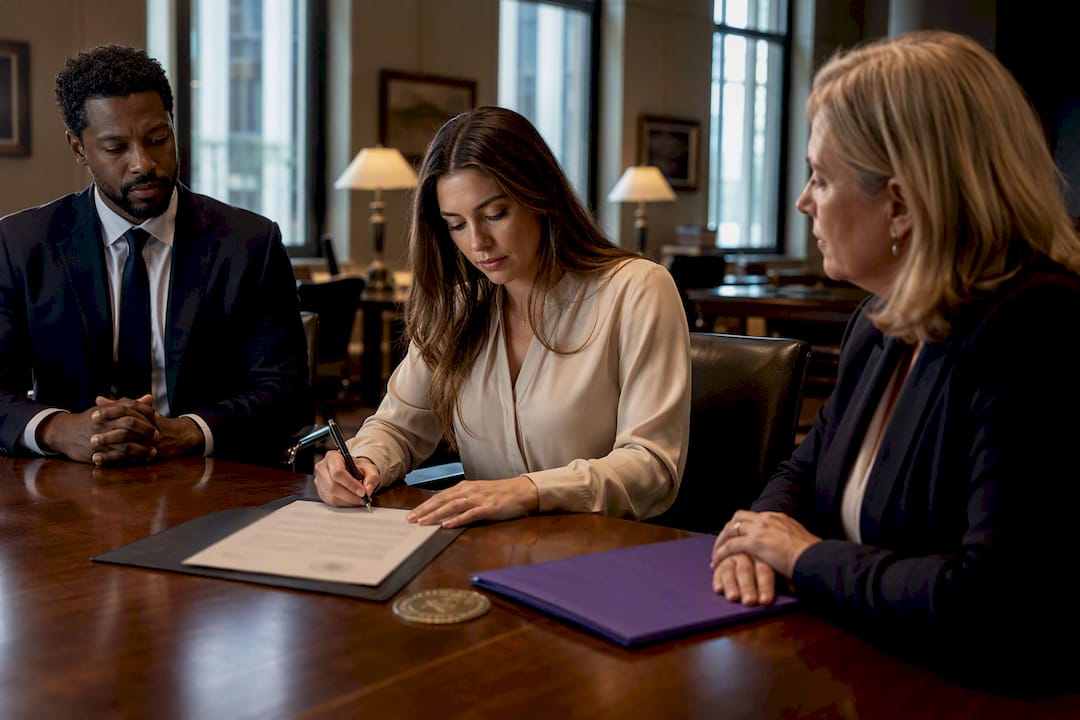
A notary public is a state-appointed official who verifies your identity and applies a formal certificate to your signature. A witness is a private person who simply watches you sign and confirms, if asked, that they saw it happen. State law decides which one your document needs, and some documents, wills with self-proving affidavits being the classic case, need both. The sections below break down the definitions, a side-by-side comparison, and a checklist for getting a signing right the first time.
TL;DR:
- Notaries perform formal acts like acknowledgments and jurats that verify signer identity and voluntary signing, but do not validate the fairness or accuracy of the content.
- Witnesses simply observe signing, are usually disinterested adults, and cannot administer oaths or apply official seals, making their evidence less formal.
- Notarization offers a broad, court-accepted proof of signer identity and voluntary signing, while witnessing alone has limited legal weight and varies by state.
- For critical documents like wills, real estate deeds, or powers of attorney, separate, disinterested witnesses and notarization are strongly recommended to prevent future legal challenges.
- Remote notarization is valid in many states, but still requires rigorous identity verification, and it often involves higher fees and specific rules for witnesses.
Table of Contents
- What a Notary Public Is: Powers, Common Acts, and What Notarization Proves
- What a Witness Is: Role, Eligibility, and Limits
- Notarization vs Witnessing: What Each One Actually Proves
- When You Need a Notary, a Witness, or Both
- Can a Notary Also Be a Witness?
- Remote Notarization and E-Signatures: What Changes
- A Practical Checklist for a Valid Signing
- Finding and Booking a Notary in the U.S.
- What Clients Consistently Get Wrong About Notarization
- Book a Notary Through Notarypage
- Where to Verify State Rules and Notary Procedures
- Sources
What a Notary Public Is: Powers, Common Acts, and What Notarization Proves
A notary public is a person commissioned by their state government to serve as an impartial witness to signings and to administer oaths. States issue the commission after an application, sometimes an exam, and often a bond. Once commissioned, a notary can perform two main types of notarial acts, and the difference between them trips up a lot of people.
An acknowledgment confirms that the signer appeared before the notary, was properly identified, and acknowledged that they signed the document voluntarily. A jurat goes a step further: the signer swears or affirms, under oath, that the contents of the document are true, and signs in the notary’s presence. Affidavits require a jurat. Deeds and powers of attorney usually only need an acknowledgment.
To complete either act, the notary has to verify identity. That typically means checking a government-issued photo ID, though some states also allow identification through personal knowledge of the signer or the sworn statement of a credible identifying witness. Many states also require the notary to log the act in a paper or electronic journal, recording the date, document type, and identification method used. The Connecticut Notary Manual lays out these procedures in detail, and it’s a useful reference for exactly how granular these requirements get, since every state writes its own version.
Documents that commonly require notarization include:
- Real estate deeds and mortgage documents
- Powers of attorney
- Affidavits and sworn statements
- Certain court filings
- Loan documents and closing paperwork
The notary’s seal and signature tell a third party one specific thing: the person named on the document actually appeared and signed it, or swore to its truth in the notary’s presence. It says nothing about whether the document itself is fair, accurate, or legally sound.
What a Witness Is: Role, Eligibility, and Limits
A witness is someone who observes a document being signed and can later confirm, if needed, that the signature is genuine and the signing happened as claimed. Unlike a notary, a witness holds no government commission and carries no official authority. Their job is narrower: watch, remember, and sign their own name as proof they were there.
Eligibility rules for witnesses vary by state and by document type, but a few patterns show up consistently:
- Witnesses generally must be adults, usually 18 or older.
- They must be mentally competent to understand what they’re witnessing.
- For wills specifically, many states require witnesses to be “disinterested,” meaning they don’t stand to inherit anything under the document.
- Some states cap how many witnesses are needed (commonly two for wills), while others require different counts for different documents.
A witness cannot administer an oath, apply a notarial seal, or issue any kind of certificate. Their identity verification is informal at best. If a witness knows the signer personally, they can vouch for who signed; if they’re a stranger pulled in off the street, that vouching carries a lot less weight. That’s part of why courts and financial institutions often want the added layer of a notary’s formal certificate rather than relying on a witness alone. As LegalClarity explains, a witness simply attests to having observed the signing, while a notary is the state official empowered to verify identity, administer oaths, and apply a seal.
Documents that commonly rely on witnesses include:
- Last wills and testaments
- Certain healthcare directives and living wills
- Some real estate contracts, depending on the state
- Prenuptial agreements in a handful of jurisdictions
Notarization vs Witnessing: What Each One Actually Proves
Here’s where a lot of confusion sets in, because a notarized document and a witnessed document can look almost identical on paper, but they prove very different things to a court, a bank, or a title company.
| Factor | Notarization | Witnessing |
|---|---|---|
| Who performs it | State-commissioned notary public | Any eligible adult, often disinterested |
| Identity check | Government ID, personal knowledge, or credible witness | Informal, based on personal familiarity |
| Oath power | Yes, for jurats | No |
| Official seal or stamp | Yes | No |
| Recordkeeping | Often logged in a notary journal | Rarely recorded independently |
| Typical documents | Deeds, POAs, affidavits, loan papers | Wills, some healthcare directives |
| Legal weight | Formal certificate accepted broadly by courts and institutions | Depends on witness credibility and state rules |
| Typical cost | Small statutory fee, often $5 per act, plus travel/service fees | Usually free if you supply your own witnesses |
The most common misunderstanding is treating a notary’s stamp as a stamp of approval on the document’s contents. It isn’t. A notary confirms that the right person signed, in the notary’s presence, and did so willingly. It says nothing about whether the terms of the contract are fair or whether the facts in an affidavit are actually true, only that the signer swore to them. That distinction shows up constantly in disputes: a party can’t invalidate a notarized contract just by arguing the deal was bad, but they might be able to challenge it if they can prove the signer’s identity was never actually verified.
There’s a related mix-up worth clearing up here: signature guarantees are not notarization. Banks and brokerages sometimes require a medallion signature guarantee before processing a securities transfer, and that guarantee comes from a financial institution authorized to issue it, not from a notary public. According to Investor, medallion guarantees exist specifically to prevent unauthorized transfers of stocks and bonds, and a regular notarization won’t satisfy that requirement even though both involve verifying a signature. If a brokerage form asks for a medallion guarantee, a notary stamp on the same page won’t substitute for it.
When You Need a Notary, a Witness, or Both
Matching the right role to the right document saves you a wasted trip and, sometimes, a rejected filing. Here’s how the most common documents typically break down, though you should always confirm with the specific agency or institution receiving your paperwork, since requirements shift by state.
- Wills: Most states require two witnesses at the time of signing. Many people also add a notarized self-proving affidavit, which lets the will skip the step of tracking down witnesses years later during probate. That’s a practical reason people often end up needing both a witness and a notary for the same document.
- Powers of attorney: Usually require notarization to be accepted by banks, hospitals, and government offices. A number of states also require one or two witnesses on top of the notarization, especially for financial or healthcare powers of attorney.
- Real estate deeds and closing documents: Almost universally require notarization, because county recording offices won’t accept an unnotarized deed into the public record. This is also why title companies and closing agents build notary time directly into a closing schedule.
- Affidavits: Require a notary specifically because they involve a jurat, the signer swearing under oath that the statement is true. A witness alone can’t satisfy this requirement.
- Certified vs. notarized translations: This one confuses a lot of people. A certified translation includes a signed statement from the translator vouching for the accuracy of the work. A notary can notarize that certification statement, but the notary is only confirming that the translator signed it, not checking whether the translation itself is accurate. The American Translators Association is explicit on this point: a notary’s seal on a translation certificate has nothing to do with translation quality. If an agency asks for a “notarized translation,” they usually mean the certification statement needs a notary’s acknowledgment, not that the notary reviewed the language itself.
Can a Notary Also Be a Witness?
In many states, yes, a notary can sign as a witness on the same document they’re notarizing, as long as they’re not also a party with a personal or financial stake in it. But “allowed” and “advisable” aren’t the same thing, and the rules shift enough from state to state that this is worth double-checking before you count on it.
A notary generally cannot notarize their own signature, so if a notary signs as a witness, someone else still has to notarize the notary’s own witness signature if that’s required. Some states restrict or discourage combining the two roles specifically for estate documents like wills, precisely because the point of having independent witnesses is to avoid any appearance that one person controlled the entire signing process. State statutes vary on this; South Carolina, for example, codifies specific notarial rules that can affect how dual roles are treated. Notary training materials commonly advise against combining the roles on the same document when it can be avoided, mainly to keep the signing above any question of impartiality.
The practical problems go beyond legal technicalities. If a will or power of attorney later gets challenged in court, having independent, unrelated witnesses and a separate notary makes the paperwork much harder to attack. If the notary was also the sole witness, an opposing party has an easier argument that the process lacked independent oversight.
- Check your state’s notary statute before assuming a notary can double as your witness.
- For high-stakes documents like wills and powers of attorney, default to separate, disinterested people for each role.
- Ask the receiving institution directly if they have a policy against combined roles, since some do even where state law allows it.
Pro Tip: If you’re signing a will, line up your witnesses and your notary as three separate people whenever possible. It costs you nothing extra and it removes an entire category of argument an opposing party could raise later.
Remote Notarization and E-Signatures: What Changes
Remote online notarization (RON) lets a notary complete an acknowledgment or jurat over live video instead of sitting across a table from you. Every state that authorizes RON still requires some form of rigorous identity verification, just delivered through technology instead of a face-to-face ID check.
Typical remote verification combines a few layers: credential analysis software that scans your ID for signs of tampering, knowledge-based authentication questions pulled from public and financial records, and a live video session where the notary visually confirms you match your ID. The notary still applies an electronic seal and signature, and still logs the act, often with a recording of the session retained for a set period.

Not every document qualifies for remote notarization in every state, and some categories, particularly certain estate and real estate documents in specific jurisdictions, still require in-person signing. Fees for remote notarization also tend to run a bit higher than in-person acts, reflecting the platform and identity-verification costs layered on top of the notary’s statutory fee.
Witnesses complicate remote sessions a little more. Some states allow witnesses to appear on the same video call as the signer and notary; others still require witnesses to be physically present with the signer even when the notary joins remotely. Before scheduling a remote session for a document that also needs witnesses, confirm exactly how your state, and the institution receiving the document, wants that handled.
- Confirm your state actually authorizes RON for your specific document type.
- Ask whether witnesses can join the same video call or must be physically present.
- Expect a modestly higher fee than an in-person notarization.
A Practical Checklist for a Valid Signing
Getting a signing rejected after the fact, because you signed early or brought the wrong ID, is one of the most avoidable headaches in this entire process. Work through this checklist before your appointment:
- Confirm exactly what the receiving party needs: notarization, witnesses, or both, and the specific wording they require on the certificate.
- Gather the original, unsigned document. Notaries and witnesses generally can’t work with a signature that’s already on the page.
- Bring valid, unexpired government-issued photo ID, ideally the same type your state’s notary manual specifies.
- Line up witnesses ahead of time if your document needs them, and confirm they meet your state’s eligibility rules, including any disinterested-party requirement.
- Do not sign the document before the notary or witnesses are present. A notary cannot notarize a signature made outside their presence.
- If going remote, confirm the platform, session requirements, and whether your document type is eligible in your state.
Ask the receiving institution ahead of time for their exact notarial wording and whether they accept remote notarization, since some banks and county offices still insist on ink signatures. Fees vary: a basic notarial act often runs a small statutory amount, while mobile notaries who travel to you and remote online notaries typically charge added service fees on top of that base rate.
Pro Tip: Call the office that will actually receive your document, whether it’s a county recorder, a bank, or a court clerk, and ask them directly what they require. Notary and witness rules exist to satisfy that receiving party, so their answer overrides any general assumption you might be working from.
Finding and Booking a Notary in the U.S.
Notaries show up in more places than people expect: banks and credit unions often notarize for account holders at no charge, law offices frequently have one on staff, shipping stores like UPS locations commonly offer walk-in notary services, and mobile notaries will travel to your home, office, or hospital room for a service fee. Remote online notary platforms round out the list for anyone who wants to skip travel entirely.
A few trust signals are worth checking regardless of which route you choose:
- Confirm the notary’s state commission is current, which most secretary of state websites let you verify directly.
- Ask whether they maintain a notary journal and use a proper seal, both signs of a notary following standard practice.
- Check for errors and omissions (E&O) insurance, since surety bonds and E&O coverage are the standard way service providers manage professional liability.
- Get pricing upfront rather than after the appointment.
A nationwide booking marketplace tends to earn its keep in a few specific situations: real estate closings where timing is tight and a mobile notary needs to show up at a title company on schedule, estate planning signings where you need a notary experienced with wills and powers of attorney, and cases where mobility limitations or a packed schedule make an in-person office visit impractical.
What Clients Consistently Get Wrong About Notarization
The single biggest misunderstanding we see is treating a notary’s seal as some kind of quality check on the document itself. It isn’t, and it never was. Notarization verifies that the person signing is who they claim to be and that they signed willingly, or under oath if it’s a jurat. It has nothing to do with whether the power of attorney is well drafted or the affidavit’s contents hold up.
That misunderstanding causes real problems. People sometimes assume a notarized contract is automatically enforceable, or that a notarized translation means a bilingual professional reviewed the language for accuracy. Neither is true, and both assumptions can cost you when a document gets challenged later.
The one habit worth building: before you pay for notary or witness services, call the institution actually receiving your document and ask exactly what they require, down to the specific wording of the certificate. Skipping that call is how people end up paying for a second notarization because the first one used the wrong certificate language.
— Amy
Book a Notary Through Notarypage
You can use an online platform that offers in-person, mobile, and remote online notarization services nationwide, allowing you to book whichever format fits your document and schedule, whether that’s a real estate closing, an estate planning signing, or a routine affidavit.
Booking runs through one streamlined process backed by a network of certified professionals, with order tracking so you know where things stand instead of waiting on a callback. Notarypage also states it carries $1,000,000 in E&O coverage through Hiscox, a trust signal worth factoring in when you’re comparing options for a document that actually matters. If you’re ready to line up a notary for an upcoming signing, check availability and pricing on Notarypage before your appointment date locks in.
Where to Verify State Rules and Notary Procedures
Notary and witness rules genuinely differ by state, so treat this article as a starting framework and confirm specifics against primary sources. The Connecticut Notary Manual offers a detailed look at how one state structures notarial acts, journal requirements, and identification standards, and most states publish a comparable handbook through their secretary of state’s office. For translation certification questions, the American Translators Association publishes clear guidance on what certified translation actually requires. For securities transfers, Investor.gov explains medallion signature guarantees and how they differ from standard notarization. When in doubt, search your own state’s notary manual and confirm the receiving agency’s exact instructions before your signing.
Sources
- Investor
- Connecticut Notary Manual (June 2020)
- ATA — What is a certified translation?
- LegalClarity — Person who watches you sign: witness or notary?